Corporate social responsibility (CSR) is a strategic framework through which companies align business objectives with social, environmental, and ethical commitments. CSR integrates sustainability into daily operations and long-term planning to create shared value for communities, employees, and stakeholders. The approach is grounded in the triple bottom line of profit, people, and planet, which evaluates success through financial performance, social contribution, and environmental stewardship.
Writing a CSR press release transforms purposeful action into verified communication. The press release provides a transparent record of what the company has achieved, the partners involved, and the measurable societal outcomes delivered. A press release about corporate social responsibility builds credibility, strengthens stakeholder trust, and positions the brand as a responsible leader within its industry. Communicating CSR initiatives through a structured release enhances visibility, attracts ethical investors, and fosters loyalty among value-driven consumers.
Write an effective corporate social responsibility press release using a structured format including a strong headline, dateline, introduction, detailed body, and standard boilerplate. Define initiatives with measurable details, maintain authenticity to avoid greenwashing, and focus on the human and environmental impact. Use multimedia elements such as visuals or short videos to strengthen storytelling and engagement. Common mistakes include using vague claims, neglecting data-driven proof, and ignoring follow-up communication after the release.
This article offers a complete framework for crafting CSR press releases that communicate responsibility with depth and clarity. The article explores how organizations build reputation, strengthen transparency, and translate corporate values with effective press releases that inspire trust and recognition.
What Is Corporate Social Responsibility?
Corporate Social Responsibility (CSR) refers to a structured organizational commitment to generating positive social and environmental outcomes alongside financial returns. CSR represents a long-term business philosophy where corporate ethics, sustainable practices, and social accountability intersect to define responsible growth. Through CSR, an organization acknowledges its influence beyond profits, which embeds sustainability principles into its supply chains, production systems, workforce policies, and community initiatives.
CSR operates through interconnected domains of environmental stewardship, social equity, and ethical governance. Environmental stewardship involves reducing carbon emissions, conserving resources, and advancing renewable innovation to mitigate ecological impact. Social equity prioritizes employee welfare, diversity, inclusion, and community investment to promote shared prosperity. Ethical governance ensures transparency, legal compliance, and accountability across corporate hierarchies.
Conceptually, CSR evolves through defined theoretical models such as Carroll’s Pyramid of CSR and the Triple Bottom Line (TBL).The Pyramid of CSR Framework identifies four hierarchical responsibilities, economic, legal, ethical, and philanthropic, that guide corporate behavior from profitability to public good. The TBL expands this logic into three measurable dimensions: people, planet, and profit, framing performance as a synthesis of human, environmental, and financial outcomes.
This evolution positions CSR as a structural approach that builds corporate resilience, strengthens stakeholder trust, and ensures long-term organizational viability in an interdependent global economy.
What Are the Different Types of Corporate Social Responsibility Press Releases?
The different types of Corporate Social Responsibility (CSR) press releases include environmental, philanthropy, employee, ethics, education, health and social, and sustainability report announcements. These press releases allow organizations to communicate value-driven initiatives, reinforce stakeholder trust, and document transparent progress toward sustainability and ethical growth.
7 different types of corporate social responsibility (CSR) press releases are detailed below.
1. Environmental Press Release
An environmental press release focuses on measurable actions that reduce ecological impact and enhance resource efficiency. Environmental press releases feature initiatives such as achieving carbon neutrality, integrating renewable energy sources, and improving waste management systems. Companies report environmental milestones substantiated by verified data, like reductions in Scope 1 and Scope 2 emissions or the volume of materials recycled.
Best practices include referencing third-party certifications, visualizing results through data graphics, and linking environmental outcomes to long-term climate commitments. This type of press release establishes environmental leadership and positions the brand within global sustainability conversations.
2. Philanthropy Press Release
A philanthropy press release highlights tangible contributions that advance social causes through financial, logistical, or human capital support. Philanthropy press releases cover community partnerships, large-scale donation programs, and employee-led volunteer initiatives. Effective press releases focus on outcomes rather than actions, such as the number of families supported, communities reached, or projects completed.
Incorporating evocative stories from beneficiaries transforms these announcements from transactional to relational. Consistency in philanthropic messaging reinforces organizational role as an active civic partner rather than a passive donor, which strengthens emotional engagement with external audiences.
3. Employee Press Release
An employee press release communicates the internal organisational commitment to fairness, safety, and personal growth. Employee press releases announce initiatives such as DEI (Diversity, Equity, and Inclusion) frameworks, career development pathways, or mental wellness programs. These releases provide statistics on workforce diversity, training hours completed, or safety metrics improved over time.
Integrating leadership commentary on cultural impact elevates authenticity and connects employee outcomes to strategic priorities. This format is critical for employer branding, as it reflects how companies integrate ethical labor practices into the foundation of corporate success.
4. Ethics Press Release
An ethics press release outlines transparent business practices that uphold integrity and compliance across all operational levels. Ethics press releases feature topics such as anti-bribery frameworks, fair trade certification, or supply chain transparency programs. The most effective release includes data from compliance audits, newly implemented ethical sourcing standards, or partnerships with global watchdog organizations.
This type of press release demonstrates that the company operates within measurable accountability systems rather than marketing statements. Ethical press releases reduce reputational risk and strengthen investor confidence by showcasing verifiable adherence to global standards.
5. Education Press Release
An education press release emphasizes investment in human potential and long-term knowledge creation. Education press releases report on scholarship endowments, mentorship programs, and collaborations with universities or vocational training centers. These initiatives build educational infrastructure that aligns with workforce readiness and community advancement.
Well-written press releases quantify the number of students reached, the duration of program funding, and the academic outcomes achieved. Linking education-focused CSR activities to future innovation and economic growth reinforces the organizational vision as a sustainable contributor to societal intellectual capital.
6. Health and Social Press Release
A health and social press release focuses on improving quality of life within and beyond corporate operations. Health and social press releases highlight initiatives related to healthcare accessibility, mental wellness, or social equity. Companies use this type of press release to announce partnerships with medical institutions, funding for wellness campaigns, or new programs that address systemic health disparities.
Press releases maintain authority by emphasizing measurable outcomes such as the number of patients supported or communities impacted. The most influential versions establish a clear link between corporate expertise and tangible social betterment.
7. Sustainability Report Press Release
A sustainability report press release announces the publication of a formal ESG or CSR performance document. Sustainability reports summarizes environmental, social, and governance achievements substantiated by audited data and performance indicators. This press release format emphasizes transparency by including forward-looking commitments and benchmarking against global standards like GRI or SASB.
Strong press releases highlight year-over-year progress, provide visual data summaries, and direct readers to the full report for verification. Sustainability reports are accountability statements, which showcase how the company translates sustainability objectives into measurable business outcomes.
These types of CSR press releases form a structured communication ecosystem that aligns social impact with business performance. Each type facilitates a different dimension of corporate responsibility while contributing to a cohesive public narrative of ethical growth, transparency, and sustainable leadership. This multi-faceted approach strengthens stakeholder relationships, enhances brand reputation, and positions the organization as a proactive force in global sustainability discourse.
What Is a Corporate Social Responsibility Press Release?
A corporate social responsibility (CSR) press release is a formal announcement that communicates the ethical, environmental, and social initiatives of a business. CSR press releases signal how a business integrates responsibility into its operations and decision-making. This type of press release documents measurable progress toward sustainability, diversity, or community investment. CSR releases transform goodwill into brand equity by aligning corporate values with societal needs, which ensures that responsibility becomes a defining feature of brand identity.
CSR press releases function as strategic communication assets that shape stakeholder perception and influence brand reputation. The release demonstrates ethical leadership in an era where transparency and sustainability define corporate value. Publicizing social betterment efforts builds investor confidence, attracts ethically aligned consumers, and strengthens relationships with employees and regulators.
Through consistent communication, CSR press releases convert social responsibility into a reputational advantage and position the company as a long-term contributor to societal progress.
What Is the Purpose of a Corporate Social Responsibility Press Release?
The purpose of a corporate social responsibility (CSR) press release is strategically communicating measurable impact, ethical vision, and social accountability to internal and external stakeholders. CSR press releases are formal documentation of how an organization integrates sustainability, equity, and community investment into its operations. The release positions the company as an active contributor to social progress, which frames responsible business conduct as a defining component of brand identity.
CSR releases signal transparency, establishes credibility, and strengthens the emotional and ethical connection between a brand and its audience. The release elevates public perception through verified data, transparent storytelling, and evidence of social contribution. The content demonstrates operational integrity by outlining concrete outcomes such as reduced emissions, employee inclusion initiatives, or investments in community development.
A structured press release validates corporate authenticity, addresses public expectations for accountability, and aligns brand reputation with measurable social impact. CSR communication generates engagement across audiences that shape corporate success. For customers, the release establishes emotional alignment and brand loyalty grounded in shared values. For employees, the release strengthens motivation, pride, and organizational belonging.
For investors, the release signals risk awareness, governance maturity, and long-term sustainability potential within Environmental, Social, and Governance (ESG) frameworks. For partners and media, CSR press releases create narrative clarity that drives collaboration and positive coverage.
Why Is a Corporate Social Responsibility Press Release Important for Companies?
A corporate social responsibility (CSR) press release is important for companies because it operationalizes purpose into measurable reputation capital. CSR press releases convert ethical commitments into tangible communication that reinforces stakeholder confidence and market legitimacy. Each CSR release acts as a reputational safeguard and a growth lever, aligning brand identity with transparent accountability, sustainability performance, and social impact
Key reasons outlining why a corporate social responsibility press release is important for companies are explained below.
1. Enhances Brand Reputation: A CSR press release elevates brand perception through factual, verifiable storytelling about the organisational role in societal advancement. CSR press releases provide narrative evidence that social impact is an integrated part of corporate identity, rather than an isolated campaign.
Reputation grows stronger when the company consistently aligns business goals with public good, which proves that success derives from contribution rather than consumption. Sustained communication of CSR results increases recognition, reinforces emotional resonance, and builds long-term equity in ethical standing.
2. Builds Public Trust and Credibility: Trust is built on transparency, consistency, and measurable action. A CSR press release functions as public proof of progress, which shows stakeholders that the company delivers on its social and environmental commitments. Publishing quantifiable results, such as emissions reduced, communities supported, or resources conserved, creates a record of integrity.
Trust deepens when the company integrates CSR outcomes into its governance narrative, which allows audiences to verify authenticity rather than depend on claims. This transparency converts perception into belief, strengthening stakeholder relationships.
3. Attracts and Retains Customers: Modern consumers engage with brands that reflect their moral frameworks. A CSR press release connects the organisational initiatives with customer values through clear, data-driven communication of real-world impact. Customers who perceive alignment between brand purpose and personal ethics develop sustained loyalty and advocacy.
CSR announcements build emotional relevance, which creates a multidimensional customer relationship anchored in shared responsibility. Companies that maintain this alignment reduce churn, command price premiums, and establish stronger brand communities.
4. Engages and Motivates Employees: Employees derive motivation from belonging to organizations with visible integrity and purpose. A CSR press release communicates the organisational culture, values, ethical action, social engagement, and environmental stewardship. Internal morale strengthens when employees see their contributions reflected in public achievements.
This acknowledgment validates their work and amplifies engagement across teams. CSR communication enhances internal culture by connecting everyday operations with global responsibility, which fosters retention and attracts individuals who prioritize meaningful work environments.
5. Attracts Investors and Funding: Investors assess companies on financial performance using the long-term sustainability metrics. A CSR press release signals strategic alignment with Environmental, Social, and Governance (ESG) standards, which directly influence investor confidence.
Documenting measurable outcomes such as reduced carbon footprint, supply chain transparency, or ethical sourcing communicates operational discipline and forward-thinking governance. These signals attract sustainable capital, lower perceived risk, and position the company as a resilient investment within the evolving global economy.
6. Provides Competitive Advantage: CSR communication generates differentiation in markets saturated with similar products and services. Companies that communicate measurable, verifiable social outcomes project leadership beyond commercial success. A CSR press release articulates competitive distinction through evidence of positive societal influence, which aligns the brand with progress rather than profitability alone.
This distinction strengthens relationships with distributors, regulators, and customers who prioritize ethical alignment. Over time, the proactive visibility in CSR creates a moat of organisational credibility that competitors struggle to replicate.
7. Mitigates Risks and Crises: Public accountability through CSR releases reduces reputational vulnerability. A transparent history of social and environmental performance creates a buffer during crises by establishing the moral and operational credibility in advance. Stakeholders evaluate the organization within the context of its proven responsibility record when unexpected challenges stir negative publicity.
This foundation allows companies to maintain trust, manage narratives effectively, and restore equilibrium faster than those without a visible CSR track record. Proactive communication minimizes misinformation and strengthens confidence under pressure.
A CSR press release operates as a strategic communication infrastructure that integrates brand ethics, market performance, and stakeholder alignment into one unified narrative. Through consistent and data-driven communication, companies secure their position as credible leaders in responsible business, which drives societal value and sustainable profitability.
What Are the Benefits of Issuing a Corporate Social Responsibility Press Release?
The benefits of issuing a corporate social responsibility (CSR) press release include building credibility, generating visibility, and strengthening relationships across stakeholder groups. A CSR press release is an authoritative disclosure tool that positions the brand as a transparent, responsible, and forward-looking organization.
The key benefits of issuing a corporate social responsibility press release are detailed below.
1. Demonstrates traction
A CSR press release shows concrete action behind sustainability claims. The release documents outcomes such as reduced emissions, community investments, or employee volunteer milestones. Publishing these measurable achievements validates organisational progress toward ESG goals.
Stakeholders interpret this as proof of operational maturity, which signals that the brand treats responsibility as a strategic function rather than a promotional message. Demonstrating traction in CSR reinforces investor confidence, as consistent reporting reflects long-term stability and compliance with ethical performance standards.
2. Builds credibility
Regular CSR communication builds organizational trust and transparency. A press release serves as verifiable evidence of accountability, providing quantifiable updates on environmental programs, diversity initiatives, or supply chain ethics. Each release strengthens credibility by transforming internal progress into public record.
This documented consistency differentiates the company from competitors that issue unsubstantiated claims. Media outlets, investors, and regulators view the release as an authentic benchmark of reliability, which reinforces organisational standing as an ethical leader in its sector.
3. Expands outreach
A CSR press release extends the reach of the sustainability message across external networks and digital ecosystems. Distribution through credible news wires and industry media exposes initiatives to journalists, policymakers, and potential partners who align with similar values.
This expanded outreach builds a network effect around the social mission of a corporation. The release positions CSR activities within broader public discourse, which ensures organisational initiatives influence wider market conversation on corporate ethics and sustainability.
4. Improves SEO
CSR press releases contribute directly to search visibility by strengthening entity-level associations between the brand and high-value keywords such as sustainability, ESG, or corporate responsibility. Optimized press releases distributed through high-authority domains generate backlinks that enhance domain authority and reinforce semantic relevance.
Each publication becomes a durable ranking signal that enables content discoverability and organic traffic growth. Over time, consistent CSR publication establishes the brand as an authoritative source for socially conscious business content.
5. Attracts media
Well-executed CSR releases provide journalists with credible, data-driven stories that align with editorial interests in sustainability, community development, and responsible business practices. Reporters seek quantifiable impact, such as volunteer hours, energy reductions, or donation figures.
A CSR press release that provides such metrics attracts coverage that multiplies visibility across trusted outlets. Media attention functions as third-party validation, that strengthens public trust and expands organisational presence beyond owned channels.
6. Enables repurposing
A CSR release provides structured content that is adaptable across communication channels. The data and narratives within the release are incorporated into annual reports, thought leadership articles, or investor briefings. Repurposing allows the organization to maintain message consistency while tailoring depth and format for specific audiences.
This approach converts a single announcement into a continuous stream of high-quality, multi-platform content that sustains engagement long after initial publication.
7. Elevates brand authority
Corporate social responsibility press releases position the company as a leading voice in sustainable innovation and ethical governance. Frequent publication of CSR milestones signals a proactive stance toward social and environmental accountability. Brands that consistently disclose progress on measurable CSR metrics shape industry standards and influence stakeholder expectations.
Over time, this visibility elevates the organisational authority as a benchmark for responsible business conduct and integrated ESG performance.
8. Drives growth
Sustained CSR communication enables measurable business growth through reputation-driven advantage. Transparent CSR reporting increases consumer loyalty, investor engagement, and employee alignment with company values. Each press release strengthens trust-based decision-making, which influences purchasing behavior and partnership opportunities.
The cumulative outcome is tangible growth in market share, workforce productivity, and access to ethical capital, which turns social responsibility into a quantifiable business asset.
The benefits of issuing a corporate social responsibility press release include measurable stakeholder engagement, elevated brand credibility, expanded organic visibility, and enhanced financial performance. A CSR press release integrates communication and accountability, which aligns public disclosure with long-term business outcomes that strengthen brand and societal value.
What Should Companies Include in a Corporate Social Responsibility Press Release?
Companies should include structured, verifiable, and strategically aligned information in a corporate social responsibility (CSR) press release to communicate impact with precision and authority. A well-structured CSR press release ensures clarity, transparency, and consistent brand positioning across media and stakeholder channels.
Key elements that companies should include in a corporate social responsibility press release are outlined below.
1. Opening Marks
A CSR press release begins with standard identifiers that define its timing and release status. “For Immediate Release” signals unrestricted publication, while the dateline provides the city, state, and release date. These markers establish temporal and geographic context, which positions the announcement as an official communication from the headquarters or regional office.
2. Headline
The headline encapsulates the core news value in a concise, keyword-rich statement. Strong press release headlines attract journalists and readers with specificity and action. Action verbs, measurable results, or quantifiable commitments make the headline compelling and credible. For instance, highlighting emissions reduced, funds donated, or partnerships formed signals tangible corporate impact rather than generic intent.
3. Lead Paragraph
The lead summarizes the key details of the initiative with factual precision. Lead paragraphs address the who, what, when, where, why, and how in three to four sentences. This section defines the relevance and sets the narrative tone for the rest of the announcement. Well-written leads present the most newsworthy element upfront, which anchors the story in measurable community or environmental benefit.
4. Company Overview
An introductory overview establishes the organizational context and CSR philosophy behind the announcement. The overview outlines the organisational operational scale, core industries, and long-term commitment to sustainable practices. This section frames the CSR initiative as part of a consistent corporate trajectory, which links the new activity to existing values and strategies.
5. Statement from a Key Executive
A quote from a senior leader, such as the CEO or CSR director, adds authority and authenticity. Executive statements articulate intent, purpose, and alignment with broader corporate goals. These remarks reflect internal commitment and reinforce that CSR is integrated within strategic decision-making, not treated as peripheral philanthropy.
6. Detailed Explanation of the CSR Activity
This section delivers the depth of the announcement, describing the objectives, implementation process, and the specific community or environmental issue addressed. Details such as project duration, target outcomes, and operational partners provide transparency and substance. Craft a narrative that demonstrates structured planning and measurable execution rather than abstract claims of goodwill.
7. Metrics or Impact Figures
Quantitative data validates CSR outcomes. Including metrics such as energy saved, funds invested, or volunteer hours completed transforms the press release into an evidence-based record. Stakeholders interpret these metrics as accountability indicators. Concrete figures distinguish genuine CSR action from aspirational statements, which reinforces credibility and public trust.
8. High-Quality Multimedia
Visual assets increase engagement and distribution potential. Photographs, infographics, and videos provide immediacy and authenticity to the CSR story. Multimedia strengthens message retention and encourages media outlets to feature the announcement across multiple formats. Select visual elements that reinforce the core narrative with clarity and accuracy.
9. Partner Organizations
Acknowledging partner organizations highlights collaboration and shared purpose. Listing NGOs, community groups, or research institutions lends external credibility. A partner quote introduces an independent voice that validates the organisational commitment and frames the initiative within a larger ecosystem of collective action.
10. Call to Action (CTA)
A clear CTA converts awareness into participation, directing audiences to engage further through links, donations, sign-ups, or educational content. The CTA strengthens connection between the announcement and measurable stakeholder action, which transforms communication into sustained involvement.
11. Contact Information
Accessible contact details ensure journalistic follow-up and transparency. Listing a specific media relations officer, with title, phone number, and email, facilitates dialogue and deepens trust. This openness signals organizational readiness for scrutiny and ongoing engagement.
12. Boilerplate
The boilerplate provides a standardized “About” section summarizing company identity, mission, and CSR philosophy. Press release boilerplates function as a reference point across all corporate communications, which ensures consistent brand representation. This section contextualizes the CSR effort within the broader strategic framework.
13. Closing Marks
Every professional press release ends with closing markers such as “###” or “-30-.” These marks indicate completion and standardize the format for media use. Their inclusion preserves editorial clarity and confirms adherence to professional communication conventions.
Each of these elements works together to create a coherent and authoritative CSR press release. A well-structured CSR announcement improves transparency and strengthens brand positioning within the evolving global dialogue on corporate accountability and sustainable business practices.
How Can Companies Write an Effective Corporate Social Responsibility Press Release?
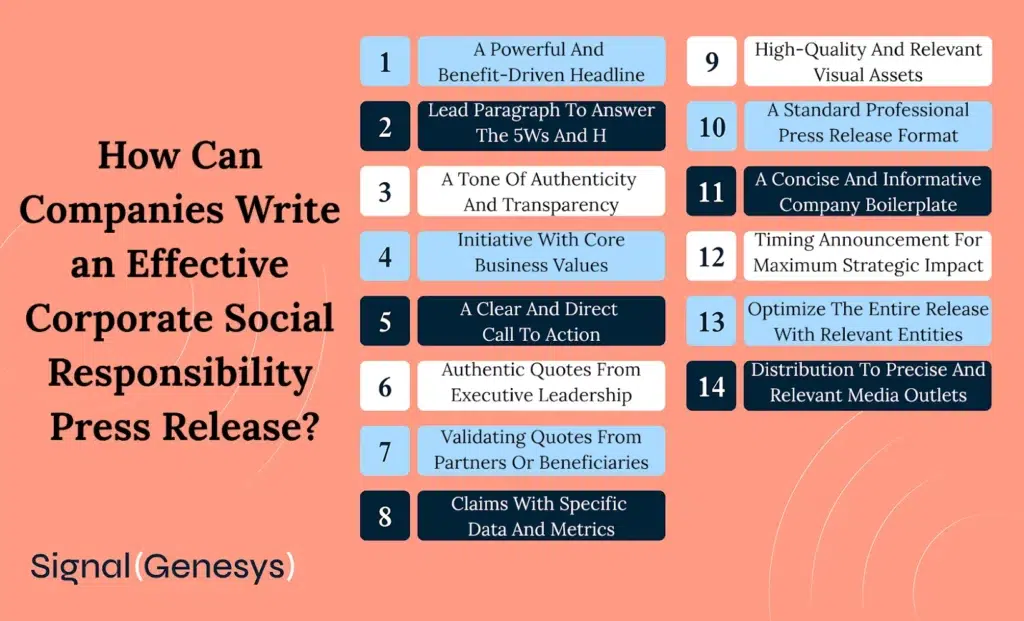
Companies can write an effective corporate social responsibility press release by following a structured, strategic, and authenticity-driven approach that prioritizes clarity, impact, and transparency. Each step contributes to a coherent communication framework that builds authority, amplifies visibility, and reinforces long-term social and environmental commitments.
Steps outlining how companies can write an effective corporate social responsibility press release are detailed below.
1. Lead With A Powerful And Benefit-Driven Headline
A CSR press release begins with a headline that captures the impact and relevance of the initiative. The headline defines the societal or environmental benefit achieved and creates an immediate connection with readers. A strong headline prioritizes clarity over creativity and highlights measurable impact or purpose-driven outcomes. Headlines that mention quantifiable achievements or keywords tied to the CSR focus area, such as “sustainability,” “education,” or “community uplift,” strengthen search visibility.
Avoid generic claims and vague phrasing that dilute the story value. A precise, benefit-led headline positions the company as a leader in responsible innovation and invites the audience to engage with credibility and interest.
2. Structure The Lead Paragraph To Answer The 5Ws And H
The lead paragraph answers who is involved, what the initiative is, where and when it occurs, why it matters, and how it contributes to broader sustainability goals. This structure eliminates ambiguity and gives journalists a complete foundation for coverage. An effective lead paragraph communicates the CSR scale, focus, and alignment with a larger social or environmental agenda.
Each sentence adds new, verifiable information rather than repeating broad intentions. Avoid promotional language or abstract moral statements that weaken the informational value.
3. Maintain A Tone Of Authenticity And Transparency
CSR communication depends on trust. Authenticity is achieved through honest disclosure of objectives, outcomes, and limitations. Transparency in describing challenges, processes, and stakeholder involvement demonstrates maturity in corporate accountability. Avoid exaggerated claims or moral superiority that signal performative intent. A well-written body reflects verifiable actions, consistent values, and real-world impact.
A transparent tone communicates ethical strength and invites scrutiny, which reinforces credibility. Readers, journalists, and regulators interpret transparency as a marker of integrity and long-term commitment rather than short-term reputation management.
4. Align The Initiative With Core Business Values
CSR initiatives gain legitimacy when they align with the core mission and operational focus. Alignment ensures that the project reflects authentic strategic intent rather than isolated philanthropy. A company focused on logistics, for instance, demonstrates coherence by providing sustainable transport solutions or supply chain ethics.
Effective press releases explicitly connect the CSR effort to corporate goals, internal policies, or innovation priorities. This integration communicates that social responsibility is embedded within business strategy. Inconsistent initiatives or misaligned partnerships create skepticism and weaken the brand narrative.
5. Provide A Clear And Direct Call To Action
A CSR press release becomes actionable when it includes a precise call to action that directs stakeholders toward meaningful engagement. The CTA invites participation, learning, or amplification of the social message. Use the CTA to encourage employees to volunteer, audiences to support the cause, or partners to collaborate.
A well-written CTA uses active language and defines the intended next step without relying on emotional appeals. Avoid generic requests such as “learn more” or “get involved” that lack context. Effective CTAs close the communication loop by turning awareness into measurable participation.
6. Incorporate Authentic Quotes From Executive Leadership
Quotes from leadership add authority and direction to the CSR message. An executive statement reflects personal conviction and aligns the initiative with corporate strategy. Strong leadership quotes express commitment to the values driving the action, not abstract goodwill.
Strong quotes avoid corporate clichés and instead provide insights into decision-making, policy integration, or measurable objectives. Readers and journalists interpret executive statements as evidence of top-level accountability. Avoid repetitive or exaggerated language that signals public relations spin rather than leadership-driven responsibility.
7. Include Validating Quotes From Partners Or Beneficiaries
Third-party voices add independent validation and reinforce authenticity. Quotes from NGO partners, local organizations, or direct beneficiaries provide social proof and external perspective. These voices transform the CSR announcement into a verified account rather than self-promotion. Incorporate quotes from partner and beneficiaries to illustrate specific results or first-hand experience rather than gratitude or generic praise.
Validation from credible partners deepens trust, confirms impact, and strengthens the narrative of cooperation and shared progress. Avoid fabricating or staging testimonials, as their absence of specificity exposes the release to scrutiny.
8. Support All Claims With Specific Data And Metrics
Quantitative evidence transforms CSR statements into measurable results. Data on funds allocated, emissions reduced, beneficiaries reached, or hours volunteered provides tangible proof of achievement. Measurable results enable analysts and journalists to assess impact and validate claims. Incorporate these figures naturally within the narrative and avoid data dumps or disconnected statistics.
Avoid vague phrasing such as “significant impact” or “substantial contribution.” Data-driven storytelling reinforces accountability and differentiates credible CSR communication from surface-level branding.
9. Incorporate High-Quality And Relevant Visual Assets
Visual assets strengthen storytelling and retention. Photographs, infographics, and short videos illustrate outcomes, humanize data, and increase media usability. Use interactive visuals that connect directly to the core message and comply with ethical representation standards. Authentic visuals of real participants, project sites, or measurable results communicate credibility.
Avoid stock imagery or unrelated visuals that weaken authenticity. Multimedia integration enhances search visibility and engagement across news and social platforms, which extends the reach of the CSR narrative.
10. Adhere To A Standard Professional Press Release Format
Structure defines readability. Professional formatting conventions that journalists recognize include a headline, subhead, date, lead, supporting paragraphs, quotes, and boilerplate. Consistent formatting ensures clarity and accessibility for editors and distribution networks. Ensure every section follows logical progression and concise paragraphing.
Avoid inserting promotional slogans or unrelated links that disrupt narrative flow. Professional structure signals journalistic quality and strengthens narrative acceptance across media outlets.
11. Include A Concise And Informative Company Boilerplate
The boilerplate is a snapshot of corporate identity, summarizing the organisational purpose, core operations, and long-term CSR commitments. An effective boilerplate communicates consistency between business objectives and social responsibility. Avoid generic branding statements and instead emphasizes measurable impact areas or sustainability milestones.
The boilerplate remains consistent across all releases to reinforce brand authority and trust. Inaccurate or exaggerated claims within this section undermine the credibility of the entire release.
12. Time The Announcement For Maximum Strategic Impact
Timing determines visibility and resonance. CSR announcements perform best when synchronized with relevant global observances, policy updates, or community milestones. Strategic timing ensures relevance in the media cycle and maximizes engagement potential. Companies benefit from releasing CSR communications during periods of heightened public focus on related issues such as climate awareness months or humanitarian campaigns.
Avoid releasing during competitive media events or crisis periods that overshadow visibility. Strategic scheduling transforms timing into a communication advantage rather than an afterthought.
13. Optimize The Entire Release With Relevant Entities
Search optimization ensures visibility across digital platforms. Entity-based optimization connects the release to semantically relevant topics such as sustainability, ESG, or community engagement. Incorporating named organizations, locations, and verified project titles strengthens press release discoverability in search and news results.
Use entities that reinforce topical accuracy and strengthen semantic relationships within the text. Avoid overuse of keywords or irrelevant tagging that reduces clarity and authority. Precision-driven optimization improves reach while maintaining informational integrity.
14. Target Distribution To Precise And Relevant Media Outlets
Strategic distribution determines audience relevance and amplification. CSR releases perform best when distributed to journalists, trade publications, and regional outlets that specialize in sustainability, social impact, or business ethics. Prioritize press release distribution outlets with established readerships aligned with the theme of the CSR initiative. Personalized media outreach and niche targeting outperform generic mass distribution.
Avoid irrelevant channels that dilute the message or reach disengaged audiences. Controlled, data-driven distribution ensures that each publication aligns with the values and interest of the target audience.
An effective CSR press release functions as a verified record of purpose-driven action. Each structured element advances transparency, aligns brand communication with ethical practice, and delivers measurable value to the public narrative. Companies that approach CSR communication with factual precision and strategic intent establish long-term authority, earn sustained media attention, and reinforce trust.
What Mistakes Should Be Avoided in a Corporate Social Responsibility Press Release?
Mistakes that should be avoided in a corporate social responsibility press release include errors that weaken credibility and distort public perception. Excessive jargon and unsubstantiated claims erode authenticity and long-term trust, which diminish media impact and stakeholder confidence.
Common mistakes that should be avoided in a corporate social responsibility press release are outlined below.
1. Using Jargon: Complex jargon or technical buzzwords obstruct clarity and alienate general audiences. Readers seek transparency and meaning, not corporate terminology. Overly technical language signals distance from the human and societal realities that CSR initiatives aim to address. Clear, accessible communication ensures the message resonates across journalists, investors, and community partners.
The goal is to convey social impact in a relatable way that connects values with measurable outcomes. Replace inflated phrases like “synergistic sustainability frameworks” with straightforward descriptions that reveal real progress. Precision in language signals authenticity, while jargon signals pretense.
2. Being Overly Promotional: Turning a CSR press release into a marketing pitch damages credibility. A socially responsible initiative loses power when framed as self-congratulation rather than newsworthy contribution. Overpromotion erodes trust because readers interpret it as an attempt to commercialize goodwill. Focus on the measurable impact and community relevance of the social initiative instead of corporate praise.
A balanced tone communicates responsibility and maturity, which proves that the organisational intent extends beyond brand enhancement. Press releases that focus on purpose instead of publicity sustain long-term stakeholder respect.
3. Exaggerating Claims: Inflated or vague statements signal greenwashing and invite scrutiny. A CSR press release built on exaggeration exposes the brand to credibility loss and public skepticism. Ensure every claim is verifiable through data, reports, or third-party validation. Precision in describing outcomes, such as emission reductions, education funding, or hours volunteered, anchors the narrative in truth.
Exaggeration replaces impact with illusion and transforms a positive initiative into a reputational risk. Responsible communication favors accuracy, accountability, and realism over emotional appeal or inflated success. Trust emerges from proof, not persuasion.
4. Choosing Irrelevant Initiatives: CSR initiatives disconnected from industry trends, organisational mission, or operations appear opportunistic. Irrelevance signals a lack of strategy and weakens brand coherence. An energy company investing in local arts without addressing environmental stewardship creates dissonance. Effective CSR announcements reflect direct alignment with business values, operational expertise, or community engagement priorities.
Relevance strengthens perceived authenticity and reinforces long-term sustainability goals. CSR loses credibility when it appears reactionary or disconnected from the core organisational purpose. Strategic relevance defines authority in social responsibility communication.
5. Lacking Transparency: Hidden data, omitted challenges, or unverified statements destroy trust. Stakeholders expect honest communication about outcomes including successes and areas requiring improvement. Transparency reveals the willingness of a company to stand accountable, while secrecy implies manipulation. Publishing measurable data, project limitations, and stakeholder involvement demonstrates maturity and ethical consistency.
Compelling CSR press releases document facts with traceable evidence rather than abstract claims. Transparency transforms perception from publicity to integrity. Readers believe actions grounded in openness, not perfection.
6. Ignoring the Human Element: CSR without people becomes statistics without emotion. The most effective CSR press releases humanize impact through storytelling, personal quotes, and community voices. Beneficiaries, employees, and local leaders validate the CSR purpose through lived experience. Human narratives transform data into meaning and strengthen emotional connection with readers.
A release that excludes the human dimension feels mechanical and disengaged. Craft the body with meaningful insights that reveal how corporate action creates tangible change in lives across the community. The presence of authentic human stories converts CSR into a shared narrative of progress and partnership.
7. Skipping Proofreading: Errors in spelling, structure, or data presentation signal carelessness and reduce professional credibility. A press release represents an official corporate record; inaccuracy reflects poor governance. Proofreading ensures factual consistency, grammatical integrity, and visual alignment. Even minor mistakes distort key figures or misrepresent stakeholders, which weakens trust among journalists and readers.
Conduct a thorough final review that involves multiple internal checkpoints, including communications, CSR, and legal teams. Precision reflects respect for language and the audience. A CSR press release without editorial rigor loses authority regardless of its content quality.
8. Making It Too Long: Excessive length diminishes reader engagement and media usability. Engaging CSR press releases deliver maximum value in minimal space through structured, factual, and high-density information. Long, repetitive paragraphs obscure key details and weaken the overall impact. Concise writing focuses attention on measurable results, human outcomes, and strategic relevance.
Editors prioritize clarity and brevity, not volume. A release that communicates its full story within an optimal word range demonstrates editorial discipline and respect for reader attention. Brevity in CSR communication enhances retention, precision, and accessibility.
Avoiding these mistakes preserves the integrity and impact of a CSR press release. Precision in structure, honesty in content, and relevance in purpose position the release as credible documentation of ethical practice rather than a promotional artifact. A CSR press release succeeds when it reflects consistent alignment between what a company communicates and how it acts in the world.
What Are Some Examples of Successful Corporate Social Responsibility Press Releases?
Examples of successful corporate social responsibility press releases demonstrate measurable commitment to sustainability, equity, and ethical governance. Examining these examples reveals how leading companies use structured storytelling, data-backed reporting, and distribution through high-authority networks to strengthen brand equity and search visibility.
Examples of successful corporate social responsibility press releases are given below.
1. Salesforce

2. HP

3. Tapestry, Inc.

4. Mastercard

5. Adobe

6. Ford

These examples highlight that success in CSR communication relies on substance, not sentiment. A strong press release integrates verified results, transparent data, and clear community outcomes that reflect long-term accountability. Organizations that tailor their CSR messaging to specific audiences like investors, customers, or partners, create higher engagement and stronger reputation signals.
What Templates Are Most Effective for Writing a Corporate Social Responsibility Press Release?
Templates that are most effective for writing a corporate social responsibility press release blend storytelling with accountability, using verified data, partner validation, and leadership quotes. Environmental, social, and governance narratives gain visibility when structured with journalistic precision, human relevance, and contextual data.
5 corporate social responsibility press release templates are given below.
1. Environmental Sustainability Initiative Press Release Template
FOR IMMEDIATE RELEASE
[Company Name] Commits to Carbon Neutrality Through Comprehensive Renewable Energy and Waste Reduction Program
[City, State] — [Month, Day, Year] — [Company Name], a recognized leader in [Industry], today announced a major environmental sustainability initiative designed to reduce its total carbon emissions by [X]% and transition all operations to renewable energy sources by [Year]. The initiative, titled [Program Name], establishes a measurable roadmap toward a carbon-neutral future aligned with global climate goals.
“Environmental responsibility defines how we operate,” said [Executive Name], [Executive Title] at [Company Name]. “This program demonstrates our accountability to future generations and solidifies our position as an industry leader in sustainable transformation.”
The [Program Name] initiative includes:
- Transitioning all corporate facilities and manufacturing sites to 100% renewable power by [Year].
- Reducing company-wide waste output by [X]% annually through a closed-loop recycling system.
- Investing in carbon offset projects such as reforestation and renewable energy development.
- Introducing supplier sustainability audits to ensure end-to-end environmental compliance.
Early projections indicate a reduction of [X metric tons] of CO₂ emissions per year once fully implemented. Employee engagement programs and community partnerships will further extend the program’s environmental impact.
High-resolution visuals and data dashboards detailing emissions progress will be available on [Company Website/CSR Portal].
About [Company Name]
[Brief description of the company, emphasizing environmental commitment and sustainability focus.]
Contact Information:
[Name]
[Title]
[Email]
[Phone]
2. Community Development and Local Empowerment Press Release Template
FOR IMMEDIATE RELEASE
[Company Name] Invests in Local Communities with [Program Name], a $[Amount] Initiative Supporting Education and Infrastructure Development
[City, State] — [Month, Day, Year] — [Company Name], a trusted innovator in [Industry], has announced the launch of [Program Name], a comprehensive community investment program dedicated to improving access to education and essential infrastructure in underserved regions. This $[Amount] initiative will directly benefit [Target Group, e.g., 10,000 families] across [Location/Region].
“At [Company Name], success means lifting communities alongside our growth,” said [Executive Name], [Executive Title]. “This program translates our corporate purpose into measurable local change, expanding access to education, clean water, and infrastructure.”
[Program Name] will fund:
- Construction of [X] new classrooms and digital learning centers in partnership with [Partner NGO].
- Training and employment opportunities for local residents within community-led projects.
- Infrastructure upgrades such as clean water systems, energy-efficient street lighting, and public health facilities.
Through a transparent implementation model, [Company Name] will publish progress reports every quarter to demonstrate impact and accountability. The initiative aims to strengthen local economies and improve long-term social outcomes.
Quotes, video stories, and case studies from beneficiaries will be available on [Company CSR Portal/YouTube Channel].
About [Company Name]
[Boilerplate focusing on corporate mission, community development, and ethical leadership.]
Contact Information:
[Name]
[Title]
[Email]
[Phone]
3. Diversity, Equity, and Inclusion (DEI) Program Press Release Template
FOR IMMEDIATE RELEASE
[Company Name] Expands Its Diversity, Equity, and Inclusion Program with New Global Initiative: [Program Name]
[City, State] — [Month, Day, Year] — [Company Name] today announced a significant expansion of its diversity, equity, and inclusion strategy with the launch of [Program Name], an initiative designed to foster equitable career development, cultural inclusivity, and leadership representation across all divisions.
“Equity and inclusion are not initiatives; they are essential values that drive innovation and unity,” said [Executive Name], [Executive Title] at [Company Name]. “This program operationalizes those values through measurable goals and continuous accountability.”
Key actions within [Program Name] include:
- Implementing equitable hiring benchmarks to ensure diverse candidate representation in leadership pipelines.
- Introducing mentorship networks and leadership academies focused on underrepresented groups.
- Conducting annual third-party audits of company equity metrics and publishing transparent progress reports.
- Partnering with external organizations to expand access to education, scholarships, and professional advancement.
The company projects measurable results within the first [X] years, including increased leadership diversity and higher employee satisfaction across global offices. The initiative aligns with [Company Name]’s broader CSR strategy and reflects its long-term social impact framework.
About [Company Name]
[Boilerplate emphasizing organizational culture, values, and inclusion-driven strategy.]
Contact Information:
[Name]
[Title]
[Email]
[Phone]
4. Ethical Sourcing and Supply Chain Accountability Press Release Template
FOR IMMEDIATE RELEASE
[Company Name] Strengthens Supply Chain Ethics with the Launch of [Program/Policy Name], Ensuring Transparency and Fair Labor Practices
[City, State] — [Month, Day, Year] — [Company Name] has introduced [Program/Policy Name], a comprehensive global supply chain accountability framework designed to ensure transparency, eliminate unethical labor practices, and reinforce fair trade compliance throughout all supplier partnerships.
“Our supply chain reflects our values,” said [Executive Name], [Executive Title] at [Company Name]. “This policy advances accountability at every level, creating visibility from sourcing to delivery.”
[Program/Policy Name] outlines clear operational reforms:
- Third-party ethical audits across 100% of Tier 1 and Tier 2 suppliers.
- Public disclosure of supplier performance metrics through an interactive transparency dashboard.
- Implementation of a supplier certification program covering labor standards, environmental practices, and anti-corruption compliance.
- Zero-tolerance policy for any supplier violating human rights or fair labor laws.
The policy will be reviewed annually, with findings made public in the company’s sustainability report. The initiative reinforces [Company Name]’s long-standing commitment to responsible business conduct and social accountability.
About [Company Name]
[Boilerplate highlighting company ethics, sustainability goals, and compliance standards.]
Contact Information:
[Name]
[Title]
[Email]
[Phone]
5. Annual ESG and Sustainability Report Press Release Template
FOR IMMEDIATE RELEASE
[Company Name] Publishes Annual ESG Report Highlighting Key Progress in Environmental, Social, and Governance Performance
[City, State] — [Month, Day, Year] — [Company Name] released its annual Environmental, Social, and Governance (ESG) Report, providing an in-depth account of measurable sustainability progress and outlining its roadmap for future improvement. The report underscores the company’s commitment to operational transparency and data-driven performance.
“Our ESG strategy continues to evolve in line with global standards and stakeholder expectations,” said [Executive Name], [Executive Title] at [Company Name]. “This report represents our dedication to measurable results, not rhetoric.”
Key highlights from the [Year] report include:
- [X]% reduction in operational greenhouse gas emissions across all facilities.
- [X]% increase in renewable energy sourcing.
- [Dollar Amount] invested in community resilience and employee well-being initiatives.
- Significant progress in board-level diversity and governance transparency.
The full ESG report includes verified data from independent auditors and aligns with [Framework Name, e.g., GRI or SASB] standards. Readers can access the complete report at [Company Website/ESG Portal].
About [Company Name]
[Boilerplate summarizing company mission, sustainability priorities, and long-term vision.]
Contact Information:
[Name]
[Title]
[Email]
[Phone]
Effective CSR press releases establish a documented record of ethical responsibility, quantifiable progress, and transparent dialogue with communities and stakeholders. These five templates demonstrate how structured storytelling, factual validation, and authentic leadership voices work together to sustain credibility and visibility. Companies that approach CSR communication as a strategic extension of corporate governance position themselves as industry authorities.
When Is the Best Time to Publish a Corporate Social Responsibility Press Release?
The best time to publish a corporate social responsibility press release is at the moment of verifiable impact. Timing transforms a CSR announcement from a simple update into a credible statement of progress. Companies issue a CSR press release when real outcomes, measurable milestones, or strategic partnerships demonstrate active commitment rather than aspirational promises. Ensure the CSR release coincides with evidence of purpose-driven performances so that public communication mirrors tangible corporate behavior.
A CSR press release achieves the greatest visibility when aligned with strategic events that mark authentic progress. Launching a new initiative provides an opportunity to present clear goals, implementation details, and leadership accountability. Announcing achievements such as hitting carbon reduction targets or completing a phase of a social impact program validates ongoing commitment and signals credibility. Publishing an annual sustainability or ESG report further amplifies transparency, which offers verified metrics that reinforce ethical governance and long-term stewardship.
Aligning CSR announcements with global awareness dates or recognized observances elevates relevance and audience engagement. Announcing an environmental initiative around Earth Day or unveiling a diversity program during an inclusion-focused month allows the company to participate in broader public dialogue. Releasing news ahead of major industry events, trade shows, or conferences ensures greater pickup, as journalists actively seek relevant content within that domain.
Avoiding high-noise periods such as election weeks, natural disasters, or major policy news increases the chance of securing media coverage without message dilution. Tactical precision determines whether a CSR press release reaches the intended audience at the right moment. Midweek distribution, particularly on Tuesday, Wednesday, or Thursday, between 8:00 a.m. and 10:00 a.m. ensures journalists and media desks view it during active editorial hours. Early morning releases position the story for same-day publication, maximizing digital visibility and social traction.
Weekends, holidays, and late Fridays reduce media engagement, which causes well-written releases to lose momentum. Strategic timing, factual credibility, and message clarity combine to make CSR press releases powerful instruments of brand accountability and stakeholder trust.
Where Should a Corporate Social Responsibility Press Release Be Distributed?
A corporate social responsibility press release should be distributed through a structured, multi-channel strategy that balances credibility, reach, and relevance. The objective is to ensure visibility across professional media networks, industry-specific audiences, and stakeholder communities that value transparency and ethical leadership.
Key channels where a corporate social responsibility press release should be distributed are given below.
1. Newswire Services: Newswire services extend distribution to global and national media outlets while maintaining credibility and consistency. Platforms such as PR Newswire, Business Wire, and GlobeNewswire syndicate the release across reputable news portals, which enhances discoverability through major search engines and aggregator sites. This distribution ensures that journalists, analysts, and investors encounter the release within trusted environments.
An effective CSR announcement on a newswire integrates high-quality multimedia, keyword optimization, and clear impact metrics to strengthen visibility. Avoid generic headlines or vague language that fail to capture the specific social or environmental outcomes of the initiative.
2. Journalists and Editors: Targeting journalists and editors creates opportunities for deeper, narrative-driven coverage. Focused outreach to reporters who specialize in sustainability, ESG performance, or community engagement fosters credibility. Each pitch requires personalization, such as referencing the past work of a journalist and connecting the CSR story to editorial interests.
Sending fact sheets, quotes, and verified impact data accelerates editorial review and improves publication likelihood. Irrelevant or mass pitches weaken credibility and reduce the potential for earned coverage across major outlets.
3. Company Newsroom or Website: A company newsroom serves as the permanent and verifiable source for CSR communication. Hosting the full press release on a branded media page consolidates all external mentions and provides a searchable archive for investors, journalists, and stakeholders. Ensure the page includes optimized metadata, accessible visuals, and downloadable assets.
Structuring the newsroom with consistent formatting and internal linking improves visibility within search results. Omitting multimedia or neglecting search optimization limits engagement and ranking potential.
4. Industry and Trade Publications: Industry and trade publications connect the CSR initiative directly to specialized audiences that understand its technical or operational relevance. Publishing through these outlets establishes leadership within niche markets such as renewable energy, manufacturing sustainability, or community healthcare.
Editors in these sectors prioritize actionable data, case studies, and expert commentary. Submitting content aligned with editorial calendars and sector priorities increases publication chances. Submitting generalized or self-promotional copy weakens positioning and credibility among professional readers.
5. Social Media Platforms: Social platforms extend the reach of CSR communications through audience engagement and real-time interaction. LinkedIn is ideal for thought leadership and professional dialogue, while platforms like X and Facebook enable broad public sharing. Visual content, such as impact videos or on-site project photos, increases algorithmic visibility and audience retention.
Use social media posts to summarize the core achievement of the CSR initiative, with a link directing readers to the full release. Automated or repetitive posting diminishes authenticity and engagement rates, while curated, audience-specific messaging drives meaningful response.
6. Email Newsletters: Email newsletters distribute CSR updates directly to internal stakeholders, customers, and partners who have expressed interest in corporate updates. Including a summary of achievements with links to data reports or case studies provides transparency and encourages deeper engagement. Segmenting lists based on audience roles, such as investors, employees, or partners, ensures message relevance.
Consistent formatting, branded visuals, and clear subject lines maintain professional presentation. Overly promotional or lengthy email content risks disengagement and reduced open rates.
7. Online News Aggregators: News aggregators such as Yahoo News, Google News, and Bing News extend the reach of CSR releases into algorithmically curated spaces. Optimizing headlines, subheadings, and schema markup increases the likelihood of inclusion in these feeds. Aggregator exposure enhances discoverability among readers who follow sustainability and business innovation categories.
Maintaining structured data integrity and factual alignment ensures the release appears alongside authoritative sources. Poor keyword selection or structural errors reduce indexing efficiency and organic visibility.
8. NGO and Community Partner Channels: Partnership-based distribution enhances authenticity and trust. Collaborating organizations, NGOs, or community partners possess highly engaged audiences who value impact-driven communication. Joint publication across their digital platforms, including newsletters, websites, and event announcements, extends reach to audiences that align directly with organisational goals.
Coordinated releases with shared messaging strengthen the narrative of collaboration and accountability. Disconnected messaging or misaligned timing between partners weakens credibility and dilutes the campaign impact.
A strategic CSR press release distribution plan combines precision targeting with broad credibility. Each outlet serves a specific function: wires establish legitimacy, journalists provide depth, websites anchor authority, and social platforms sustain visibility. Coordinating across these channels ensures every stakeholder encounters a consistent message of purpose-driven impact and transparent progress.
How Can Companies Ensure Successful Distribution of a Corporate Social Responsibility Press Release?
Companies can ensure successful distribution of a corporate social responsibility press release through precise media targeting, strategic channel integration, transparent storytelling, and sustained stakeholder engagement. The process involves orchestrating visibility, credibility, and alignment between message, audience, and timing to maximize social and reputational impact.
A well-defined targeting strategy establishes the foundation for meaningful visibility. Identifying journalists, publications, and digital platforms that align with the CSR objectives ensures coverage in outlets that attract the intended audience. Relevance of distribution defines effectiveness. For instance, CSR content about sustainability gains greater traction with environmental reporters, while community impact stories perform best with local and philanthropic media.
Strategic use of communication channels ensures balanced exposure across controlled and uncontrolled media environments. Controlled channels such as corporate websites, social media pages, and internal newsletters allow organizations to maintain narrative control and long-term visibility. Uncontrolled channels, including online news sites and media partnerships, expand reach and introduce third-party validation.
Building long-term media relationships transforms distribution from a transactional process into a collaborative exchange. Engaging journalists through consistent communication, transparency, and access to credible data builds mutual respect. Cultivating relationships with NGO partners and local organizations extends this trust into the community sphere, which enhances CSR legitimacy.
What Tools Can Help Companies Write and Share a Corporate Social Responsibility Press Release?
Tools that help companies write and share a corporate social responsibility press release combine SEO-driven publishing, data distribution, and targeted outreach to strengthen message visibility. These platforms turn CSR initiatives into structured, searchable, and newsworthy assets that enhance brand credibility while driving measurable engagement across online and editorial ecosystems.
5 tools that can help companies write and share a corporate social responsibility press release are reviewed below.
1. Signal Genesys
Signal Genesys transforms corporate social responsibility communications into verifiable SEO assets designed to amplify authority across search and media channels. Each CSR press release is converted into a structured data object optimized for search visibility and schema markup enrichment. Distribution extends to high-authority outlets like Yahoo, and AP News, which ensures the announcement reaches diverse audiences and indexable platforms.
The platform integrates multimedia elements, Google Maps data, and dynamic tagging to build a digital footprint of authenticity. Real-time analytics provide transparency into how audiences interact with CSR content, which allows businesses to refine narrative strategies for stronger impact. Through this model, Signal Genesys positions CSR announcements as part of a measurable and discoverable digital presence rather than isolated statements.
2. eReleases
eReleases provides editorially reviewed access to the PR Newswire network, which enables companies to achieve professional-grade CSR visibility through trusted media distribution. The eReleases editorial team ensures that every CSR press release meets journalistic standards of clarity, precision, and balance. With direct connections to more than 1.7 million journalists and editors, eReleases facilitates targeted exposure within industry-specific and national outlets.
Pricing tiers between $399 and $699 offer scalable solutions for organizations of different sizes while maintaining consistent editorial quality. Each release includes keyword optimization and distribution tracking, which enables brands to measure media traction and refine future campaigns. eReleases remains an essential choice for CSR teams prioritizing credibility and precision in their corporate storytelling.
3. Respona
Respona delivers an AI-powered approach to media outreach, which enables companies to build personalized relationships with journalists and editors who cover sustainability and corporate ethics. The automated research engine identifies contacts most aligned with organisational CSR focus areas, streamlining outreach and improving placement potential. Respona provides campaign automation with advanced personalization tools that position CSR news as part of a broader social dialogue.
Through data-backed contact segmentation, teams scale outreach without compromising message integrity. The unified dashboard manages communications, follow-ups, and performance insights in one workspace, ensuring full oversight of every earned media opportunity. Respona offers the data infrastructure to deliver meaningful and authentic press coverage for CSR announcements aiming for high editorial alignment.
4. BuzzStream
BuzzStream provides a structured environment for managing journalist and influencer outreach tied to CSR campaigns. BuzzStream enables teams to organize contact databases, monitor conversations, and track outcomes across multiple channels. The platform maintains continuity in CSR storytelling by preserving interaction histories and outreach progress. Built-in analytics reveal which outreach efforts generate engagement, which allow brands to adjust tone and targeting for stronger connections.
BuzzStream offers customizable templates to simplify large-scale communication while preserving authenticity in each message. BuzzStream allows organizations to strengthen long-term relationships with media professionals covering sustainability and corporate governance.
5. PRLog
PRLog offers an accessible distribution channel for CSR press releases, which combines free publication options with affordable paid upgrades for broader reach. PRLog allows organizations to include multimedia assets, keyword tags, and hyperlinks to enhance search discoverability and engagement. Paid tiers, beginning at $99, extend visibility to over 500 outlets and introduce advanced SEO features for optimized indexing.
The interface provides quick publication, making it suitable for smaller organizations or startups that prioritize agility in CSR communication. Despite its simplicity, PRLog contributes valuable backlinks and organic exposure across diverse digital environments. Brands seeking efficiency and affordability find PRLog suitable for its streamlined method for publishing and amplifying socially responsible initiatives.
Selecting the right tool for a corporate social responsibility press release requires aligning distribution strategy with organizational goals and audience priorities. Companies begin by defining the purpose of their CSR announcement, such as reputation building, stakeholder transparency, or thought leadership. Then, businesses select a platform that best reinforces that intent.
How Much Does It Cost to Distribute a Corporate Social Responsibility Press Release?
The cost of distributing a corporate social responsibility press release through Signal Genesys depends on the publishing frequency and the level of platform access selected.
Organizations starting with limited CSR activity access the Grow plan, which offers free entry to the platform and pay-as-you-go pricing at $50 per press release. This plan includes editorial oversight, publication across 40–60 verified media sites, and premium channel upgrade options.
Brands executing frequent CSR initiatives benefit from the Scale plan, priced at $250 per month, which includes 125 credits and lowers the cost to $25 per distribution. This level is ideal for ongoing campaigns, such as annual sustainability reports or philanthropic updates, which allows marketers to maintain a consistent rhythm of high-authority placements.
High-volume communicators adopt the Elite plan, a lifetime access option costing $6,500, which lowers the per-release price to $15. The Elite plan includes enhanced editorial technology, E-E-A-T optimization, and long-term access to the Signal Genesys signal generation framework.
How Can Companies Select the Right Distribution Service for a Corporate Social Responsibility Press Release?
Companies can select the right distribution service for a corporate social responsibility press release by applying a methodical, data-informed approach that aligns communication goals with distribution needs. The decision directly influences visibility, media credibility, and stakeholder perception. Every CSR press release represents an opportunity to demonstrate authenticity, transparency, and measurable impact.
Effective selection begins with clarity on goals and audience. Companies define their CSR distribution strategy by determining whether they seek broad media coverage, investor recognition, or public engagement. Precision in audience definition creates alignment between message intent and distribution scope. CSR releases targeting local community efforts perform best through regional news networks, while ESG-focused disclosures require services trusted by financial media.
Thorough evaluation of available services establishes the foundation for strategic distribution. Each provider offers distinct advantages in reach, functionality, and reporting quality. A service with robust journalist databases and advanced targeting filters delivers higher editorial pickup rates. Pricing structures vary across platforms, but value depends on audience relevance, not volume. CSR stories demand high-quality multimedia to visualize impact, and newsroom hosting enhances discoverability.
Service credibility and technical integration determine message authority and long-term value. Established networks such as Business Wire or GlobeNewswire enhance legitimacy through trusted syndication channels. Platforms offering SEO optimization, structured data, and verified publishing improve organic reach and digital footprint. Editorial assistance ensures alignment between journalistic standards and corporate voice. Reliable customer support accelerates distribution readiness and maintains consistency under tight deadlines.
Final evaluation focuses on performance validation before commitment. Testing a platform through limited releases provides insight into usability, newsroom performance, and audience engagement metrics. Alignment between the core capabilities of the service and the organisational CSR communication goals drives effective execution. CSR storytelling gains long-term traction when the press release distribution process reflects the same responsibility, transparency, and integrity that define the corporate initiative itself.
Which Providers Offer the Best Support for Corporate Social Responsibility Press Releases?
Signal Genesys offers the best support for corporate social responsibility press releases through its integrated distribution technology, SEO intelligence, and precision-focused publishing network. The platform strengthens the visibility and credibility of CSR initiatives by ensuring every announcement generates measurable digital signals across news outlets, search engines, and large language models. Signal Genesys amplifies CSR narratives through its proprietary signal generation technology, which enhances search engine visibility and builds long-term digital authority.
Every press release distributed through the platform is optimized for indexing across Google and high-authority publishers such as Yahoo, and AP News. This structured visibility gives companies ownership of their narrative while maximizing engagement through verified placements and permanent backlinks. The technology-driven distribution process creates quantifiable growth in brand reach, with documented signal increases exceeding 98 percent across published content.
Unlike traditional press release services that rely on outdated syndication models, Signal Genesys operates as an AI-augmented visibility engine tailored to modern PR goals. The platform integrates SEO, multimedia, and analytics, which empowers companies to present their CSR initiatives through branded storytelling that retains full editorial control. White label capabilities reinforce corporate identity, while multimedia integration allows organizations to embed photos, infographics, and video testimonials to strengthen emotional resonance.
Signal Genesys proves its leadership through transparency, affordability, and measurable ROI. The à la carte pricing and lifetime access options eliminate restrictive contracts and hidden costs, which gives companies full control over budget allocation. Agencies and lean corporate teams use Signal Genesys to replace legacy PR systems with an agile, data-driven framework that produces sustained digital equity.
How Can Companies Publish a Corporate Social Responsibility Press Release Using Signal Genesys?
Companies can publish a corporate social responsibility press release using Signal Genesys through a guided workflow designed for speed, quality, and visibility. The process begins with selecting “New Release” in the platform dashboard, where users initiate the creation of their CSR announcement. Signal Genesys offers three distinct writing paths: self-written, AI-assisted, or expert-crafted. CSR teams focused on authenticity choose to write the release internally, while AI-assisted or professional writing options provide structure, clarity, and optimization for wider distribution.
Once the creation mode is selected, the next step involves entering company information and defining the press release subject and writing theme. In CSR-focused releases, this includes outlining the CSR purpose, social or environmental objectives, and measurable impact. Users guide the AI with specific input, which ensures the final article communicates accountability and aligns with corporate values. Adding images or documents such as project photos, sustainability reports, or partner logos enriches the narrative and provides visual context to the CSR message.
Signal Genesys then allows users to choose content quality levels and target word counts, which ensures the press release matches editorial standards and campaign goals. After content generation, the preview stage enables fine-tuning to remove redundant phrases, add verified data, or enhance storytelling depth before distribution. This review process guarantees precision in tone, relevance, and alignment with brand communication standards.
The final step involves configuring distribution and publication details, where users select categories, publish dates, and channels. Signal Genesys integrates with a network of digital publishers and media endpoints, which enables direct distribution across high-authority domains. The structured process facilitates CSR communication with narrative integrity and search engine visibility, which ensures that ethical initiatives receive measurable digital amplification.
How Often Should Companies Issue Corporate Social Responsibility Press Releases?
Companies should issue Corporate Social Responsibility press releases to communicate verified progress, measurable outcomes, and authentic impact with strategic precision. CSR communication gains credibility when every announcement documents a tangible milestone, a quantifiable result, or a validated partnership that contributes to measurable social or environmental progress. The emphasis stays on truth, data, and transparency rather than frequency.
Ensure each announcement emerges from real developments within CSR initiatives. Newsworthy developments include launching a new sustainability program, achieving a verified emissions reduction target, publishing an ESG performance report, or earning a respected certification. These developments demonstrate corporate integrity and validate long-term commitments to sustainable growth.
Issuing press releases for minor activities diminishes impact and contributes to media fatigue, while selective publication preserves journalistic interest. A quarterly rhythm aligns naturally with stakeholder reporting cycles, which enables consistent updates without diluting attention. Larger organizations with multiple CSR arms sustain authority through two to four substantial releases per quarter. Smaller enterprises gain stronger results through annual or biannual announcements tied to verified milestones or sustainability audits.
A deliberate CSR communication calendar ensures coherence across campaigns. Aligning press release distribution with ESG reporting, brand initiatives, and global observances such as Earth Day or World Environment Day enhances contextual visibility. Integrating CSR releases with broader corporate communication and search-optimized newsroom content reinforces topical authority.
Can Companies Combine Multiple CSR Initiatives in a Single Press Release?
Companies combine multiple CSR initiatives in a single press release to communicate a unified vision of social responsibility and reinforce thematic coherence across diverse programs. This approach establishes strategic depth when each initiative aligns with a shared purpose, measurable impact, or overarching sustainability framework. Ensure that each initiative contributes to a cohesive story that strengthens the corporate narrative around ethical leadership and verified outcomes. A well-structured, multi-initiative press release positions the organization as intentional and results-driven in its CSR communication.
Combining CSR efforts becomes effective under specific conditions that reinforce authenticity and narrative clarity. A company announcing a multi-organization partnership or integrated sustainability roadmap benefits from a single, consolidated release that underscores collaboration and scale. Thematic cohesion across environmental, social, and governance dimensions, such as combining renewable energy investment with workforce inclusion programs, creates a holistic representation of CSR strategy.
Annual or semi-annual CSR or ESG reports provide a natural opportunity to group multiple initiatives under one communication framework to showcase collective impact and long-term consistency. Clarity defines success in a multi-initiative release. Each program requires a distinct subsection or paragraph that communicates its unique purpose, data-driven outcomes, and direct contribution to the larger CSR objective. Ensure the structure progresses logically with subheadings and quantified evidence to distinguish between initiatives while maintaining narrative flow.
How Is a Corporate Social Responsibility Press Release Different From Other Types of Press Releases?
Yes, a corporate social responsibility press release is different from other types of press releases because it communicates purpose, impact and integrity rather than promotion or transaction. The primary goal is to position the organization as a socially accountable leader by highlighting measurable progress in sustainability, ethics, or community development. A CSR press release serves as an instrument of trust-building and stakeholder engagement rather than a vehicle for marketing or financial reporting.
Unlike product or event announcements that emphasize market differentiation and consumer appeal, a CSR release establishes moral and social alignment between the company and its audience. The focus shifts from features to values and from commercial outcomes to public benefit. The structure follows an evidence-led narrative that defines the issue addressed, outlines the corporate initiative, and presents quantifiable outcomes. The language is factual yet human, designed to engage emotionally while maintaining analytical credibility.
A CSR press release differs in its communicative tone and risk profile. While product and financial releases operate in a transactional communication space, CSR announcements exist in a credibility-sensitive domain. Overstating achievements or masking inconsistencies risks accusations of greenwashing, which erodes trust faster than silence.