A research paper press release transforms technical findings into accessible information that captures media and public attention. A research paper is a formal document that communicates original results, data analysis, or theoretical insight. A research paper press release provides a summary of that work, written in concise, journalistic language that highlights the significance and broader implications. This type of communication allows complex academic studies to reach non-specialist audiences, stimulate public understanding, and reinforce the societal value of scientific research.
Institutions use research paper press releases to translate scholarly impact into measurable visibility across news media, policy discussions, and digital platforms. Publishing research is valuable, but communicating it effectively determines its real-world influence. A research paper press release increases exposure by distilling the essential message into a format journalists and readers recognize. A research press release enhances institutional reputation, strengthens the authority of the researchers, and promotes future grant opportunities by demonstrating public engagement.
Press releases make studies accessible, verifiable, and shareable, enabling discoveries to reach communities that benefit from their outcomes. Writing a successful release requires strategic refinement. Focus on the most newsworthy element, present it in the simplest accurate language, and maintain journalistic structure through the inverted pyramid model. Avoid technical jargon that isolates readers, weak headlines that obscure the story, and overpromotion that diminishes credibility.
This article explains how to write an effective research paper press release, and identifies mistakes that reduce visibility or credibility. Readers will learn how to identify the most newsworthy aspects of their findings, craft headlines that attract attention, and organize details for journalistic impact.
What Is a Scientific Research?
Scientific research is the systematic and evidence-based process of generating, testing, and refining knowledge to explain and predict natural or social phenomena. Scientific research relies on structured inquiry and logical reasoning to uncover new information, establish patterns, and validate existing theories. Every scientific investigation follows a deliberate sequence of observation, hypothesis formation, experimentation, and analysis, to ensure that conclusions derive from verifiable data.
This methodical approach differentiates scientific inquiry from casual observation, anchoring it in empirical verification and reproducibility. The goal of scientific research is describing phenomena while explaining causality, uncovering associations, and enabling discoveries that expand human understanding. Scientific research operates on two interconnected levels: theoretical and empirical. The theoretical level formulates concepts, models, and hypotheses that explain how elements of a phenomenon interact. The empirical level tests these theoretical constructs through data collection and analysis.
Theoretical research develops frameworks, while empirical research validates or refines them through measurable results. Reliable research integrates both components, as neither theory without evidence nor evidence without interpretation constitutes complete scientific knowledge. Scientific research provides a foundation for solving practical problems, informing innovation, and guiding policy decisions based on evidence.
Research enables discovery of universal principles, from physical laws governing the natural world to behavioral patterns shaping societies. Through replicable methods and transparent communication, scientific research establishes credibility, fosters global collaboration, and drives progress across disciplines.
What Is a Scientific Research Paper Press Release?
A scientific research paper press release is a concise and structured communication designed to summarize the findings of a newly published study. Research paper press releases transform complex scientific data into clear, factual narratives that highlight research relevance, outcomes, and implications for society. The release allows verified research to circulate beyond scholarly journals and reach audiences that influence discourse, policy, and innovation.
A scientific research press release includes a compelling headline, a lead summarizing essential facts, and subsequent sections that provide context, key results, and quotes. Research press releases conclude with a boilerplate that defines the institutional role and a media contact section for further inquiry. A consistent narrative flow ensures that journalists extract reliable story angles without diluting the scientific precision of the study.
A research paper press release increases public awareness, strengthens institutional visibility, and amplifies the reach of scientific evidence through media channels. Accurate dissemination of research findings through press releases allows credible science to inform journalism, shape policy, and stimulate new research directions. Media exposure derived from these releases directly correlates with higher citation rates and stronger recognition for the research team and the publishing institution.
Through consistent media engagement, scientific press releases transform isolated academic discoveries into active elements of public and professional dialogue. Research institutions, universities, and academic journals rely on press releases to connect the rigor of scientific inquiry with the immediacy of public communication.
What Is the Purpose of a Research Paper Press Release?
The purpose of a research paper press release is communicating new scientific knowledge to capture media attention, inform the public, and amplify reach. Research press releases translate technical findings from scholarly work into concise, media-ready language that maintains scientific integrity while engaging non-specialist audiences. The press release operates as a strategic dissemination tool designed to generate media coverage and increase the visibility of scientific achievements.
Journalists rely on structured summaries to identify research worth reporting, and institutions use this format to ensure that key messages and findings are presented accurately. Each release delivers essential information such as the main research discovery, the significance, and real-world implications, which enables reporters to construct factually grounded stories. This controlled communication process ensures that scientific contributions receive attention while preserving the original context and credibility of the research.
Visibility generated through a research paper press release directly enhances the academic and social impact of the study. Media coverage raises awareness among global audiences, which leads to higher citation potential, stronger academic recognition, and greater institutional authority. Broader dissemination enables future funding opportunities, as public engagement and measurable research impact form part of grant assessment criteria. Beyond metrics, consistent press coverage positions the institution and its researchers as credible contributors to global innovation and thought leadership.
Research paper press releases fulfill a public service function by making verified scientific knowledge accessible. Releases strengthen science literacy, counter misinformation, and create pathways for informed dialogue between researchers, policymakers, and citizens. The press release operates as an academic amplifier that enables research outcomes to reach audiences who transform information into action, awareness, and advancement.
Are Research Paper Press Releases Important for Researchers and Institutions?
Yes, research paper press releases are important for researchers and institutions because they convert scientific findings into accessible narratives and create measurable academic, financial, and reputational impact. A research press release translates technical discoveries into stories that resonate with journalists, funding bodies, and policymakers. For researchers, this communication extends the lifespan of their work beyond academic journals and transforms it into a public asset.
The resulting media coverage increases citation counts, validates expertise, and positions the researcher as a trusted authority in their domain. Each release contributes to professional advancement by increasing visibility among collaborators, potential funders, and institutions seeking research talent. For institutions, research paper press releases operate as instruments of influence and reputation management. Press releases project institutional leadership in innovation and signal the success of funded programs to stakeholders and the public.
Strong visibility through earned media elevates the standing of a university or research center across global rankings, which enables opportunities for international partnerships and research grants. Strategic communication of discoveries highlights institutional contribution to solving global problems, and reinforces the social value of research investment. The outcome is increased trust among donors, alumni, and government agencies that view transparent communication as a marker of accountability and excellence.
A well-crafted research press release drives measurable engagement across academic and public channels. Search-optimized releases generate high-authority backlinks that strengthen domain authority, and improve discoverability in search results for researchers and their institutional departments. Consistent distribution across press networks extends digital reach, which places the institution name in recurring circulation across major media platforms. This continuous exposure sustains institutional awareness, attracts top faculty and students, and shapes long-term brand equity within the research ecosystem.
What Are the Benefits of Issuing a Research Paper Press Release?
The benefits of issuing a research paper press release extend across visibility, influence, institutional reputation, and measurable academic growth. Research press releases transform scientific findings from isolated data into a communicative asset that informs, persuades, and attracts. Each benefit contributes to the research lifecycle by amplifying discovery, reinforcing authority, and connecting science with global audiences that include peers, policymakers, and the public.
Key benefits of issuing a research paper press release are detailed below.
1. Increased Visibility and Reach: A research paper press release expands the audience for scientific work far beyond academic boundaries. A press release gives research a public platform that reaches journalists, policymakers, and sector experts who rarely engage with academic journals. Media coverage introduces the study to global audiences within hours, which creates a network effect that multiplies exposure across academic, professional, and public domains.
This visibility accelerates the rate at which findings are read, cited, and discussed, which ensures the study gains recognition faster than traditional publishing cycles allow.
2. Enhanced Credibility and Academic Recognition: A press release confers legitimacy through third-party validation from established media organizations. Coverage in reputable outlets builds authority around the researcher and the institution, demonstrating reliability and relevance. Earned media adds an external layer of endorsement that complements peer-reviewed credibility.
This combination of scientific rigor and journalistic amplification establishes the researcher as a thought leader, which strengthens citation potential and professional influence across disciplines.
3. Institutional Branding and Reputation Strengthening: For universities, laboratories, and research centers, every published press release becomes an asset that reinforces institutional authority. A scientific press release showcases ongoing innovation and positions the institution as a central hub of discovery within its field.
Consistent communication of research outcomes establishes a long-term brand narrative grounded in expertise, transparency, and social contribution. Strong brand authority attracts top researchers, global partnerships, and high-caliber students seeking association with leading academic environments.
4. Improved SEO and Digital Performance: Online press releases integrate research communication with digital visibility strategies. Media publications that cite and link to institutional pages generate high-value backlinks, which improves domain authority and search engine ranking. Increased visibility on Google Scholar, research repositories, and academic indexing platforms strengthens the discoverability of future publications.
A strong digital footprint sustains audience growth and directs organic traffic to the website, research databases, and author profiles, which consolidates digital presence in the long term.
5. Funding Opportunities and Financial Impact: Press release coverage signals influence and relevance to funding agencies, investors, and grant committees. Public recognition demonstrates the real-world applicability of research, supporting proposals with measurable outreach evidence. Institutions with documented media engagement receive preference for funding renewals because they show effective dissemination of taxpayer-supported research.
Visibility in high-impact publications attracts private sponsorships, philanthropic donors, and strategic research partnerships seeking alignment with credible scientific innovation.
6. Academic Collaboration and Cross-Disciplinary Exchange: Widespread communication of research findings encourages collaboration across institutions and disciplines. A press release introduces new data and methodologies to scientists working in parallel domains, which enables knowledge exchange to spark new investigations.
Collaborative recognition accelerates interdisciplinary problem-solving and fosters long-term academic relationships. Exposure through media networks creates visibility across professional conferences, research consortiums, and citation networks that strengthen scholarly connectivity.
7. Public Engagement and Science Communication: Research paper press releases transform technical information into accessible narratives that make science relevant to everyday life. Scientific press releases enhance public understanding of scientific progress and establish direct communication between researchers and society.
Clarity in language and structured storytelling foster trust and appreciation for evidence-based knowledge. This active engagement increases scientific literacy, combats misinformation, and positions research institutions as reliable educators and communicators.
8. Policy Influence and Societal Application: Research communicated through a press release reaches decision-makers, advocacy groups, and policy influencers who shape legislative and institutional priorities. This visibility ensures that data-backed insights inform public health initiatives, environmental standards, and technology regulations.
Policymakers rely on summarized, credible information, making press releases essential in translating complex findings into actionable policy frameworks. Strategic dissemination transforms academic discoveries into instruments of change, extending the social and economic relevance of research.
A well-executed research paper press release transforms academic work into a dynamic source of influence that drives recognition, collaboration, and measurable scientific impact. Releases convert isolated findings into stories that inspire dialogue between researchers, institutions, and society, which strengthens the link between discovery and real-world progress. A scientific press release establishes a long-term communication framework where science gains enduring relevance across media, policy, and industry.
What Should a Research Paper Press Release Include?
A research paper press release should include structured sections that translate technical discovery into accessible, authoritative communication. Each element contributes to clarity, credibility, and impact, and ensures that research reaches journalists, stakeholders, and the broader public with precision and meaning. A strong release transforms complex findings into verified, digestible, and widely shareable information that reinforces scientific integrity while advancing institutional reputation.
Key elements that a research paper press release should include are outlined below.
Lead
The lead introduces the core discovery with directness and clarity, and outlines what was achieved, who conducted it, and why it matters. This section highlights the novelty of the research and its primary takeaway in the first sentence, anchoring attention immediately. The best leads merge journalistic sharpness with academic accuracy, setting the informational tone that guides the rest of the release.
Lead Quote
The lead quote adds interpretive depth and human connection. Quotes translate data into meaningful insights conveyed through the voice of a principal investigator or lead author. A well-crafted quote emphasizes motivation, breakthrough, or significance in plain language. Use the lead quote to convey conviction and authority, not speculation, and express how the findings advance understanding in the field. Effective lead quotes transform the study from data-driven content into a credible, human-centered story.
Significance
Significance explains why the research matters beyond its scientific context by linking the study to public relevance, policy influence, or potential industry transformation. This section clarifies what problem the research solves and what outcomes it drives. Emphasize research significance by drawing connections between the discovery and broader trends in health, technology, climate, or economics. Journalists use this part to assess newsworthiness, so precision and impact framing are critical.
Background
Background situates the study within the broader scientific conversation, defines existing gaps in knowledge, summarizes prior efforts, and establishes why the research findings represent progress. This section gives readers the context they need to understand the scale and novelty of the research. Providing background builds credibility by demonstrating that the researchers are advancing the field. For non-experts, this narrative bridge creates comprehension without oversimplification.
Approach
The approach outlines the process behind the discovery with transparency and brevity, and specifies the study design, data sources, or experimental models used. The aim is not to reproduce a full methods section but to establish research validity and rigor. Well-explained methodology signals accountability, especially for journalists assessing reliability, and establishes that the findings rest on systematic evidence rather than anecdotal observation.
Findings
The findings section delivers the most critical data points, emphasizing measurable outcomes and verified conclusions. Findings validate the headline claim introduced in the lead and substantiates the overall message with facts. Ensure every statement links back to the central discovery to maintain narrative coherence. Quantitative clarity, comparative metrics, and explicit results increase media confidence and strengthen citation potential in secondary reporting.
Secondary Quote(s)
Secondary quotes provide perspective and reinforcement. These statements, from co-authors or external experts, demonstrate scholarly consensus and independent validation. Secondary quotes offer a multidimensional view of the research, emphasizing collaboration, cross-disciplinary relevance, or long-term implications. This section deepens narrative richness and broadens research appeal across scientific and general audiences.
Lookahead
The lookahead positions the research within a trajectory of future innovation, and identifies upcoming studies, experiments, or partnerships arising from the findings. This section highlights continuity, showing that the research forms part of a larger mission or inquiry. Forward-looking statements demonstrate active momentum and give journalists an angle for follow-up coverage.
Credit
Credit acknowledges institutional affiliations, research partners, and funding sources with precision and transparency. Credits include links to the original publication, datasets, or open-access materials for verification. This section reflects academic integrity and ensures attribution across all contributors. Proper credit builds trust with media outlets and reinforces institutional reputation as a reliable source of verified knowledge.
A research paper press release succeeds when structure, evidence, and narrative align. Well-written scientific press releases capture discovery, interpret scientific impact, and maintain factual integrity across every section. Each element encourages visibility, reinforces public understanding of science, and positions the institution as a credible leader in knowledge dissemination.
How Can Researchers Write an Effective Research Paper Press Release?
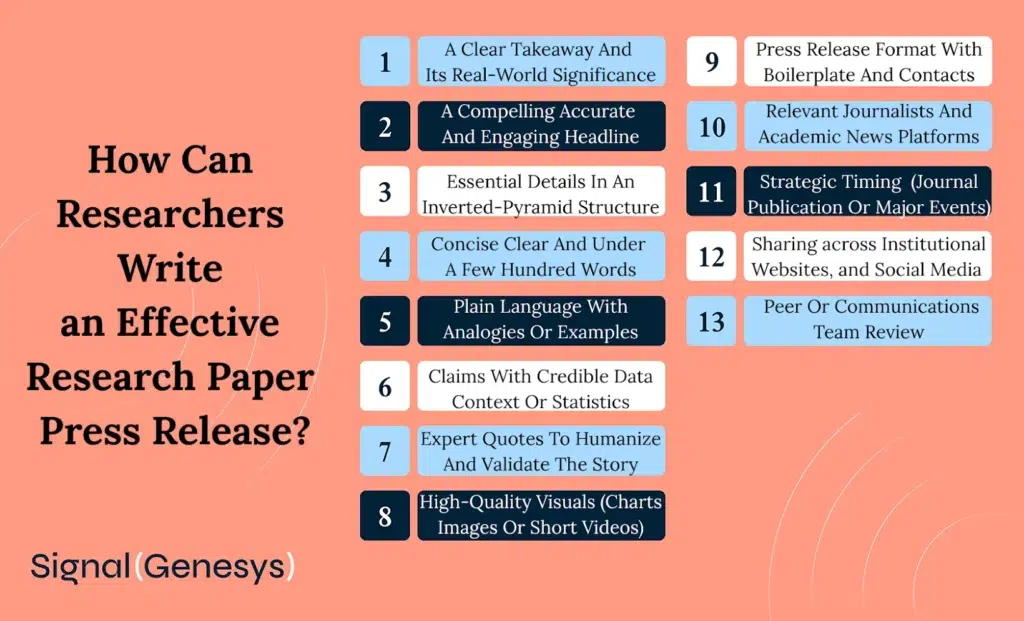
Researchers can write an effective research paper press release by following structured communication principles that transform technical discoveries into precise, newsworthy information. Each step enhances visibility, ensures interpretive clarity, and builds trust between researchers, journalists, and the public. The goal is to present research as scientifically rigorous and publicly relevant, combining factual depth with accessible storytelling.
Key steps outlining how researchers can write an effective research paper press release are detailed below.
1. Define A Clear Takeaway And Emphasize Its Real-World Significance
A compelling research paper press release communicates a singular, powerful takeaway that captures the most impactful scientific findings. The takeaway functions as the anchor of the narrative and defines how readers interpret the research. Establish a clear link between the research findings and measurable real-world outcomes, whether in healthcare, environmental policy, or technological innovation.
Framing significance in terms of societal or practical application transforms academic insight into actionable knowledge. For instance, highlighting how the research improves treatment precision or informs resource management increases its resonance beyond academia. A clear takeaway builds authority by demonstrating that the research influences systems, behavior, or industry standards. Ensure every supporting detail reinforces this central claim and establishes its enduring value.
2. Write A Compelling Accurate And Engaging Headline
The headline determines whether a journalist or reader engages with the release, which makes precision and clarity essential. Summarize key research findings in active, factual language without exaggeration or jargon. Effective phrasing highlights novelty, relevance, and scale, and reflects the research position within its field.
Adding a subheadline with expanded context, such as the application or institution, improves discoverability and reader comprehension. Headlines optimized for search visibility integrate key terms like “study,” “findings,” or “researchers discover,” which align with journalistic and academic indexing systems. An accurate headline sets the informational tone and reinforces credibility before the body introduces supporting evidence.
3. Lead With Essential Details In An Inverted-Pyramid Structure
The lead paragraph condenses the essential facts like who conducted it, what was found, where it was published, and why it matters. Structuring information in the inverted pyramid format ensures that the most critical points appear first for editors scanning quickly. This approach respects journalistic efficiency and allows immediate extraction of core details for media use.
Strong leads encapsulate the entire narrative in a few sentences, enabling understanding even without reading further. Directly referencing research outcomes or implications improves clarity and reader retention. Ensure every sentence in the lead introduces new value by building context, impact, or verification without redundancy. The goal is to create an entry point that conveys authority and relevance while maintaining accessibility for a broad audience.
4. Keep The Content Concise Clear And Under A Few Hundred Words
Effective research press releases maintain precision through brevity. Editors and journalists prioritize releases that convey maximum information in minimal space, typically between 300 and 500 words. Ensure each paragraph contributes new insight rather than rephrasing prior information. Short sentences and compact phrasing increase readability and strengthen message retention.
Dense language, technical terminology, or redundant background erodes engagement and delays comprehension. Strategic brevity aligns with digital media constraints, which ensures full visibility across email, web, and mobile formats. Concise structure signals editorial professionalism and increases the likelihood of full-text reproduction by academic and mainstream outlets.
5. Use Plain Language And Simplify Complex Concepts With Analogies Or Examples
Research communication demands precision without abstraction. Translating complex data into plain, accessible language broadens reach beyond specialists. Analogies and real-world parallels clarify abstract concepts, which enhances interpretive accuracy for non-specialist readers. Avoiding discipline-specific jargon prevents misinterpretation while improving accessibility for journalists.
Contextual examples anchor technical findings in everyday understanding, converting academic results into relatable insights. This linguistic clarity strengthens engagement and builds credibility of the researchers and their institution.
6. Support Claims With Credible Data Context Or Statistics
Quantitative evidence establishes trust and authority. Every claim in a research press release requires data or empirical grounding that validates its significance. Including key metrics, such as sample size, success rate, or effect magnitude, provides transparency and substantiates discovery claims. Comparative context, such as improvement over prior models or methods, highlights measurable advancement.
Mentioning the peer-reviewed journal or dataset source reinforces authenticity and traceability. Data-driven communication aligns with journalistic and academic integrity, which ensures accurate dissemination of results. Structured, factual data points guide readers toward understanding both the credibility and scope of the study.
7. Add Concise Expert Quotes To Humanize And Validate The Story
Expert commentary transforms technical information into a human narrative. Quotes from lead researchers articulate motivation, interpretation, and emotion behind the data, which create intellectual and personal connection. Incorporate quotes that add new insights, and clarify why the discovery matters or what challenges it resolves.
Additional quotes from collaborators or external experts expand perspective and enhance credibility through independent validation. Well-placed attribution ensures journalistic reliability and ethical transparency. Quotes act as interpretive bridges between empirical evidence and public understanding, and strengthen the authenticity of the narrative.
8. Include High-Quality Visuals Such As Charts Images Or Short Videos
Visuals translate complex findings into immediate comprehension. Graphs, data visualizations, and microscopy images contextualize quantitative information and reduce cognitive load. High-resolution media assets increase shareability across scientific and mainstream platforms. Short videos or animations illustrating key mechanisms or results transform technical work into engaging, educational content.
Ensure each visual aligns precisely with scientific data to maintain integrity and accuracy. Proper captions and attributions ensure compliance with publication standards and enhance clarity for editors. Visual storytelling increases retention and differentiates the release within saturated media feeds.
9. Follow Standard Press Release Format With Boilerplate And Contacts
A structured format establishes professionalism and consistency. Begin with a dateline and lead paragraph, followed by supporting body content, quotes, visuals, and institutional boilerplate. The boilerplate introduces the organizational mission, credibility, and research expertise, reinforcing authority. Provide complete media contact details, including names, titles, emails, and phone numbers, to facilitate direct follow-up.
Adhering to conventional structure ensures compatibility with newsroom workflows and academic aggregators. Standard formatting signals editorial readiness and reduces processing time for journalists. A well-formatted release projects institutional reliability and strengthens long-term media relationships.
10. Target Relevant Journalists Outlets And Academic News Platforms
Relevance determines outreach success. Distributing a research release to journalists specializing in science, medicine, or technology ensures alignment between content and audience. Curated media lists improve engagement by focusing on outlets that regularly cover academic discoveries. Specialized platforms like EurekAlert, ScienceDaily, or institutional newswires increase exposure within scholarly networks.
Personalizing outreach emails with concise, data-focused summaries improves open rates and response likelihood. Building long-term relationships with domain-specific reporters increases the probability of future coverage. Targeted distribution maximizes visibility and credibility across public and professional spheres.
11. Time The Release Strategically With Journal Publication Or Major Events
Timing determines visibility and competitive relevance. Coordinating the press release with the research publication date ensures immediate alignment with public interest and search trends. Releasing ahead of major conferences, awareness campaigns, or seasonal events amplifies contextual relevance. Aligning timing with embargo schedules safeguards integrity and prevents premature disclosure.
Strategic timing allows researchers to leverage simultaneous institutional and media coverage for maximum impact. Consistent synchronization between publication and outreach establishes a predictable pattern of credibility. Precision in release timing transforms communication into a strategic visibility mechanism.
12. Share Through Institutional Websites, Social Media And Email Pitches
Multi-channel distribution extends audience reach and reinforces credibility. Posting the release on institutional websites ensures archival permanence and discoverability through search engines. Sharing through verified social media channels increases visibility among journalists, researchers, and the public. Direct email pitches to targeted contacts promote high-value engagement and response.
Embedding multimedia or links to the published study enhances accessibility and interactivity. Institutional repositories and newsletter digests preserve the content for long-term academic referencing. Coordinated digital dissemination enables immediate awareness and sustained visibility over time.
13. Proofread Carefully And Seek Peer Or Communications Team Review
Accuracy defines professional credibility in research communication. Every numerical value, name, and citation requires verification before publication. A review process involving peers or institutional communications teams eliminates factual inconsistencies and stylistic errors. Objective editing enhances readability, logical flow, and structural balance.
Cross-checking all data and quotes ensures alignment with the original journal article. Professional proofreading reduces risk of misinterpretation or reputational harm. Rigorous review finalizes the release as a reliable, authoritative reflection of the research and the institution behind it.
What Mistakes Should Be Avoided in a Research Paper Press Release?
Mistakes that should be avoided in a research paper press release include failing to establish a newsworthy narrative, exaggerated headlines, and overloading academic jargon. A press release that merely announces the research publication without framing its broader significance lacks journalistic value. Editors seek discoveries that connect to societal impact, real-world application, or public interest. Headlines that overstate findings or use promotional language like “revolutionary” or “breakthrough” reduce credibility and discourage coverage.
Another critical mistake involves poor structure and buried information. Journalists expect an inverted pyramid format that delivers the main takeaway in the opening paragraph, followed by essential data and supporting context. Releases that hide key findings or overwhelm readers with background detail lose engagement quickly. Excessive technical content or dense paragraphs hinder accessibility and alienate non-specialist audiences. A concise structure, limited to 300–500 words, reinforces clarity and respects editorial workflow.
Lack of readability and presentation quality weakens the communication value of even the most important research. Using discipline-specific jargon without clear explanation restricts reach and comprehension. The goal is translation, which requires transforming specialized terminology into accessible ideas substantiated by examples or analogies. Poor formatting, missing subheadings, or long text blocks signal unprofessional preparation. Visual elements such as infographics, charts, and imagery strengthen comprehension and improve media pickup.
Omitting key logistical details like contact information, institutional boilerplates, or relevant links interrupts media engagement. A strong press release guides journalists toward direct follow-up, which enables interviews or data verification. Failing to proofread for accuracy or stylistic errors further undermines credibility, especially for scientific institutions where precision defines reputation. Timely distribution synchronized with journal publication, conferences, or trending discussions amplifies reach and positions the research within current discourse.
What Are Some Examples of Successful Research Paper Press Releases?
Examples of successful research paper press releases demonstrate how complex scientific findings can achieve public visibility without losing technical accuracy. Effective press releases showcase the balance between clarity, authority, and storytelling that transforms dense academic content into narratives that attract journalists, institutions, and policymakers. Examining these examples reveals how structure, timing, and audience targeting determine whether a discovery influences media coverage, academic conversation, or policy direction.
Some examples of successful research paper press releases are given below.
1. Harvard University

2. Johns Hopkins Medicine

3. Stanford University

4. University of California, Berkeley

5. University of Michigan

The most effective research paper press releases succeed because they merge scientific integrity with communication precision. Effective press releases identify the right media context, apply accessible language without simplifying meaning, and distribute content through channels trusted by journalists and researchers. Selecting formats that highlight societal relevance, measurable outcomes, and expert validation ensures each release strengthens academic credibility and public engagement.
What Templates Are Most Effective for Writing a Research Paper Press Release?
Templates that are most effective for writing a research paper press release templates transform complex academic findings into clear, newsworthy stories. Each template organizes information according to journalistic logic, which guides writers through headline creation, contextual framing, and structured presentation of data and quotes. The key to effectiveness lies in how well the template preserves scientific precision while ensuring readability for journalists and non-specialist audiences.
5 research paper press release templates are given below.
Template 1: Breakthrough Scientific Discovery
Headline: Researchers at [Institution] Reveal Landmark Discovery Advancing [Field of Study]
Subheadline: New findings published in [Journal Name] redefine understanding of [Key Topic] and open pathways for future innovation.
[City], [Date] — Researchers at [Institution] have announced a breakthrough that advances the scientific understanding of [specific area]. The study, recently published in [Journal Name], demonstrates [main discovery or mechanism] and provides new insights that reshape existing models of [scientific concept].
Lead author [Researcher Name] stated, “Our team identified a process that changes how we interpret [phenomenon], offering a foundation for developing more effective [applications or technologies].”
The research holds wide significance for [industry or scientific domain], addressing a longstanding gap in knowledge that has limited progress in [related area]. It introduces data-driven evidence that supports a new theoretical framework, offering actionable implications for [academic, clinical, or technological] applications.
The study involved [describe approach or methodology], analyzing [subjects, materials, or systems] through advanced [techniques, such as spectroscopy, machine learning, or statistical modeling]. Findings revealed that [summarize core results], confirming [specific hypothesis or prediction] and strengthening the empirical foundation for ongoing exploration in [broader field].
According to [Co-Author Name], “This research expands the frontier of [field] by quantifying relationships that were previously only theorized.”
Next steps include collaborative testing with [partner institution or research consortium] to validate the findings across diverse experimental settings. The authors credit funding support from [Funding Body or Agency] and acknowledge peer collaboration with [Partner Institution].
About [Institution]:
[Institution] is a leading center for advanced research in [discipline], dedicated to developing knowledge that drives innovation, informs global policy, and improves public understanding of science.
Media Contact:
[Name]
[Title]
[Email Address]
[Phone Number]
Template 2: Public Health or Clinical Research Study
Headline: [Institution] Researchers Identify Key Insights into [Health Issue] with Implications for [Public or Clinical Impact]
Subheadline: Findings published in [Journal Name] highlight measurable outcomes that strengthen public health responses and treatment frameworks.
[City], [Date] — A new study from [Institution] has identified evidence-based insights into [specific condition or behavior], marking an important advancement in clinical research on [related health issues]. The research offers a comprehensive analysis of [patient group or sample] and reveals measurable effects of [treatment, intervention, or behavior] on [specific outcome].
Lead researcher [Name] stated, “Our results clarify how [variable] influences [health metric], providing clinicians with actionable data to improve care strategies.”
This study carries strong real-world significance as [health issue] continues to affect [population size or demographic]. Researchers used [method or dataset] to examine [core variables], generating statistically verified results that inform both preventative and therapeutic decision-making.
Using a cross-sectional design and advanced data analytics, the team observed [specific finding or pattern] that correlates with improved [health or behavioral outcome]. The data offer strong support for implementing [policy change, clinical protocol, or intervention] within [specific setting].
Co-author [Name] commented, “The findings provide a clearer understanding of patient-level variability and inform next-generation approaches for public health intervention.”
Researchers plan to extend this work through longitudinal studies to evaluate the lasting impact of [treatment or behavior]. The project was supported by [Funding Body], with collaboration from [Partner Organization].
About [Institution]:
[Institution] conducts interdisciplinary health research focused on translating clinical data into practical outcomes for healthcare systems worldwide.
Media Contact:
[Name]
[Title]
[Email Address]
[Phone Number]
Template 3: Technological or AI Innovation Research
Headline: [Institution] Develops Advanced [Technology/AI Model] to Accelerate Breakthroughs in [Application Field]
Subheadline: Published in [Journal Name], the research introduces a scalable model that enhances accuracy and reduces computational limitations in [specific task].
[City], [Date] — Scientists at [Institution] have unveiled a next-generation [technology or AI system] designed to transform [application area]. The research, detailed in [Journal Name], presents a novel framework that improves performance benchmarks in [specific process] while maintaining transparency and reproducibility in data-driven science.
Lead investigator [Name] explained, “Our approach integrates interpretability into complex systems, providing more reliable predictions for high-impact applications in [industry or field].”
The research addresses a growing challenge in [technological domain], where traditional models lack the scalability required for real-time analysis. The team’s algorithmic structure introduces a hybrid method combining [technical element 1] and [technical element 2], enabling precision across diverse datasets.
Results demonstrated a [percentage]% improvement in accuracy compared to existing methods, reinforcing the system’s value for [industry, academic, or commercial use]. The findings provide a foundation for developing efficient, transparent, and ethically aligned AI models in scientific research.
Co-author [Name] added, “This study sets a precedent for integrating human oversight with automation to ensure responsible technological advancement.”
Future work includes adapting the framework for [related domain] and integrating open-access tools for global research collaboration. Funding was provided by [Agency/Consortium], with contributions from [Collaborating Partner].
About [Institution]:
[Institution] advances technological innovation through interdisciplinary research in AI, computing, and data science, driving impact across industries and academia.
Media Contact:
[Name]
[Title]
[Email Address]
[Phone Number]
Template 4: Environmental and Sustainability Research
Headline: [Institution] Study Reveals New Data on [Environmental Issue] Influencing Global Sustainability Efforts
Subheadline: Research published in [Journal Name] provides actionable insights into [specific ecosystem, climate process, or sustainability metric].
[City], [Date] — A new environmental study from [Institution] has uncovered significant relationships between [factor 1] and [factor 2], offering evidence that redefines understanding of [environmental challenge]. The findings contribute to ongoing discussions about [policy or conservation strategy] and establish a clearer framework for sustainable resource management.
Lead researcher [Name] said, “This research demonstrates how local interventions translate into measurable global outcomes for environmental stability.”
The team analyzed [dataset or geographic region] using advanced [method or instrument], identifying [statistical finding or correlation] that informs predictive models for [climate, ecosystem, or energy efficiency]. The results advance current sustainability science by quantifying impacts across diverse temporal and spatial scales.
Co-researcher [Name] added, “Our findings provide actionable metrics for governments, industries, and communities to adapt strategies based on reliable data.”
The research contributes to environmental resilience frameworks and supports new policy recommendations for [specific initiative]. Supported by [Funding Organization], the project aligns with international sustainability targets under [Program Name or UN Goal].
About [Institution]:
[Institution] is a global leader in environmental science, committed to advancing evidence-based research that informs sustainable development and policy reform.
Media Contact:
[Name]
[Title]
[Email Address]
[Phone Number]
Template 5: Collaborative or Multidisciplinary Academic Research
Headline: Global Research Collaboration Between [Institution 1] and [Institution 2] Produces Landmark Study on [Topic]
Subheadline: The peer-reviewed paper in [Journal Name] highlights cross-disciplinary insights combining [Field A] and [Field B].
[City], [Date] — A joint research effort between [Institution 1] and [Institution 2] has led to a landmark study integrating diverse methodologies from [discipline 1] and [discipline 2]. The collaborative project explores [key topic] and establishes a new framework for solving interdisciplinary challenges.
Lead author [Name] noted, “Our cross-field approach allowed us to generate insights that neither discipline could achieve independently.”
The study’s significance lies in bridging theoretical and applied sciences, offering a unified model that addresses [specific issue]. Researchers applied [approach or dataset] to evaluate [core hypothesis], generating results that advance both fields simultaneously.
Supporting researcher [Name] explained, “This collaboration represents the future of academic inquiry, where interdisciplinary methods drive innovation and broaden scientific reach.”
Future initiatives will expand this framework to include [additional institutions or regions], reinforcing a global network of expertise. Funding was provided by [Grant Name], with institutional support from [Organization].
About [Institution 1]:
[Institution 1] promotes innovation through research excellence, focusing on cross-disciplinary collaboration and societal impact.
About [Institution 2]:
[Institution 2] fosters global partnerships in research and education, advancing knowledge through cooperative scientific exploration.
Media Contact:
[Name]
[Title]
[Email Address]
[Phone Number]
Using these templates strategically means adapting structure without compromising clarity or integrity. The goal is to maintain narrative control while making the research accessible and verifiable. Institutions that treat templates as frameworks for precision communication, rather than fixed formats, achieve stronger media engagement and greater scientific visibility.
When Is the Best Time to Publish a Research Paper Press Release?
The best time to publish a research paper press release aligns with mid-week distribution, specifically Tuesday through Thursday, during the morning to early afternoon hours. Press releases distributed between 8:00 AM and 2:00 PM coincide with the period when journalists review pitches, plan coverage, and decide editorial priorities. This timing ensures visibility at the start of the media workday, which positions research stories within the same news cycle. Monday releases face competition from weekend backlog, while Friday afternoon submissions are overlooked as newsrooms prepare to close.
Weekends and holidays lack editorial capacity, resulting in minimal traction and reduced exposure. A well-timed release sent mid-week in the morning captures editorial attention and secures placement in the daily reporting schedule. Journal publication timing plays an equally critical role. Synchronizing the press release with the embargo lift of the journal maximizes relevance and credibility. Embargoed distribution provides journalists the lead time to conduct interviews, review data, and craft accurate stories before public release.
Once lifted, simultaneous coverage across outlets amplifies the visibility of the research. Coordinating press releases with the exact moment of publication reinforces authority and ensures accurate representation of findings. Research institutions that time releases with embargo schedules achieve deeper coverage and maintain narrative precision. Industry-specific cycles further influence release performance.
A health science discovery benefits from morning distribution aligned with medical news cycles, while technology findings perform better around global events or major conferences. Academic communications teams that monitor competing announcements and industry events avoid being overshadowed by higher-profile news. Scheduling distribution during a quieter news window, particularly outside peak global events or crisis coverage, enhances visibility and media pickup. Aligning timing with the attention rhythm of the target industry ensures maximum audience engagement and sustained reach.
Time zone coordination determines international impact. Global research announcements require tailored scheduling across multiple regions to reach journalists during their local working hours. A 9:00 AM release in London differs significantly in effect from the same release received pre-dawn in New York or late evening in Asia. Adjusting distribution schedules ensures equal visibility across time zones and maintains engagement from global outlets. Strategic institutions analyze data from email analytics and media engagement tools to refine timing precision.
Releases sent during optimal hours and adjusted for audience geography achieve higher open rates, improved coverage quality, and longer-lasting visibility across academic and mainstream media ecosystems.
Where Should a Research Paper Press Release Be Distributed?
A research paper press release should be distributed across channels that bridge academic visibility and public communication. Institutional newsrooms, academic press offices, and scientific journals amplify credibility within scholarly networks. Distribution through established science wire services, research-focused media outlets, and open-access platforms extends research reach beyond academia into mainstream awareness. Strategic placement on university websites, digital repositories, and research databases promotes long-term discoverability.
Key channels where a research paper press release should be distributed are detailed below.
1. Academic Newswires (EurekAlert!, AlphaGalileo, Newswise)
Academic newswires provide direct access to journalists and editors who specialize in covering scientific developments. EurekAlert!, AlphaGalileo, and Newswise serve as established hubs for verified research, trusted by global media outlets. Submissions through these platforms reach reporters seeking peer-reviewed content, which ensures precise alignment between research topics and media coverage.
Each platform manages embargoes effectively, giving journalists time to prepare informed features. Exposure through academic newswires results in syndication across platforms like ScienceDaily, Nature News, and Phys.org, amplifying academic visibility and public awareness.
2. Commercial Newswires (PR Newswire, Business Wire, GlobeNewswire)
Commercial distribution networks extend research visibility into mainstream, business, and technology-focused media. PR Newswire, Business Wire, and GlobeNewswire deliver large-scale reach across global editorial desks, data terminals, and industry-specific publications. Their systems enable multimedia integration, ensuring research announcements appear with visuals, expert commentary, and relevant metadata that enhance SEO authority.
These services create measurable search impact through keyword optimization and link placement. Distributing research with commercial newswires generates broader engagement beyond the academic sphere, positioning findings within conversations that influence innovation, investment, and policy.
3. Institutional Channels (University Newsroom, Lab Site)
Institutional websites and lab newsrooms serve as the primary record of authority for scientific announcements. Publishing the press release within these platforms builds transparency, reinforces institutional credibility, and ensures long-term accessibility for journalists and researchers.
Institutional channels rank highly in search results, driving organic visibility and reinforcing brand authority within the academic ecosystem. Embedding supporting data, multimedia, and downloadable summaries increases depth and encourages media outlets to cite the source directly. This central hub becomes the definitive reference point for subsequent coverage, citations, and institutional archives.
4. Academic Networks (ResearchGate, Academia.edu, LinkedIn)
Academic networks extend communication directly to researchers, collaborators, and domain experts. Platforms such as ResearchGate and Academia.edu allow controlled dissemination of findings to highly targeted academic audiences. Posting updates or summaries on these networks establishes researcher visibility within their discipline and encourages post-publication engagement.
LinkedIn expands that reach to professionals in adjacent industries, enabling the research to connect with organizations, think tanks, and policymakers. Frequent activity within these networks promotes recognition and positions the research as a credible contribution within a broader professional community.
5. Social Media (Twitter/X, LinkedIn, Facebook)
Social media delivers immediate reach and public engagement through interactive and shareable formats. Twitter and LinkedIn remain central to science communication, where researchers, journalists, and institutions engage in real-time dialogue. Sharing concise findings, striking visuals, or key statistics invites discussion and reposting within professional circles.
Facebook enables engagement among public audiences, educators, and science enthusiasts. Strategic timing and consistent branding across platforms sustain visibility beyond initial publication, which ensures the research remains discoverable in digital conversations.
6. Free Distribution (Signalgensys, EIN Presswire, PR.com)
Free distribution services provide an accessible entry point for expanding visibility without cost barriers. Signalgensys, EIN Presswire, and PR.com push press releases into online databases, secondary aggregators, and specialized blogs that feed larger media ecosystems. These channels improve search presence and increase citation potential, especially for smaller teams or early-stage studies.
Structuring headlines and summaries with precise keywords ensures proper indexing in Google News and academic aggregators. Strategic use of free networks promotes long-tail visibility and complements paid or institutional releases.
Selecting the best distribution channels for a research paper press release requires aligning the distribution strategy with research relevance, target audience, and communication goals. Academic research gains the strongest traction through institutional networks, while interdisciplinary studies benefit from hybrid exposure across scientific and general-interest platforms. Evaluating the audience reach, domain authority, and media relationships allows researchers to identify high-impact outlets.
How Can Researchers Ensure Successful Distribution of a Research Paper Press Release?
Researchers can ensure successful distribution of a research paper press release through a strategy that combines precise messaging, targeted outreach, and authoritative timing. Firstly, researchers identify the single most impactful finding and position it as a concrete outcome rather than a technical observation. Headlines emphasize measurable results, relevance to ongoing issues, and the advancement the study represents in its field. Clear, jargon-free writing ensures accessibility without compromising scientific integrity. Visual elements such as charts, diagrams, and photos of experimental settings elevate comprehension and strengthen journalistic engagement.
Secondly, researchers seek strategic collaborations with institutional communication teams that maintain relationships with science journalists and understand how to frame discoveries for media consumption. An embargo provides a synchronized media moment that heightens attention and credibility. Leading outlets value exclusivity and preparation time, and embargoes create the structured timing that drives deeper, more accurate reporting. A personalized press list outperforms broad syndication, as targeted outreach connects research directly with journalists who specialize in relevant disciplines or applications.
Thirdly, researchers prioritize a multi-channel distribution plan that drives visibility and reach. Specialized academic newswires such as EurekAlert! and AlphaGalileo distribute research efficiently to global science reporters. Commercial networks like Business Wire and PR Newswire extend access to mainstream and business media. Institutional websites and repositories serve as permanent reference points that maintain press release visibility long after initial publication. Social media platforms amplify the announcement through concise summaries, tagged collaborators, and embedded visuals that invite reshares from peers and organizations.
Ongoing engagement solidifies long-term visibility. Researchers track pickup data, citations, backlinks, and referral traffic to assess which outlets generate the highest authority signals. Continuous analysis informs future outreach cycles and refines audience targeting. Journalists value experts who remain responsive and credible after publication, and timely follow-ups sustain these professional relationships.
What Tools Can Help Researchers Write and Share a Research Paper Press Release?
Tools that can help researchers write and share a research paper press release include digital platforms and distribution networks that enhance visibility, amplify credibility, and ensure scientific alignment. These tools bridge the gap between research discovery and public dissemination through optimized targeting, multimedia integration, and data-driven reporting.
5 tools that can help researchers write and share a research paper press release are reviewed below.
1. Signal Genesys
Signal Genesys strengthens research visibility through AI-powered distribution and SEO-driven publishing. The white label functionality allows institutions to maintain branding control while distributing press releases across authoritative domains like AP News, and Yahoo. Real-time analytics measure signal amplification, traffic, and referral engagement, which allows researchers to evaluate communication impact with accuracy.
Multimedia integration enables the inclusion of charts, visuals, and video abstracts that translate technical findings into accessible stories. The pricing flexibility and transparent structure make Signal Genesys particularly effective for academic teams with limited budgets seeking measurable digital reach.
2. PR Newswire
PR Newswire provides one of the largest professional distribution networks for science and research communication. With over 4,000 connected outlets and targeted lists across 100 industries, PR Newswire enables press releases to reach relevant journalists and subject-specific publications. The platform offers editorial oversight to refine clarity and structure while maintaining accuracy of technical data.
Detailed analytics reveal engagement metrics, and multilingual targeting ensures research visibility across diverse geographies. The integration with Cision enhances access to journalist databases and monitoring dashboards, which allows institutions to coordinate outreach and evaluate results with precision.
3. Business Wire
Business Wire delivers strategic distribution for high-impact research announcements. The global network connects to over 100,000 media outlets and financial terminals, which makes it ideal for academic research with economic, technological, or policy implications. The platform delivers unlimited hyperlinks, which enhances citation accessibility and SEO authority.
Business Wire provides granular targeting within 200 industry categories to ensure relevance across specialized domains, while the intuitive interface simplifies campaign management. Multimedia publishing and analytics further cement academic transparency by combining visual storytelling with performance measurement.
4. Muck Rack
Muck Rack offers researchers a direct path to journalists covering their specific discipline. The platform integrates media outreach, press release drafting, and performance tracking within a single dashboard. The journalist database includes detailed profiles, recent publications, and active social presence, which enables personalized engagement based on topical relevance.
Press releases distributed through Muck Rack achieve high discoverability in search results and generative AI tools, reinforcing visibility among academic and media audiences. Built-in analytics provide actionable feedback for improving future research communications.
5. LexisNexis
LexisNexis combines traditional newswire capabilities with data intelligence and targeted amplification through Nexis Newswire. The platform merges press release distribution with paid media promotion using Google Ads, guaranteeing broad digital visibility. Researchers access demographic targeting by country, region, and discipline to ensure the right audience engagement.
Integrated translation options in nine languages expand global accessibility, while post-distribution analytics offer a complete view of impressions, clicks, and placements. LexisNexis enables researchers to transform complex studies into discoverable, impactful narratives supported by measurable outcomes.
Selecting the right distribution tool for a research paper press release requires strategic alignment between communication goals, target audience, and media relevance. Precision targeting, transparent analytics, and regulatory compliance determine the difference between visibility and authority in scientific communication.
Can Multiple Research Findings Be Combined in a Single Press Release?
Yes, multiple research findings can be combined in a single press release when they share a unified research objective, address interconnected variables, or originate from a mixed-methods study. The effectiveness of this approach depends on a cohesive central narrative that links all results under one thematic direction. Ensure each finding links to a broader conclusion rather than compete for attention. The goal is to communicate synthesis, not compilation.
A compelling introduction establishes the unifying discovery, followed by an explanation of how distinct datasets or methodologies collectively reinforce the conclusion. This structure transforms diverse findings into a coherent account that reflects methodological rigor and intellectual depth rather than fragmented reporting. Integration of multiple findings relies on narrative architecture. A well-composed press release explains how quantitative data defines measurable patterns while qualitative evidence provides contextual understanding.
Mixed-methods research benefits from triangulation and complementarity, where one approach validates and enriches another. Sequential integration, where one phase of research informs the next, further strengthens the interpretive framework. Highlighting the combined insight rather than discrete results amplifies the overall scientific significance and reinforces the credibility of the research design.