vFairs is an enterprise-focused event management platform designed for virtual, hybrid, and in-person experiences at a global scale. vFairs combines environment design, attendee interaction, and operational oversight into a single system that supports conferences, career fairs, trade shows, and multi-day programs. The platform targets organizations that prioritize brand control, engagement depth, and execution reliability across complex event portfolios. This vFairs review examines how the platform performs in 2026 across features, pricing structure, and strategic tradeoffs.
vFairs delivers immersive 3D virtual venues that mirror physical layouts and guide attendee movement through booths, auditoriums, and networking areas. vFairs integrates structured networking through scheduled one-to-one video meetings, topic-based chat rooms, and engagement mechanics tied to participation goals. The platform extends event access through a fully branded mobile application that supports QR-based check-in, live agenda updates, push notifications, and on-site coordination.
vFairs pricing follows a bespoke quote model that reflects event size, geographic reach, feature scope, and customization depth. This pricing structure positions vFairs as a premium solution for organizations that require dedicated project management, enterprise-grade security, and continuous operational support. The cost aligns with platforms that replace fragmented event tools through a unified system that manages registration, engagement, analytics, and mobile access.
The primary strength of vFairs lies in its proactive support model that assigns dedicated project managers and maintains 24 7 technical assistance during live events. This support structure reduces execution risk for large-scale programs that involve exhibitors, sponsors, and distributed audiences. The primary limitation involves a complex administrative interface that demands structured onboarding and ongoing coordination during setup.
What is vFairs?
vFairs is an all-in-one event management platform designed to run in-person, virtual, and hybrid events from a single system. vFairs consolidates event planning, execution, and measurement into a unified operational framework that supports complex event programs. The platform enables centralized control over attendee journeys, exhibitor participation, and sponsor visibility. This structure reduces fragmentation across tools and vendors. Organizations adopt vFairs to standardize event delivery across regions and formats.
What types of events does vFairs support? vFairs supports conferences, trade shows, career fairs, and large-scale enterprise events across global audiences. The platform accommodates single-day activations and multi-day programs with thousands of attendees. Event teams configure workflows for exhibitors, recruiters, speakers, and sponsors within defined access controls. This flexibility supports corporate, academic, and nonprofit use cases. Global delivery capabilities enable multilingual experiences and regional customization.
How does vFairs manage the full event lifecycle? vFairs manages the entire event lifecycle from registration creation to post-event analysis. The platform includes custom event websites that align with brand guidelines and campaign objectives. Registration, ticketing, and email communication operate within the same system to maintain data continuity. Exhibitor onboarding and sponsor asset management follow structured workflows. Real-time dashboards track attendance, engagement, and lead activity.
What virtual experience capabilities define vFairs? vFairs delivers immersive 3D virtual environments that replicate physical venues through interactive layouts. These environments guide attendee navigation through lobbies, exhibit halls, auditoriums, and networking zones. Visual design reinforces brand identity through custom theming and spatial configuration. Interactive booths enable document sharing, video playback, and live conversations. Attendees explore content through intuitive movement rather than static menus. This approach increases session discovery and exhibitor visibility.
What level of service and support does vFairs provide? vFairs operates under a done-for-you service model with dedicated project management. Each event receives a named project manager who oversees configuration and execution. This role coordinates timelines, feature setup, and stakeholder alignment. Live event days include continuous technical coverage for attendees and exhibitors. Training and onboarding sessions prepare teams for platform usage.
What is the History of vFairs?
The history of vFairs is traced back to 2016 as a bootstrapped event technology company focused on virtual event delivery through 3D environments. Founder and CEO Muhammad Younas launched vFairs alongside CTO Arfeen Godil to address limitations in online trade shows and career fairs. The initial product emphasized immersive digital venues and structured attendee interaction. Early development relied on customer-led iteration rather than external funding. The company adopted a remote-first operating model with technical and support teams primarily based in Pakistan.
How did vFairs grow during its early years from 2016 to 2019? vFairs achieved steady organic growth between 2016 and 2019 while expanding beyond a single-purpose virtual event product. Revenue increased from $110,000 in 2016 to $1.7 million by 2019 without venture capital. The platform expanded into registration management, exhibitor workflows, and event marketing tools. Unified system design reduced dependency on third-party software. Early profitability reinforced the bootstrapped strategy and established financial discipline and product stability.
What impact did the COVID-19 pandemic have on the vFairs growth trajectory? The global shift to digital events in 2020 accelerated vFairs growth at enterprise scale. Revenue increased 20x in 2020, recorded at $17.2 million as organizations replaced physical events with virtual formats. Client adoption expanded to Fortune 500 companies and global institutions. Workforce size grew beyond 250 employees to support demand. Revenue reached $25 million in 2021 and approximately $30 million in 2022.
How did vFairs evolve after the return of in-person events? vFairs product development expanded into onsite technologies such as QR-based check-in, badge printing, and lead capture applications. Unified data architecture connected physical and digital engagement. Industry recognition followed through Gartner Customer Choice awards in 2023, 2024, and 2025. Gartner named vFairs a Leader in the 2025 Magic Quadrant for Event Technology Platforms. The platform powered over 50,000 events for more than 100 million attendees.
What long-term strategy defines vFairs position in event technology? vFairs maintains a bootstrapped, customer-driven growth strategy focused on execution quality and service depth. The company prioritizes dedicated project management and enterprise support as core differentiators. Annual initiatives such as the DiscoverNext user conference guide product direction through direct customer feedback. Investment continues toward AI-powered event management capabilities.
Who is vFairs For?
vFairs is for organizations that require a unified platform to run virtual, hybrid, and in-person events with structured engagement and measurable outcomes. vFairs serves teams that manage complex event programs with multiple stakeholders, exhibitors, and audiences. The platform fits organizations that prioritize global reach, brand control, and operational consistency. The system supports events that depend on real-time interaction and data visibility, which aligns vFairs with enterprise and mid-market use cases.
Which corporate teams use vFairs? Corporate marketing and events teams use vFairs to execute conferences, trade shows, and executive programs with precision. These teams manage speaker schedules, exhibitor participation, and attendee journeys through a single interface. Built-in lead capture supports sales alignment and post-event attribution, while the reporting dashboards surface engagement trends and sponsor performance. This structure supports revenue-focused event planning, and corporate teams favor vFairs for repeatable execution.
Why do HR and talent acquisition teams choose vFairs? HR and talent acquisition teams select vFairs to run recruitment events with structured candidate interaction. Recruiters deploy branded employer booths and schedule interviews to control hiring workflows. Real-time activity tracking exposes candidate interest and recruiter responsiveness. Virtual delivery expands reach across regions and time zones. Centralized reporting supports pipeline analysis. This setup supports enterprise hiring operations.
How do educational institutions and associations use vFairs? Educational institutions and professional associations rely on vFairs to deliver career fairs and member events at scale. Universities connect students with employers through curated booths and live communication. Associations organize conferences, certifications, and networking programs with defined agendas. The platform supports large attendance without operational strain, and engagement metrics guide future programming decisions.
What are the vFairs Features?
vFairs features provide a unified event technology stack for virtual, hybrid, and in-person events, combining immersive environments, attendee engagement, registration, and analytics into one platform. vFairs structures event delivery around a consistent data model, so registration, content, exhibitor management, and reporting share the same underlying dataset. The platform supports large-scale conferences, trade shows, career fairs, and internal corporate events.
Key features of vFairs are detailed below.
1. Event Website Builder
The vFairs event website builder creates a branded, structured event website that hosts all event information, registration, and access links. Planners use templates and layout controls to publish agendas, speaker profiles, exhibitor directories, and sponsor placements. The website connects directly to registration and ticketing modules, so attendee data flows into the platform without manual exports.
Event content updates reflect instantly across the site, agenda, and attendee communications. The builder supports custom domains and brand assets, which maintain consistency across campaigns. Teams use the site as the single source of truth for event information and access.
2. Custom Event Landing Pages
The custom event landing pages deliver targeted entry points for campaigns, regional markets, and audience segments. Planners design pages for ticket tiers, partner promotions, or specific event tracks. Each landing page connects with registration and payment processing, so conversion data tracks back to the campaign.
The pages support content blocks for speakers, sponsors, and session highlights, which improves clarity and relevance. Campaign teams use landing pages to control messaging for different attendee groups. Landing pages enable tracking and attribution through URL parameters and performance metrics.
3. Registration Forms & Ticketing Tiers
vFairs registration forms and ticketing tiers manage attendee capture, access rules, and payment workflows. Planners configure custom fields, validation rules, and attendee categories to collect structured data. Ticket tiers define pricing, session access, and networking permissions, which enforce event rules at the registration stage.
The system supports payment processing through 30-plus gateways, which facilitates global events and multiple currencies. Registration data feeds into attendee profiles to enable segmentation and targeted communications. Teams use registration insights to forecast attendance and allocate resources.
4. Email Marketing and Automation
The vFairs email marketing and automation manages event communications across the attendee lifecycle, from pre-event reminders to post-event follow-ups. Planners build email campaigns with templates, scheduled sends, and audience targeting. Automation triggers connect registration status and attendee behavior to specific messaging workflows.
Email performance metrics track opens, clicks, and conversions, which enables iterative optimization. The system integrates attendee lists with event modules, so communication remains aligned with session schedules and access permissions. This feature reduces manual coordination and centralizes messaging within the event platform.
5. Enterprise Management Dashboard
The enterprise management dashboard centralizes control across multiple events, teams, and brand assets. Planners create and clone events from a single control layer, which standardizes event structure and speeds deployment. Role-based access assigns permissions for planners, exhibitors, and speakers, which protects sensitive data and prevents operational errors.
Shared asset libraries store brand elements and reusable content to enforce consistency across event portfolios. Performance dashboards compare metrics across events, which enable program-level optimization. Teams use this feature to scale event operations without adding tools or workflows.
6. AI Content Generator
The vFairs AI Content Generator produces structured marketing copy for landing pages, emails, social posts, and event notifications. Users enter prompts and select content types, and the tool generates ready-to-edit drafts. The generator outputs speaker bios, agenda copy, and promotional messaging aligned to the event format.
Teams use the output to reduce time spent writing repetitive marketing assets. The tool supports in-event content like moderator questions, polls, and notifications, which maintains engagement without manual content creation. Planners use the generator to maintain a consistent tone and speed up campaign production.
7. User Segmentation and Role-Based Access
User segmentation and role-based access organize attendee groups and control access to event areas. Segmentation groups users based on ticket type, interests, and behavior, which supports personalized agendas and communications. Role-based access defines permissions for planners, exhibitors, speakers, and attendees, which prevents unauthorized actions.
Segmentation drives targeted messaging and content visibility, which increases relevance and reduces information overload. Access rules apply across sessions, booths, and networking tools, which maintains event structure. Teams use segmentation to deliver different experiences without creating separate events.
8. Abstract Management and Call for Papers
vFairs abstract management features collect submissions, manage reviews, and convert approved abstracts into sessions. Planners configure submission forms, review criteria, and workflow stages to match event requirements. Reviewers evaluate abstracts, score entries, and track decisions in one interface to maintain accountability.
Approved abstracts feed into agenda building and speaker profiles to reduce manual re-entry. The system supports multiple abstract types, tracks, and categories, which facilitates large academic and industry events. Teams use the workflow to maintain consistency and transparency throughout the submission process.
9. Virtual Lobbies and Exhibit Halls
Virtual lobbies and exhibit halls recreate physical event flow within a digital environment. Lobbies serve as navigation hubs that connect attendees to sessions, booths, and networking spaces. Exhibit halls host branded booths with multimedia content, live chat, and video meeting access.
Exhibitors manage content through dedicated portals, which keep booth assets organized and consistent. Lead capture tools track booth visits, downloads, and conversations to enable sponsor ROI measurement. Attendees initiate interactions directly from booths, which replicates in-person engagement patterns.
10. 3D Virtual Environments
vFairs 3D virtual environments deliver immersive auditoriums, exhibit halls, and networking lounges for online events. Attendees navigate spatial environments with visual context and interactive elements. Session access links connect directly from virtual rooms to reduce navigation friction.
The environment supports multimedia presentations, live streaming, and networking features like chat and video. Engagement metrics track movement, interactions, and session attendance, which supports performance analysis. Teams use 3D environments to provide a higher level of immersion than standard video platforms.
11. Mobile Event App
The vFairs mobile event app extends the event experience to attendees’ smartphones for hybrid and on-site events. The app delivers a full agenda with personalized schedules and session details, and it syncs selections across devices. Attendees use the app to network through chat, 1:1 messaging, and video calls to maintain engagement outside the main event platform.
The app includes interactive floor maps and venue navigation tools, which reduce onsite friction and improve session attendance. Push notifications deliver real-time updates and announcements to keep attendees informed of schedule changes and special sessions. Event teams use the app builder to white-label the app with custom branding and menu tiles.
12. Gamification and Animated Avatars
Gamification features like animated avatars drive engagement through reward systems and immersive representation. vFairs assigns points for attendee actions such as visiting booths, attending sessions, and downloading resources. Leaderboards display activity rankings to encourage competitive participation and repeat engagement.
Scavenger hunts direct attendees across virtual spaces or onsite locations using QR codes to increase exploration and booth traffic. Trivia games provide structured interaction and break the monotony of long sessions. Animated avatars represent attendees inside 3D environments to enable identification, personalization, and informal networking.
13. Live Help Desk
The live help desk delivers real-time support to attendees, exhibitors, and organizers during live events. Support teams use live chat and email workflows to resolve access issues, session problems, and exhibitor queries. The help desk integrates with event data to allow the support staff access to attendee profiles and session registrations without switching tools.
An AI chatbot answers common questions and routes complex issues to human agents, which maintains response speed under high traffic. Support agents track requests through a ticket system to prevent duplicate responses and ensure issue resolution. The help desk supports 24/7 coverage for global events and cross-timezone audiences.
14. AI-Powered Matchmaking
The vFairs AI-powered matchmaking connects attendees, exhibitors, and speakers based on profile data and behavior. The system analyzes attendee interests, ticket type, and engagement patterns to recommend relevant connections. Matchmaking generates suggested meeting lists and enables booking of 1:1 or group video calls.
This feature aligns networking with event goals to improve relevance and reduce random interactions. Organizers use matchmaking to increase booth meetings and session attendance by connecting users to targeted content. Matchmaking results appear inside attendee dashboards to enable self-service scheduling and follow-up planning.
15. Spatial Networking
Spatial networking tools recreate real-life networking environments using virtual lounges and roundtables. Attendees enter shared spaces where proximity triggers audio and video conversations mimicking in-person interaction dynamics. Roundtables support topic-based discussions, which encourage structured networking and group collaboration.
Spatial networking integrates with attendee profiles and allows users to discover like-minded peers based on interests and roles. Organizers use spatial networking to increase dwell time in networking zones and reduce the barrier to conversation. Spatial networking works across virtual and hybrid events and delivers consistent engagement across formats.
16. Webinars & Webcasting
The vFairs webinars and webcasting tools deliver live and on-demand session streaming inside the platform. Event teams host sessions using built-in streaming tools and integrate with external providers like Zoom. Webcasting supports real-time Q&A, polls, and chat to drive interaction during sessions.
The platform stores session recordings in a content library to enable on-demand access after the event. Organizers track attendance and engagement metrics per session, which supports content performance analysis and follow-up outreach. Webinars integrate with agendas and notifications to improve attendance and reduce no-shows.
17. Sponsor and Exhibitor Management
Sponsor and exhibitor management tools provide self-serve portals for booth setup and asset uploads. Exhibitors create booth profiles, upload logos, banners, and promotional materials, and configure lead capture forms. Event teams assign booth spaces, manage sponsor tiers, and enforce access rules from a centralized dashboard.
vFairs tracks booth traffic, chat interactions, and content downloads to provide measurable sponsor ROI. Exhibitors use lead capture tools to collect contacts and assign leads to sales teams. Organizers use sponsor management to standardize booth quality and reduce onboarding time.
18. AI-Powered Facial Recognition Check-In
vFairs AI-powered facial recognition check-in accelerates onsite entry through touchless verification. Attendees register and verify identity at kiosks, which reduces queue times and improves throughput. The system supports QR code scanning as a backup and maintains flexibility for on-site access.
Check-in data feeds into attendee profiles and session access logs, which enable audit trails and compliance requirements. Organizers use facial recognition to prevent duplicate check-ins and reduce manual verification errors. The feature integrates with badge printing workflows to streamline on-site operations.
19. Lead Capture App and Badge Printing
The lead capture app and personalized badges connect onsite interactions to sales workflows and CRM systems. Exhibitors scan badges using QR codes or manual entry to capture contact data and interaction context. The app supports notes, tags, and scoring, which prioritize high-value leads and improve follow-up planning.
Lead capture works offline to prevent data loss in low-connectivity venues. Badge printing generates custom badges on-demand with QR codes, sponsor logos, and ticket details to maintain brand consistency and access control. Organizers use bulk printing and group check-in to speed up entry for large attendee groups.
20. Real-Time Analytics Dashboards and AI Reporting Chatbot
The real-time analytics dashboards provide instant visibility into event performance across sessions, booths, and engagement. Dashboards display metrics such as attendance, booth visits, chat volume, and content downloads to enable rapid decision-making during live events. vFairs aggregates data across virtual, hybrid, and in-person components to enable unified reporting.
An AI reporting chatbot answers specific questions using the event dataset, which eliminates manual analysis and accelerates insight delivery. Organizers use chatbot queries to compare event performance across days and sessions to facilitate operational adjustments and post-event reporting.
How Does vFairs Work?
vFairs works as a browser-based event platform that centralizes planning, execution, and measurement across virtual, hybrid, and in-person formats. vFairs combines customizable digital venues, onsite event technology, and a unified management layer that controls every workflow. Organizers coordinate timelines with a dedicated project manager to establish structure, accountability, and execution clarity. The platform replaces fragmented tools with one operational environment that governs design, engagement, and reporting.
How does vFairs handle event setup and customization? vFairs structures event setup through fully branded landing pages, registration forms, and configurable virtual venues. Organizers design 3D lobbies, exhibit halls, and networking lounges that mirror real-world navigation patterns. Each environment aligns visual branding with functional flow to improve attendee orientation and session discovery. vFairs centralizes configuration controls inside one dashboard to accelerate iteration and approval cycles.
How does vFairs manage registration and ticketing workflows? vFairs controls registration and ticketing through a drag-and-drop form builder integrated with payment processing and badge logic. Organizers define audience segments, pricing tiers, and access permissions inside a single registration layer. The system generates customized badges and automates email campaigns tied to registration behavior. Registration data flows directly into analytics and exhibitor tools without duplication.
How does vFairs drive attendee engagement during virtual and hybrid events? vFairs activates engagement through real-time chat, webinars, virtual booths, and AI-powered matchmaking. Participants connect through one-to-one, audio, or video interactions based on shared interests and intent signals. Virtual auditoriums support live, on-demand, and semi-live sessions with polling, Q and A, and translation features. Gamified elements increase session exploration and dwell time across the venue. Engagement tools operate inside the same environment to preserve context and continuity.
How does vFairs manage event day operations and performance reporting? vFairs executes event day operations through live session delivery, attendee tracking, and AI-powered reporting. Organizers monitor traffic, engagement depth, and lead activity in real time through an analytics dashboard. An AI reporting chatbot surfaces insights related to ROI, session performance, and audience behavior. Post-event reports export structured data for sales and marketing systems. This measurement layer converts event activity into decision-ready intelligence.
What Pricing Plans Does vFairs Offer?
The pricing plans that vFairs offers follow a custom quote-based structure tailored to event scope, format, and operational complexity. vFairs prices events according to attendee volume, selected features, and service depth rather than fixed public tiers. This model aligns spend with actual usage across virtual, hybrid, and in-person deployments. Unlimited registrations form part of core packages, which shifts cost control away from per-attendee fees. Organizations receive pricing that reflects event scale rather than arbitrary thresholds.
Which factors influence the final vFairs quote? vFairs determines pricing through event format, attendee volume, feature selection, and service intensity. Virtual, hybrid, and in-person formats carry different infrastructure and staffing requirements. Advanced capabilities such as AI matchmaking, gamification layers, mobile apps, and onsite hardware increase overall investment. Managed services add cost in exchange for direct execution support, booth configuration, and speaker readiness.
What services are included in most vFairs plans? vFairs packages typically include dedicated project management, platform training, and continuous technical support. Organizers receive custom-branded environments that span 2D or 3D venues, registration flows, and engagement modules. Networking tools support text, audio, and video interactions across attendee segments. Real-time analytics dashboards track engagement depth, lead activity, and conversion performance.
Does vFairs offer a free plan or free trial? vFairs does not provide a free plan or standard free trial. Prospective users access the platform through a personalized demo that reflects industry context and event objectives. This demo delivers a realistic view of workflows, feature depth, and operational demands. Pricing discussions follow the demo based on defined requirements. This approach prioritizes qualified adoption over self-service entry.
Is vFairs Tool Worth it? vFairs justifies its pricing through unlimited registrations, managed execution, and enterprise-grade depth across event formats. The platform suits organizations that value scale, control, and measurable outcomes over low-entry cost tools. Teams running high-impact conferences, trade shows, or job fairs gain operational leverage through consolidated infrastructure. vFairs delivers cost efficiency for complex event programs through scope alignment rather than surface-level affordability.
What is the vFairs Rating?
vFairs Rating reflects aggregated user sentiment across major B2B software review platforms, based on verified reviews and platform-level performance signals. The rating profile shows consistent approval for delivery quality, customer service structure, and end-to-end event execution, while isolating limitations tied to reporting flexibility and backend clarity.
vFairs ratings across major software review platforms are given below.
- Capterra. 4.8 / 5 (621 reviews)
- G2. 4.7 / 5 (1,758 reviews)
- Gartner Peer Insights. 4.8 / 5 (329 reviews)
- Trustpilot. 2.9 / 5 (2 reviews)
The rating distribution indicates strong alignment with enterprise and mid-market event teams that value operational reliability and managed execution. High scores across Capterra, G2, and Gartner confirm consistent performance across implementation, usability, and functional coverage. The Trustpilot score carries limited analytical relevance due to low review volume and consumer skew.
What are the Pros of vFairs?
The pros of vFairs focus on streamlined event planning, interactive attendee experiences, and data measurement. vFairs centralizes event workflows and keeps organizers aligned under one platform. This structure reduces tool fragmentation and lowers coordination overhead. The strengths of vFairs show up most clearly in cost, engagement, and analytics.
The key benefits of vFairs are outlined below.
- Unified event management dashboard. vFairs combines registration, ticketing, event websites, virtual environments, and post-event analytics in one dashboard. Organizers maintain consistent control across every event component without switching platforms. This setup accelerates planning cycles and reduces coordination errors across teams. Centralized data collection improves reporting accuracy for sponsors and stakeholders.
- Cost efficiency and scalability. vFairs reduces physical event expenses such as venue rentals, travel, and staffing, which lowers total event costs by up to 75%. Organizers scale attendee capacity without increasing venue or staffing overhead. This structure supports small webinars and large multi-day conferences. The cost model makes recurring events more financially sustainable.
- Immersive virtual experiences. vFairs delivers 3D exhibit halls, interactive booths, and virtual auditoriums that replicate physical event environments. Attendees navigate spaces using intuitive layouts and branded visuals, which increases engagement and session attendance. Immersive experiences strengthen event identity and support sponsor visibility through prominent placement and interactive displays.
- Robust networking and interaction. vFairs supports live chat, video meetings, group discussions, and AI-driven matchmaking, which improves connection quality. Attendees connect with relevant peers and exhibitors through personalized recommendations and scheduling tools. Exhibitors capture leads through digital business card exchange and booth interactions. Networking features increase event ROI for exhibitors and sponsors.
- Strong analytics and reporting. vFairs offers detailed reports on attendee behavior, booth traffic, session participation, and lead generation. Organizers track engagement trends and identify high-performing sessions and exhibitors. Real-time dashboards allow rapid adjustments during live events. Analytics support clear ROI measurement and provide actionable insights for future event strategy.
- Hybrid event support and onsite tools. vFairs includes onsite check-in, badge printing, and a mobile app for agenda management, which improves the live attendee experience. The mobile app keeps attendees updated on sessions and exhibitor activities. On-site technology reduces wait times and improves event flow. Hybrid features maintain consistency between virtual and in-person experiences.
- Dedicated support and training. vFairs assigns a dedicated project manager for each event who guides planning, setup, and execution. Organizers receive responsive technical support and training resources throughout the event lifecycle. This support structure reduces setup time and increases event reliability. Strong support improves overall user confidence and event quality.
- High attendee accessibility and engagement. vFairs removes geographical barriers and supports access from any device to increase global reach. Attendees access sessions and content on-demand, which improves flexibility and participation rates. Gamification features like leaderboards and scavenger hunts increase session interaction and retention. Accessibility and engagement features strengthen event satisfaction and attendance consistency.
vFairs offers a complete event platform with immersive virtual environments, powerful networking, and strong analytics, which makes it suitable for virtual, hybrid, and in-person events. The platform reduces event costs, scales efficiently, and delivers measurable ROI through centralized data and reporting.
What are the Cons of vFairs?
The Cons of vFairs include limitations in self-service administration, reporting, mobile functionality, and cost transparency. The most common drawbacks reported by users focus on issues that affect event agility, data access, and platform usability.
The key drawbacks of vFairs are discussed below.
- Complex backend administration and limited self-service control. The administrative interface requires significant familiarity, and teams often need project manager support for simple changes. This structure slows down event updates and reduces agility during peak planning periods.
- Steep learning curve for organizers and speakers. vFairs demands training that some users describe as fast and stressful, especially for non-technical participants. This learning burden increases onboarding time and creates dependency on support resources.
- Reporting and analytics require extra effort for actionable data. Standard reports lack the flexibility needed for real-time decision-making, and users frequently request custom reporting to obtain relevant metrics. This limitation reduces the speed of insight generation and complicates post-event analysis.
- Mobile app functionality remains weaker than desktop. Mobile users encounter reduced features and less consistent performance compared to the desktop environment. This gap limits engagement for attendees who rely on mobile access during live events.
- High cost relative to simpler event platforms. The pricing structure targets mid-market and enterprise clients, which creates a high total cost for smaller organizations. This pricing model reduces budget flexibility and increases the need for clear ROI justification.
- Technical glitches and limited data export options. Users report occasional issues with chat performance, login stability, and data sync across modules. These technical constraints disrupt the attendee experience and complicate data management workflows.
- Reduced “human touch” compared to in-person events. Some users feel the platform lacks the personal interaction and spontaneous networking found in live events. This limitation affects engagement quality and reduces event impact for community-driven formats.
These cons highlight the tradeoffs of choosing a highly customizable platform, where control and execution speed depend on dedicated support and advanced setup.
What do Reddit Users think about vFairs?
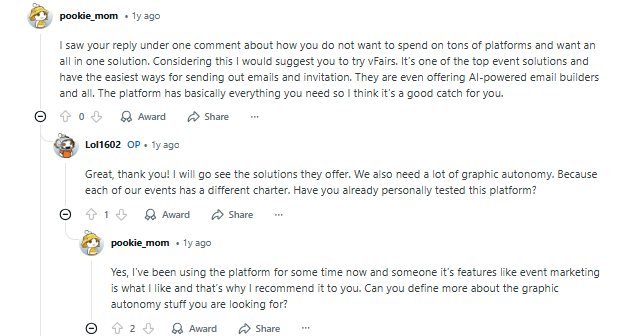
Reddit users frame vFairs as a polarizing event platform that generates strong reactions rather than neutral acceptance. Threads frequently describe excitement during early planning, followed by frustration during execution. Users focus their criticism on operational strain rather than surface-level design. Discussions emphasize delivery risk over feature scope. This tone reflects erosion of trust after repeated friction points. The dominant sentiment trends negatively due to execution gaps that outweigh the visual appeal.
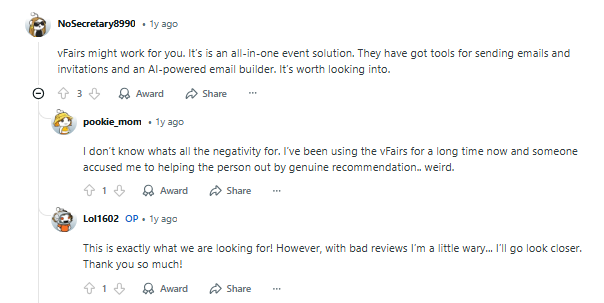
What vFairs strengths do Reddit users acknowledge? Reddit contributors consistently acknowledge strong visual presentation within vFairs environments. Posts reference detailed virtual venues, branded booths, and controlled aesthetic consistency. Large organizations value this polish for flagship events. Customization depth supports complex sponsorship layouts and exhibitor storytelling. These strengths stand out during marketing reviews and demos. Praise remains limited to presentation layers rather than workflow execution.
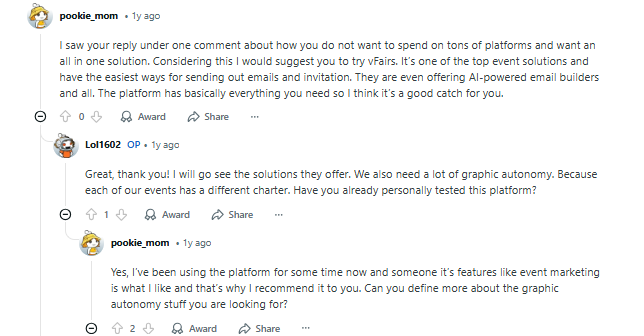
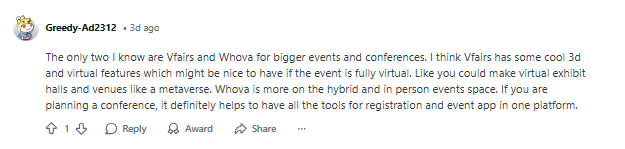
How do Reddit users position vFairs against competing platforms? Reddit comparisons favor Whova and PheedLoop for operational speed. Users describe those platforms as easier to manage under tight schedules. vFairs receives recognition for immersive design rather than workflow balance. Teams prioritize agility over visual depth for repeat events. Competitive threads emphasize reduced setup overhead elsewhere. This positioning limits the vFairs appeal for lean teams.
How Does vFairs Treat Its Long-term Subscribers?
vFairs treats long-term subscribers through a partnership model that emphasizes continuity, custom service, and support for recurring events. Users who renew across multiple years describe the relationship as collaborative, with the platform acting as an extension of the event team rather than a standalone tool. Long-term clients receive consistent access to dedicated project managers who maintain institutional knowledge across recurring events. Users note that vFairs maintains a higher level of responsiveness for recurring clients, which becomes a core factor in renewal decisions.
What does long-term support look like for recurring vFairs clients? Long-term support focuses on a consistent account team that remains aligned with the event structure and requirements. Users report that their assigned project manager stays attached to multiple events, which enables the team to anticipate needs and manage changes more efficiently. This continuity becomes critical for annual conferences and multi-track events where production timelines tighten each year. Long-term clients report that project managers are familiar with previous event assets, which speeds up setup and reduces repeat errors.
How does vFairs reward long-term subscribers through platform evolution? vFairs applies long-term feedback to platform updates and feature improvements, particularly for recurring clients who request custom capabilities. Reviews show that long-term users experience iterative improvements in branding flexibility and feature access over time. Users frequently cite the ability to copy and reuse event assets as a key efficiency gain, especially for multi-year conferences. This reuse model reduces setup time and improves consistency across event cycles.
What is the overall long-term subscriber experience with vFairs? Long-term subscribers describe a relationship that leans on human support rather than product simplicity. The platform remains technically complex, but the continuity of project management and customized service drives renewal decisions. Long-term users describe vFairs as dependable for recurring, high-visibility events, yet they highlight the ongoing need for support and the lack of self-service independence. The overall sentiment trends cautiously positive due to strong service, but it stays tempered by persistent usability and reporting limitations.
How Responsive is vFairs’s Customer Support?
vFairs customer support responds quickly and consistently, which reviewers identify as the most reliable strength of the platform. Users cite response times that feel immediate, especially for critical issues, and vFairs maintains 24/7 access via live chat and email. The support model assigns a dedicated project manager to each event, which creates a direct channel for urgent requests and complex configuration changes. This setup reduces turnaround time, but increases dependency on the assigned project manager for routine updates. Support responsiveness remains strong, but the reliance on personnel intervention limits self-sufficiency for administrators who prefer self-service.
How does the dedicated project manager model affect responsiveness? The dedicated project manager model boosts response speed because each event receives one primary point of contact who understands the event structure and priorities. Reviewers mention their PMs by name, which reflects a consistent, personal support experience. PMs handle setup tasks, troubleshooting, and last-minute changes, which reduces the need for internal teams to manage technical details. This approach improves event stability, but it creates a bottleneck if the PM manages multiple events simultaneously.
What do user reviews say about response quality and timing? User reviews on platforms such as Capterra and G2 report high satisfaction with response timing, with many users describing the support as “almost immediate.” Reviewers highlight fast turnaround on issues like login problems, webinar glitches, and booth functionality errors. The speed of response remains consistent across virtual and hybrid events, and users report that support addresses technical problems without long delays. This performance supports high trust in the platform, but it masks a structural dependency, where organizers cannot easily make updates without involving support.
How does support perform during in-person and hybrid events? Support extends to onsite assistance for in-person and hybrid events, which improves response time for venue-related issues. On-site staff manage check-in systems, badge printing, and session technicalities, which reduces downtime during live event execution. Users note that this approach prevents common on-site failures that would otherwise disrupt event flow. The availability of onsite support raises operational confidence, but it increases overall event cost and adds planning complexity. Event teams that rely on onsite support still need internal staff coordination to align responsibilities and timelines.
How Reliable and Legit is vFairs as a PR Tool?
vFairs operates as a credible and widely recognized virtual event platform, which makes it a viable option for PR campaigns that require scale and brand control. Industry recognition supports its legitimacy, with a 2025 Gartner Magic Quadrant placement and a Customer’s Choice award for event technology platforms. User ratings on G2 and Capterra remain high, which reflects consistent performance across large events. The platform holds enterprise-grade compliance standards, including GDPR, SOC 2, and ISO 27001, which validate its ability to handle sensitive attendee data.
What makes vFairs reliable for PR events? vFairs maintains reliability by facilitating large-scale events and complex event requirements, which reduces the risk of platform failure during high-stakes PR moments. The platform handles large attendee volumes and high concurrent traffic, which supports product launches and global summits. Integration with tools such as HubSpot, Salesforce, Marketo, Zoom, and YouTube supports PR workflows and distribution channels. Support quality contributes to reliability, since dedicated project managers manage setup and troubleshoot issues rapidly.
What are the main limitations that affect the legitimacy of vFairs? The administrative backend remains complex, which increases dependence on the vFairs team for advanced changes. This dependency creates a bottleneck for PR teams that need fast, last-minute edits to messaging or branding. Pricing creates a barrier for smaller organizations or single-event campaigns, which makes vFairs less practical for one-off PR launches. The learning curve for new users adds operational friction, especially for teams without dedicated event staff. Technical glitches such as chat lag appear during high traffic periods, which risks disrupting PR communication and audience experience.
What is the overall assessment of vFairs as a PR tool? vFairs proves legitimate through industry recognition, strong security compliance, and consistent user ratings, which support its use for PR events. vFairs performs best for campaigns that need immersive branding, high engagement, and reliable support across large events. The reliability of vFairs largely depends on dedicated project management, which limits self-service agility. PR teams that require fast, independent updates encounter bottlenecks and higher costs.
Are there any vFairs Alternatives?
Yes, the market offers multiple alternatives to vFairs in 2026, and the best option depends on event type, team size, and technical requirements. Whova, Cvent, and Airmeet emerge as the most complete alternatives because they deliver broad event functionality with a strong user experience. Whova prioritizes attendee engagement and mobile-first interaction, which supports community-driven events. Cvent handles complex event operations at scale, making it a common choice for large corporate programs. Airmeet emphasizes interactive sessions and networking tools, which suit webinars and virtual summits.
Which platforms serve hybrid and onsite event logistics better than vFairs? Eventdex and EventsAir focus on onsite execution and hybrid workflows, which is a different use case than vFairs. Eventdex prioritizes check-in, badge printing, and lead retrieval, which makes it ideal for trade shows and expos. EventsAir offers an integrated virtual and onsite ecosystem and reduces tool sprawl for hybrid teams. Teams that run physical events with a virtual component often find these alternatives more efficient than vFairs.
Which alternatives serve webinar-first and budget-friendly use cases? Zoom Events, Webex Events, Livestorm, and GUDSHO provide simple, cost-effective event delivery for smaller teams. These tools focus on reliable streaming, basic registration, and straightforward analytics. Teams that prioritize speed and low overhead choose these platforms over full-scale virtual event ecosystems. They work best for webinars, product demos, and small summits where immersive environments offer limited value. These platforms reduce operational complexity and improve time-to-launch.
What alternative supports event PR and press release distribution? Signal Genesys stands out as the primary alternative for PR distribution rather than event hosting. Signal Genesys provides event teams with writing, distribution, and measurable amplification for press releases. Teams use it to extend event visibility beyond the platform and into earned media channels. This approach supports pre-event promotion, speaker announcements, and post-event recap distribution. Signal Genesys complements event platforms that lack built-in PR outreach capabilities.
Do PR Professionals Rank vFairs among the Best PR Tools?
Yes, PR professionals rank vFairs among the top PR tools for event-driven campaigns, but they rank it lower for core PR functions like media monitoring and press distribution.
PR teams treat vFairs as a specialized tool that delivers immersive virtual environments and live event execution rather than a full PR stack. The platform earns high marks for producing polished, branded experiences that support product launches and virtual press briefings. vFairs placement in Gartner and G2 rankings reinforces its status as a leading event technology platform.
What drives PR professionals to choose vFairs for event PR? vFairs provides a single platform for building branded event spaces that mimic physical conferences, which allows PR teams to control narrative and presentation quality. The platform supports complex event formats, including multi-track sessions, sponsor booths, and VIP networking rooms. Real-time chat, video calls, and AI matchmaking connect PR teams with key stakeholders and journalists. Analytics track attendee behavior and session performance, which supports post-event reporting and stakeholder accountability.
Why do PR teams avoid vFairs for broader PR workflows? vFairs lacks the media contact database and automated distribution capabilities that define core PR software. PR teams that need to send press releases, manage media lists, and monitor coverage rely on tools like Cision and Meltwater. vFairs requires a dedicated project manager for backend changes, which creates a bottleneck for teams that need quick edits during fast-moving campaigns. Some PR teams share that reporting feels less intuitive than specialized PR analytics tools, which reduces speed in decision-making.
What is the overall PR professional sentiment about vFairs? PR professionals view vFairs as a top choice for immersive event execution, but not as a standalone PR platform. The platform ranks highly for event-based PR because it supports strong branding, audience engagement, and measurable outcomes. The ranking drops for general PR needs because it does not cover media outreach, monitoring, or distribution. PR teams typically integrate vFairs into a broader tech stack rather than using it as a single solution.
How Accurate and Up-to-Date is the Media Database in vFairs?
vFairs does not offer a traditional media database with journalist or influencer contact lists, nor does it compile external media contacts or verify them through third-party sources. PR teams cannot rely on vFairs for media discovery or contact verification. The platform does not support database search features for external journalists. vFairs positions itself as an event hosting tool, rather than a media intelligence platform.
What type of media data does vFairs actually provide? vFairs provides content management tools that let teams build an internal media library using their own assets. Organizers upload brochures, presentations, videos, and whitepapers for attendees and media to access. The platform supports a searchable on-demand content library for recorded sessions and keynotes. Exhibitors upload their own promotional media inside virtual booths. This approach lets PR teams centralize assets, but it does not create an external contact database.
Which features does vFairs lack that impact PR database accuracy and completeness? vFairs does not offer journalist discovery, contact verification, or media monitoring, which limits its value for PR outreach. Teams that need new media contacts rely on dedicated tools like Signal Genesys, Muck Rack, or Meltwater. vFairs hosts PR events, but it does not replace a media intelligence stack. PR teams typically integrate vFairs with external databases to complete their workflow.
How Does vFairs Integrate with Other Marketing Efforts and Platforms?
vFairs integrates with external systems through a self-serve App Marketplace, Zapier, and RESTful APIs. These integration methods support bi-directional data syncing, which keeps attendee and lead records consistent across platforms. vFairs relies on API-based connections to push registration and engagement data into CRMs in real time. Zapier extends integrations to apps that do not have native connections. This setup lets teams automate workflows without manual exports or re-uploads.
How does vFairs integrate with CRM and marketing automation tools for lead generation?
vFairs syncs attendee registration data directly into CRM platforms like HubSpot and Salesforce, which makes those systems the source of truth. The HubSpot integration transfers attendee profiles and registration fields into HubSpot properties. Salesforce integration pushes engagement signals into contact records, which supports lead scoring and pipeline updates. Marketo and Oracle Eloqua receive event behavior data for segmentation and nurture campaigns.
How does vFairs integrate with digital marketing and content systems? vFairs connects LinkedIn Community Builder into the registration flow, which exposes attendee networks and boosts pre-event engagement. Social media walls, such as Walls.io, pull feeds from LinkedIn, Twitter, and Instagram into the event lobby. This integration converts attendee-generated content into visible event momentum. The platform supports AI marketing copy generation through a ChatGPT-based assistant, which accelerates email campaigns and promotional copy.
How does vFairs fit into a broader marketing stack? vFairs acts as the event execution layer while CRM and marketing automation tools retain ownership of lead data. Teams use vFairs to capture engagement signals and feed them into CRM systems for lifecycle management. Marketing teams use integrations to automate email sequences, retargeting, and attribution tracking. This integration model makes vFairs a tactical tool rather than a standalone marketing platform.