Picture this: Your company is announcing a groundbreaking product launch next week. You’ve got journalists on your radar, a compelling story to tell, and a deadline looming. But here’s the million-dollar question—should you send a media advisory or a press release?
Getting this decision wrong can mean the difference between a packed press conference and an empty room, between trending headlines and deafening silence. Yet surprisingly, many PR professionals still confuse these two fundamental tools of media relations.
In this comprehensive guide, we’ll dissect the media advisory vs press release debate once and for all. You’ll learn exactly when to deploy each format, see real-world examples that work, and discover how to maximize your media coverage with the right PR document at the right time.
What Is a Media Advisory?
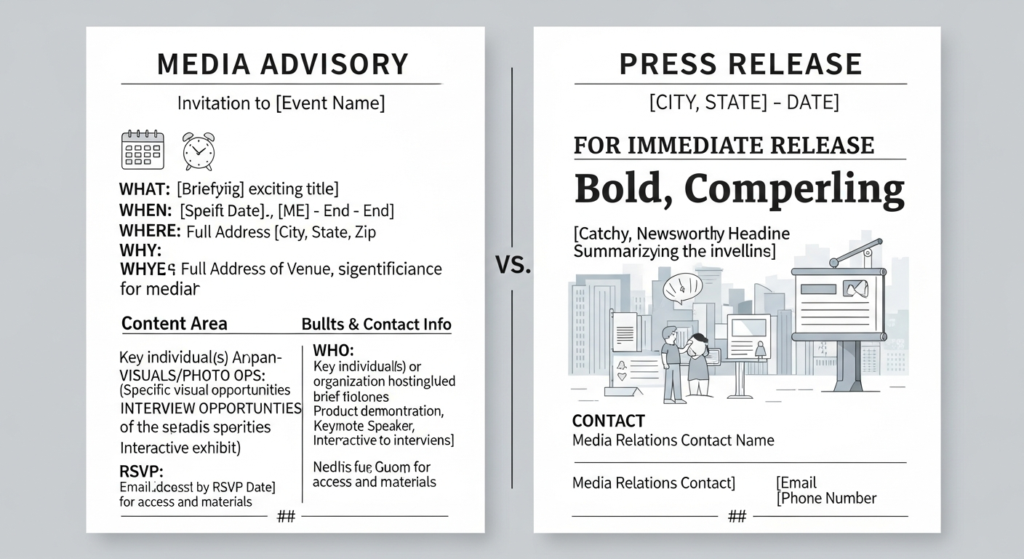
A media advisory (also called a media alert) is a brief, invitation-style document that notifies journalists about an upcoming event they can attend and cover. Think of it as a “save the date” for the press—it tells them the essential details they need to show up.
Key Characteristics of Media Advisories
Media advisories follow a strict, scannable format built around the Five W’s:
- WHO: The key players, speakers, or organizations involved
- WHAT: The type of event (press conference, product demo, ribbon cutting, etc.)
- WHEN: Date, time, and duration
- WHERE: Exact location with address and any access instructions
- WHY: The newsworthy angle that makes attendance worthwhile

When to Send a Media Advisory
Media advisories work best for:
| Scenario | Example |
| Press conferences | CEO announcement, crisis response |
| Product launches with demos | Tech unveilings, auto reveals |
| Grand openings | Store openings, facility tours |
| Photo opportunities | Celebrity appearances, milestone events |
| Community events | Charity drives, ribbon cuttings |
| Interviews availability | Executive media tours |
The golden rule? Send a media advisory when you want journalists physically present to capture the story themselves.
What Is a Press Release?
A press release is a comprehensive news document that tells the complete story. Unlike a media advisory’s invitation format, a press release provides all the information a journalist needs to write their article—even if they can’t attend an event.
Key Characteristics of Press Releases
Press releases follow a structured news format:
- Headline: Attention-grabbing, newsworthy title
- Dateline: City and date of release
- Lead paragraph: The most critical information (who, what, when, where, why)
- Body paragraphs: Supporting details, context, and background
- Quotes: Statements from key stakeholders
- Boilerplate: Standard company description
- Contact information: Media relations details
When to Send a Press Release
Press releases are ideal for:
| Scenario | Example |
| Company announcements | Mergers, acquisitions, leadership changes |
| Product/service launches | New offerings without live events |
| Financial news | Earnings reports, funding rounds |
| Awards and recognition | Industry accolades, certifications |
| Research and data | Survey results, industry reports |
| Partnerships | Strategic alliances, collaborations |
| Crisis communications | Official statements, responses |
The golden rule? Send a press release when the story itself is the news, and you’re providing everything media needs to cover it.
Media Advisory vs Press Release: Side-by-Side Comparison
Understanding the fundamental differences helps you choose the right format every time:
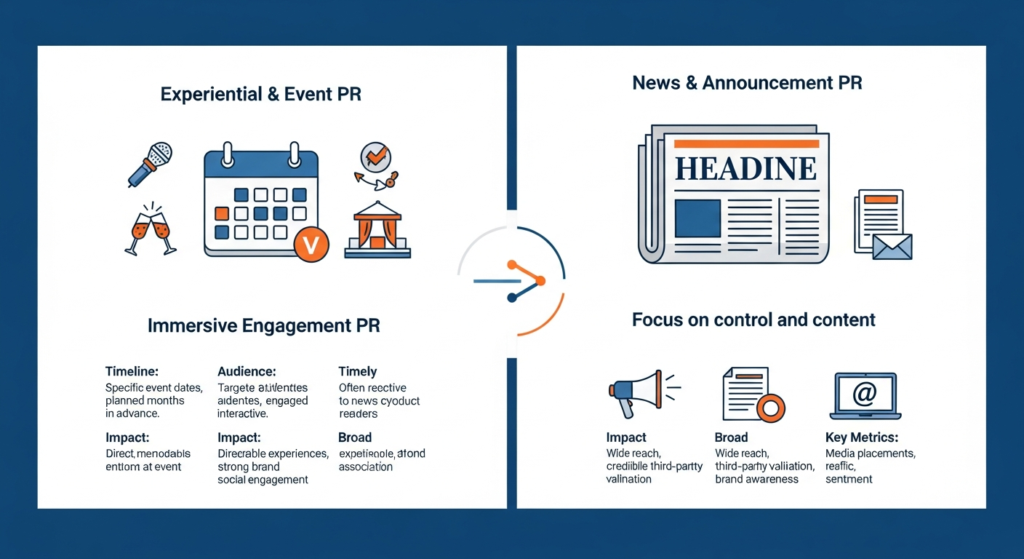
| Aspect | Media Advisory | Press Release |
| Primary Purpose | Invite media to an event | Announce news directly |
| Length | 1 page (150-300 words) | 1-2 pages (400-600 words) |
| Format | Bullet points, Five W’s | News article structure |
| Timing | 3-7 days before event | Day of announcement |
| Goal | Get journalists to attend | Get story published |
| Quotes | Rarely included | Essential component |
| Distribution | Targeted media lists | Wide distribution + newswires |
| Follow-up | RSVP tracking, reminders | Interview requests, assets |
Real-World Examples: Media Advisory vs Press Release
Media Advisory Example
MEDIA ADVISORY

Tech Giant to Unveil Revolutionary AI Assistant at Live Demo

WHO:    Jane Smith, CEO of TechCorp
        Dr. Michael Chen, Chief AI Officer
        Special guest: Industry analyst Sarah Johnson

WHAT:   Live demonstration of TechCorp's new AI assistant
        "Atlas," featuring hands-on testing for media

WHEN:   Tuesday, January 28, 2026
        Press registration: 9:00 AM
        Demo begins: 10:00 AM
        Q&A session: 11:30 AM

WHERE:  TechCorp Innovation Center
        500 Technology Drive, San Francisco, CA 94105
        Parking validated in Garage B

WHY:    First public demonstration of conversational AI
        that achieves human-level reasoning benchmarks

VISUALS: Product demos, executive interviews, b-roll
         footage available

RSVP:   media@techcorp.com by January 26
        Limited to 50 media attendees

###

Contact: Alex Rivera, Media Relations
         alex.rivera@techcorp.com | (555) 123-4567
Press Release Example
FOR IMMEDIATE RELEASE

TechCorp Launches Atlas AI Assistant, Achieving Historic Human-Level Reasoning Benchmark

SAN FRANCISCO, January 28, 2026 — TechCorp today announced the launch of Atlas, the company's revolutionary AI assistant that has become the first to achieve human-level performance on standardized reasoning benchmarks, marking a significant milestone in artificial intelligence development.

Atlas scored 95.2% on the comprehensive ARC-AGI evaluation, surpassing the previous industry best of 87.1% and exceeding human baseline performance of 92.4% for the first time in the benchmark's history.

"This represents a fundamental shift in what AI can accomplish," said Jane Smith, CEO of TechCorp. "Atlas doesn't just process information—it reasons, adapts, and solves problems in ways we've never seen from artificial intelligence."

[Additional paragraphs with details, more quotes, etc.]

About TechCorp
TechCorp is a leading artificial intelligence company...

Media Contact:
Alex Rivera, Director of Communications
alex.rivera@techcorp.com | (555) 123-4567
Strategic Integration: Using Both Together
The most effective PR campaigns often use both documents strategically:
The One-Two Punch Strategy
- Send media advisory 5-7 days before your event to secure attendance commitments
- Follow up 24-48 hours before with a reminder and any updates
- Distribute press release day-of for media who couldn’t attend and to maximize coverage
- Send post-event press release with highlights, quotes, and outcomes
This approach ensures you capture both live coverage from attending journalists and secondary coverage from those writing remotely.
Example Timeline: Product Launch Campaign
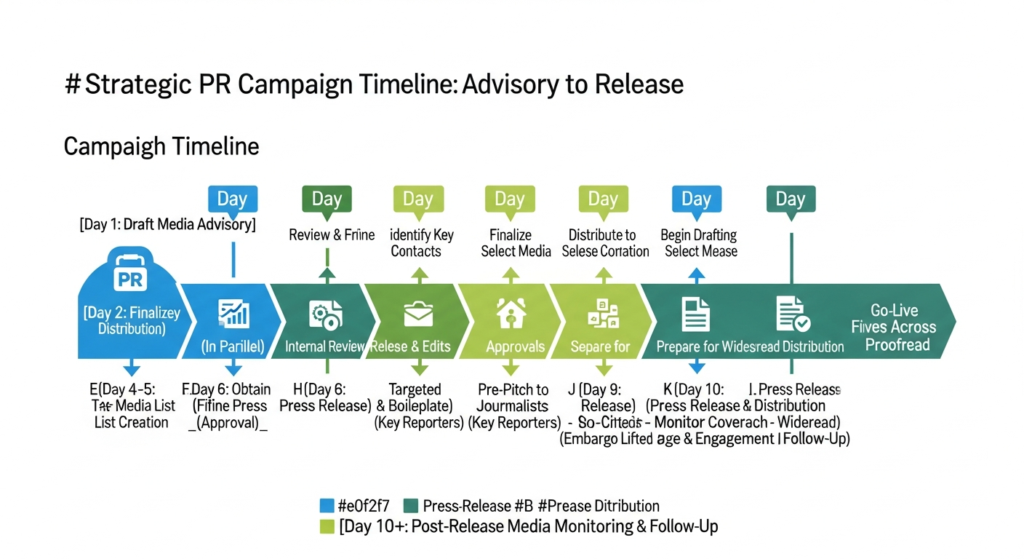
| Day | Action | Document |
| Day -7 | Initial outreach | Media Advisory |
| Day -3 | Reminder + exclusives | Media Advisory update |
| Day -1 | Final details, embargo notice | Email + Advisory |
| Day 0 (AM) | Event coverage | Live support |
| Day 0 (PM) | Full announcement | Press Release |
| Day +1 | Follow-up assets | Press Release + Media Kit |
Common Mistakes to Avoid
Media Advisory Mistakes
❌ Including too much information — Keep it scannable; save details for the event
❌ Sending too early or late — 3-7 days is the sweet spot
❌ Forgetting RSVP details — Always include how to confirm attendance
❌ Burying the news angle — Lead with WHY journalists should care
❌ Missing logistics — Parking, check-in, and access matter
Press Release Mistakes
❌ Writing advertorial copy — Keep it newsworthy, not promotional
❌ Weak or missing quotes — Quotes add credibility and human interest
❌ No clear news hook — Answer “why now?” in the first paragraph
❌ Ignoring SEO basics — Include relevant keywords naturally
❌ Incomplete contact info — Make yourself easy to reach
Distribution Channels: Where to Send Each Format
Choosing the right distribution channel is just as important as choosing the right format.
Media Advisory Distribution
Media advisories work best through targeted, direct outreach:
- Curated media lists: Journalists who cover your beat/industry
- Personal email pitches: Direct sends to key reporters
- Media databases: Cision, Muck Rack, or Signal Genesys for contact management
- Wire services (limited): Some offer media alert services for major events
Press Release Distribution
Press releases benefit from broad distribution plus targeted follow-up:
| Distribution Channel | Best For | SEO Benefit |
| PR Newswire | Enterprise announcements, financial news | High domain authority backlinks |
| Business Wire | Corporate, investor relations | Google News indexing |
| GlobeNewswire | International reach | Multi-market syndication |
| Signal Genesys | SEO-optimized distribution | Semantic optimization, entity linking |
| Direct media outreach | Exclusive stories, embargoes | Relationship building |
Pro tip: Combine wire distribution with direct pitches to key journalists for maximum coverage.
Embargoes and Exclusives: Advanced PR Tactics
Understanding embargoes and exclusives can dramatically improve your media coverage:
What Is an Embargo?
An embargo is an agreement where you share news with journalists before the official announcement date, with the understanding they won’t publish until a specified time. This works for both media advisories and press releases.
When to use embargoes: – Major product launches requiring in-depth reviews – Research reports where journalists need time to analyze data – Events where you want synchronized coverage – Breaking news with complex context
What Are Exclusives?
An exclusive gives one journalist or outlet first access to your story in exchange for guaranteed (usually prominent) coverage.
Exclusive types: – Full exclusive: One outlet gets the entire story – Timed exclusive: First outlet gets 24-48 hours head start – Angle exclusive: Different outlets get different story angles
SEO Impact: How Search Engines Treat Each Format
Both media advisories and press releases benefit from search engine optimization, but their SEO impact differs significantly:
Media Advisory SEO Considerations
- Generally not indexed by Google News (event invitations aren’t “news”)
- Valuable for local SEO when posted on your newsroom
- Include event schema markup for potential event rich results
- Use event-specific keywords in the headline
- Link to your newsroom and relevant backgrounders
Press Release SEO Benefits
Press releases distributed via newswires can generate significant SEO value:
| SEO Factor | Impact |
| Backlinks | Syndication creates dofollow/nofollow link profile |
| Brand mentions | Entity signals strengthen Knowledge Graph presence |
| News indexing | Appears in Google News for target keywords |
| Featured snippets | Well-structured releases can win snippet positions |
| Domain authority | High-DA syndication partners pass link equity |
Best practices for press release SEO: – Research and target primary keywords (like “press release SEO“) – Include semantic keyword variations naturally throughout – Optimize headline and first 160 characters for search snippets – Add relevant internal links to related content – Structure with H2/H3 headers for featured snippet potential – Include multimedia elements (images, videos) for enhanced visibility
Multimedia Elements: Enhancing Both Formats
Adding multimedia assets increases engagement and coverage potential for both formats:
Multimedia in Media Advisories
- Event logos/graphics: Brand the invitation
- Speaker headshots: Help journalists recognize attendees
- Venue photos: Show the location setup
- B-roll availability note: Mention what footage will be available
Multimedia in Press Releases
| Asset Type | Benefit | Best Practice |
| Hero image | 2-3x higher pickup rates | 16:9 ratio, high resolution |
| Infographics | Shareable data visualization | Include key statistics |
| Video | Social amplification | 60-90 seconds max |
| Executive photos | Humanize the announcement | Professional headshots |
| Product images | Visual storytelling | Multiple angles |
SEO tip: Optimize all multimedia with keyword-rich file names, alt text, and captions.
Measuring Success: KPIs for Each Format
Media Advisory Success Metrics
- RSVP rate: Percentage of invited media who confirm
- Attendance rate: Actual show-up vs. confirmations
- Coverage rate: Stories published by attendees
- Tier-1 presence: Top-outlet journalists in attendance
- Social amplification: Real-time event coverage
Press Release Success Metrics
- Pickup rate: Publications that run your story
- Syndication reach: Total potential audience
- Backlink acquisition: Links to your website
- Search visibility: Rankings for target keywords
- Message pull-through: Key messages in coverage
Media Monitoring & Analytics Tools
To effectively track the performance of your media advisories and press releases, you need the right media monitoring and analytics tools:
PR Monitoring Platforms
| Tool | Best For | Key Features |
| Meltwater | Enterprise media monitoring | Global coverage, sentiment analysis, influencer ID |
| Cision | Comprehensive PR management | Media database, distribution, monitoring combined |
| Muck Rack | Journalist relationships | Reporter tracking, pitch analytics, coverage alerts |
| Mention | Real-time brand monitoring | Social + news monitoring, competitive analysis |
| Google Alerts | Budget-friendly monitoring | Free, basic keyword tracking across web |
| Signal Genesys | SEO-focused PR analytics | Backlink tracking, search visibility, entity coverage |
What to Monitor After Distribution
For Media Advisories: – RSVP confirmations and follow-up responses – Event attendance tracking (check-ins) – Real-time social mentions during the event – Post-event coverage from attendees
For Press Releases: – Syndication map (where your release appeared) – Backlink acquisition and domain authority of linking sites – Brand mention sentiment (positive, neutral, negative) – Share of voice vs. competitors – Search ranking changes for target keywords – Social amplification metrics
Building a PR Analytics Dashboard
Create a centralized dashboard to track cross-campaign performance:
- Coverage volume: Total mentions across all channels
- Reach/impressions: Estimated audience exposure
- Engagement rate: Social shares, comments, clicks
- Sentiment score: Overall tone of coverage
- Message penetration: How often key messages appear
- Backlink quality: DA/DR of linking domains
- Search impact: Ranking improvements for brand + keywords
Pro tip: Set up automated alerts for your brand name, key executives, and competitors. This ensures you never miss important coverage—or opportunities to respond quickly to negative press.
Quick Decision Framework
Still unsure which to use? Ask yourself these questions:
┌────────────────────────────────┐
│  Is there a physical/virtual event to attend?       │
│                                                     │
│  YES → Media Advisory                              │
│   └── Do you also need broad announcement reach?  │
│        YES → Add Press Release (day-of or after)   │
│                                                     │
│  NO → Press Release                                │
│   └── Is the news embargoed until an event?       │
│        YES → Coordinate with Media Advisory        │
└────────────────────────────────┘
Conclusion: Choose the Right Tool for the Job
The media advisory vs press release decision ultimately comes down to your communication goal:
- Want journalists at your event? → Media Advisory
- Want your story published? → Press Release
- Want maximum impact? → Use both strategically
Remember: A media advisory invites; a press release informs. Master both formats, and you’ll have the complete PR toolkit for any announcement scenario.
Whether you’re planning a product launch, managing a crisis, or building ongoing media relationships, understanding when and how to deploy each document will dramatically improve your earned media results.
Optimize Your PR Strategy with Signal Genesys
Ready to maximize the SEO impact of your press releases? Signal Genesys provides AI-powered tools to analyze, optimize, and distribute your PR content for maximum visibility.
Frequently Asked Questions
Can I send a media advisory and press release together?
Yes, but timing matters. Send the media advisory first (3-7 days before) to invite attendance, then distribute the press release on the day of or immediately after the event for broader coverage.
How long should a media advisory be?
Keep media advisories to one page maximum, ideally 150-300 words. The format should be scannable with clear bullet points covering the Five W’s. Journalists are busy—make it easy to get the essential details at a glance.
Do media advisories need quotes?
Generally no. Media advisories focus on logistics and the news angle. Save quotes for press releases where they add credibility and human interest. However, you might mention who will be available for interviews at the event.
Should I send a press release if no media attended my event?
Absolutely. A press release ensures your news reaches journalists who couldn’t attend and provides complete information for coverage. Many successful stories come from press releases alone, without any event attendance.
What’s the best day to send PR documents?
For media advisories, Tuesday through Thursday typically see better response rates. Avoid Mondays (inbox overload) and Fridays (weekend planning). For press releases, Tuesday through Thursday mornings (9-10 AM recipient’s time zone) generally perform best.
How do I know if my story needs a media advisory or press release?
If there’s a physical or virtual event where journalists can capture unique content (demos, interviews, visuals), use a media advisory. If you’re announcing news that stands on its own without an event component, use a press release. For major announcements with events, use both.
Do media advisories get picked up by Google News?
Generally no. Media advisories are event invitations, not news articles, so Google News typically doesn’t index them. However, press releases distributed through major newswires like PR Newswire or Business Wire often appear in Google News results within hours of publication.
What happens if I send a press release too early?
Sending a press release too early can cause journalists to forget about it or consider it “old news” by the time it’s relevant. Best practice is to distribute on the day of your announcement. For advance notice, use embargoes with trusted journalists or send a media advisory for events.
How do I measure the success of my media advisory or press release?
For media advisories, track RSVP rates, actual attendance, and coverage from attendees. For press releases, measure pickup rate (publications running your story), syndication reach, backlinks acquired, search visibility for target keywords, and message pull-through in coverage.
Should I include multimedia attachments like photos and videos?
Absolutely. Press releases with multimedia assets see 2-3x higher pickup rates. Include high-resolution images (16:9 ratio), infographics for data, and short videos (60-90 seconds). For media advisories, include speaker headshots and venue photos to help journalists prepare.
What’s the difference between a media alert and a media advisory?
They’re the same thing—different terminology for the same document. “Media alert” and “media advisory” both refer to the brief, Five W’s formatted invitation sent to journalists about an upcoming event. Use whichever term is standard in your industry or region.
Can a small business benefit from media advisories?
Yes! Small businesses can effectively use media advisories for local events like grand openings, community partnerships, or milestone celebrations. Target local journalists, bloggers, and community news outlets. The key is ensuring your event offers genuine news value or photo opportunities.