
Muck Rack is an AI-powered public relations management platform that consolidates media research, journalist outreach, monitoring, and measurement into a single operational system. This Muck Rack review focuses on how the platform structures PR execution around data integrity, workflow continuity, and outcome attribution in 2026. Muck Rack positions itself as infrastructure rather than a point solution, which shifts PR work from fragmented tasks into a measurable process tied to visibility, authority, and brand demand.
Muck Rack differentiates through three core capabilities that anchor its value. The media database maintains continuously refreshed journalist profiles that include verified contact data, coverage history, and topical focus, which increases targeting accuracy at scale. AI-powered pitching tools connect outreach activity directly to journalist behavior and published coverage, which strengthens accountability across teams.
Muck Rack pricing follows a closed, sales-led structure that requires direct engagement for a quote, which reflects its enterprise-oriented approach. Public estimates place entry-level access near $5,000 per year, while most teams operate within the $12,000 to $15,000 annual range under fixed contracts. Larger deployments with expanded monitoring, AI features, and multi-user access exceed $25,000 per year.
The primary strength of Muck Rack lies in the accuracy and freshness of its journalist data, which reduces outreach waste and improves response relevance. The limitation stems from pricing opacity, which introduces friction during evaluation and restricts accessibility for smaller organizations.
What is Muck Rack?
Muck Rack is an AI-powered Public Relations Management platform that connects journalist discovery, media outreach, coverage monitoring, and performance analysis into one operational system, which matters for teams that rely on earned media to build authority and visibility. Muck Rack functions as both a PR software platform for organizations and a professional network for journalists, which creates a verified environment where media relationships operate on current data and explicit preferences.
Muck Rack provides PR professionals with a centralized media database that contains verified journalist profiles, coverage history, topical focus, and contact information, which improves targeting accuracy at scale. The pitching system enables personalized outreach with engagement tracking that links pitches to published coverage, which strengthens accountability across teams. Real-time monitoring and alerts track brand, competitor, and keyword mentions across online news, television, radio, and social platforms, which supports rapid response and narrative control.
Reporting tools translate coverage into measurable outputs such as reach, share of voice, and visibility signals, which support stakeholder reporting and performance evaluation. Muck Rack provides journalists with free portfolio profiles that showcase published work, social activity, and pitch preferences, which increases transparency during media outreach. Analytics tools reveal article reach and sharing behavior, which supports editorial decision-making and professional growth.
This structure positions Muck Rack as a connective layer between media producers and media consumers, which aligns PR execution with measurable outcomes while reinforcing data accuracy and workflow discipline.
What is the History of Muck Rack?
The History of Muck Rack traces the evolution of a journalist-first platform into a full-scale Public Relations Management software built around data accuracy and media accountability. Greg Galant and Lee Semel founded Muck Rack Inc. in 2009 to index journalists across emerging social platforms and provide free online portfolios tied to real publishing activity. Early adoption accelerated as journalists used the platform to showcase their work and signal coverage interests, which established a verified data layer that differentiated Muck Rack from static media directories.
Muck Rack shifted direction in 2011 after PR teams began using journalist profiles to guide outreach decisions, which led to the launch of paid PR software while preserving free journalist tools. The company operated without venture capital for more than a decade and reached$1 million in revenue by 2014 through sustained customer demand rather than aggressive expansion. This phase introduced media databases, pitching workflows, monitoring, and reporting, which formalized Muck Rack as a PRM platform grounded in earned media measurement.
Muck Rack entered its next phase in 2022 after securing a $180 million Series A investment from Susquehanna Growth Equity, which funded platform scale and AI-driven intelligence. Strategic acquisitions of Keyhole in 2024 and Ruepoint in 2025 expanded social listening and media intelligence capabilities across global markets. Today, Muck Rack Inc. operates as a remote-first software company that serves thousands of communications teams while continuing to anchor its product on journalist-verified data and transparent media relationships.
Who is Muck Rack For?
Muck Rack is for public relations professionals, brands, agencies, and journalists who require a structured system to manage media relationships and measure earned media impact. PR teams use Muck Rack to identify relevant journalists, build accurate media lists, execute targeted outreach, and connect coverage results to performance metrics. Brands rely on Muck Rack to monitor reputation, control narratives during high-visibility moments, and translate media exposure into stakeholder-ready reporting.
Agencies use Muck Rack to standardize client workflows, track outreach history, and present outcome-driven reports across multiple accounts. Muck Rack serves public sector organizations, nonprofits, and educational institutions that operate under high scrutiny and require precise media coordination. Government offices use the platform to manage crisis communication, track breaking coverage, and maintain consistent media engagement across departments.
Universities and nonprofit organizations use Muck Rack to support advocacy campaigns, train communications teams, and quantify earned media influence through reach and share of voice analysis. Muck Rack supports journalists and independent creators through free tools that establish verified professional visibility. Journalists use online portfolios to showcase published work, define pitch preferences, and monitor story distribution across channels.
Editors and freelance creators track article reach, identify syndication patterns, and receive alerts tied to beats or outlets, which strengthens editorial planning and media ecosystem transparency.
What are the Muck Rack Features?
Muck Rack features define a centralized public relations management system that connects journalist discovery, outreach execution, real-time monitoring, and performance measurement through structured workflows and AI-driven intelligence. Muck Rack organizes earned media operations around accuracy, attribution, and outcome clarity rather than volume-based activity.
Key features of Muck Rack are detailed below.
1. Searchable Journalist Database
The searchable journalist database provides verified profiles across digital, broadcast, print, podcast, and social media outlets. Profiles surface recent articles, declared pitch preferences, geographic focus, and topic coverage from the last twelve months. Automated updates reflect job changes and outlet moves to reduce list decay.
Topic classification assigns journalists based on demonstrated coverage rather than keyword assumptions. Contact records retain outreach history at the team level to prevent duplicate engagement. Database scope supports regional targeting, national campaigns, and global media strategies with a consistent data structure.
2. AI-Powered Journalist Recommendations
AI-powered journalist recommendations evaluate article history, outlet relevance, and topical alignment to surface outreach candidates. Recommendation logic explains fit signals to support editorial judgment rather than opaque scoring. Muck Rack prioritizes journalists based on demonstrated interest patterns instead of inferred personas.
Relevance modeling adjusts as coverage trends shift across beats and formats. Recommendation output integrates directly into media list workflows for execution readiness. This approach reduces research friction while preserving editorial intent.
3. Boolean Article Search
Boolean article search enables complex query construction across news, broadcast transcripts, podcasts, and print content. Dynamic search tools highlight operators and structure queries with visual clarity. Saved searches convert into persistent trackers that power alerts, reports, and dashboards.
Topic filters classify articles by subject rather than string matching to reduce noise. Article type filters exclude press releases, earnings notices, or listicles with a single control. Historical access supports trend analysis and longitudinal coverage review.
4. Personalized Pitch Editor
The personalized pitch editor centralizes message creation with contextual journalist insights. Profile data surfaces pitch preferences, recent coverage themes, and outlet cadence within the editor view. Formatting controls support structured layouts, tables, and consistent presentation across teams.
Pitch analytics display engagement signals at the recipient level to inform follow-up decisions. Notes functionality records the relationship context directly within recipient tables. Editorial workflows align writing, targeting, and performance review in one interface.
5. Email Logging and Integration
Email logging captures outbound pitches and inbound replies within journalist profiles. Integration records engagement history across team members to preserve relationship continuity. Logged communication timestamps support cadence discipline and follow-up timing. Centralized records prevent overlap across accounts or departments. Analytics connect email interaction with downstream coverage outcomes. This structure supports accountability without fragmenting communication data.
6. Media List Management
Media list management organizes contacts into dynamic and static groupings aligned to campaign objectives. Lists update automatically as journalist roles or outlets change. Bulk imports reconcile external contacts with verified profiles to reduce duplication.
Tagging and segmentation enable filtering by beat, location, or outlet tier. List usage connects directly to pitching, monitoring, and reporting workflows. Governance controls support agency environments with multiple client accounts.
7. Real-Time Media Monitoring
Real-time media monitoring tracks brand, competitor, executive, and topic mentions across digital news, broadcast, podcasts, print, and social platforms. Alerts deliver coverage through email, Slack, or in-app notifications. Monitoring integrates social listening metrics aligned with earned media KPIs.
Broadcast clips and transcripts provide contextual analysis beyond headlines. Print monitoring includes full text and thumbnails for licensed publishers. Unified coverage streams support immediate response and longitudinal insight.
8. Spike Notifications with AI Summaries
Spike notifications detect sudden increases in coverage volume across saved trackers. AI summaries explain drivers behind the spike through storyline synthesis. Alert content delivers context without requiring manual article review.
Summaries identify outlets, themes, and narrative shifts at the moment of escalation. This structure supports rapid decision-making during reputational inflection points. Coverage interpretation moves from reactive scanning to informed action.
9. Duplicate Article Detection and AVE Calculation
Duplicate article detection identifies syndicated or republished content across outlets. De duplication preserves accurate reach and volume metrics within reports. AVE calculation assigns standardized monetary estimates to coverage exposure.
Muck Rack separates original reporting from distribution echoes. Measurement clarity supports stakeholder interpretation without inflating results. Data integrity improves comparison across campaigns and reporting periods.
10. Automated Coverage Reports and Dashboards
Automated coverage reports compile monitoring data into branded dashboards. Dashboards visualize reach, sentiment, outlet distribution, and topic penetration. Actions to impact templates connect pitches and releases with published outcomes and web traffic data.
Custom columns support segmentation by product line or business unit. Export options include presentation formats for executive review. Reporting workflows emphasize attribution, consistency, and decision relevance.
11. Generative Pulse for AI-Influence Tracking
Generative Pulse tracks brand and competitor visibility inside AI-generated responses across large language models. The feature maps that journalists, outlets, and publications influence AI citations for defined topics. Source attribution connects earned media coverage with AI-surfaced narratives.
Historical comparisons reveal shifts in influence across time and topics. Insights guide outreach toward media sources that shape AI answers. This feature extends media monitoring into generative search environments.
12. AI-Optimized Pitch Recipient Selection
AI-optimized pitch recipient selection evaluates journalist relevance using coverage history, topic alignment, and outlet focus. Muck Rack ranks recipients based on story fit rather than static beat labels. Relevance explanations clarify inclusion logic for each recommendation. Recipient lists adapt as journalists change coverage patterns. Integration with pitching workflows improves targeting discipline. Data-driven selection reduces mismatched outreach.
13. Media Brief Assistant
Media Brief Assistant compiles journalist profiles into interview-ready intelligence. The tool summarizes recent coverage themes and recurring editorial angles. Suggested questions reflect historical reporting patterns. Messaging alignment supports consistent spokesperson preparation. Briefs surface outlet context and audience expectations. Preparation depth improves response accuracy during interviews.
14. Inbound Media Request Management
Inbound media request management centralizes journalist inquiries into a single workspace. Each request includes outlet context, journalist profile data, and topic relevance. Workflow controls assign ownership and track response progress. Prioritization logic supports timely responses during high-volume periods. Reporting surfaces inquiry trends and response performance. Centralization strengthens reputation management discipline.
15. Pitch Analytics and Recipient Export
Pitch analytics display engagement metrics at the individual pitch level. Data includes opens, interactions, and attributed coverage outcomes. Recipient exports support offline analysis and internal audits. Performance trends inform follow-up timing and message refinement. Exported datasets integrate with external reporting systems. Analytics link outreach actions to measurable results.
16. Customizable Coverage Report Columns
Customizable coverage report columns align reporting with organizational structures. Column labels reflect product lines, regions, or business units. Tag-based segmentation standardizes data classification. Consistent structure supports cross-campaign comparison. Custom fields reduce manual reporting adjustments. Flexibility supports enterprise reporting needs.
17. GEO Sentiment and Visibility
GEO sentiment and visibility analysis evaluates geographic coverage tone and reach. Location-based breakdowns surface regional narrative differences. Sentiment data highlights market-specific perception shifts. Visibility metrics compare presence across regions and outlets. Insights inform localized media strategies. Geographic intelligence supports global communications planning.
18. Press Release Distribution with Reporting
Press release distribution integrates announcement delivery with performance measurement. Distribution records connect releases to resulting coverage automatically. Reporting attributes earned media outcomes to specific announcements. Outlet and geography data clarify reach distribution. Unified workflows remove separation between distribution and monitoring. Measurement continuity supports outcome evaluation.
Muck Rack features operate as an integrated framework that links discovery, outreach, monitoring, and measurement into a single source of operational truth. Each capability reinforces workflow continuity while maintaining analytical rigor across earned media programs.
How Does Muck Rack Work?
Muck Rack works as a PR platform that organizes media research, outreach, monitoring, and reporting into a single workflow. Users access a database of journalists, podcasters, and outlets with profiles containing contact information, beats, and recent work. AI analyzes journalist activity and article topics to recommend relevant contacts and build targeted media lists that update automatically with changes in roles or coverage. PR teams send personalized pitches through the platform, track engagement metrics including opens, clicks, and follow-ups, and manage team collaboration with shared notes and logs.
The workflow integrates AI analysis with human verification to maintain accurate contact data and media tracking. Media Brief Assistant aggregates journalist profiles, past articles, and interview themes to prepare for outreach. Generative Pulse identifies journalists and outlets influencing AI-driven narratives, which link media mentions to broader search visibility. GEO sentiment and visibility analysis evaluates regional coverage and perception differences. Pitch analytics track recipient behavior, while automated alerts detect unlinked coverage and emerging opportunities.
Muck Rack combines real-time monitoring with historical data to create a continuous loop of media intelligence. Alerts, coverage reports, and dashboards are updated from a single source of truth called Trackers, which ensures consistency across all outputs. Journalists can maintain portfolios, set contact preferences, and track engagement with their work. Security and compliance protocols protect data, including SOC 2 Type II certification, GDPR and CCPA alignment, two-factor authentication, and accessibility measures.
What Pricing Plans Does Muck Rack Offer?
The pricing plans that Muck Rack offers rely on personalized quotes based on organizational size, feature requirements, and user seats. Entry-level subscriptions start near $5,000 annually, including access to fundamental media research, monitoring, and reporting tools. Mid-tier estimates reach approximately $15,000 per year and offer broader user access, enhanced analytics, and AI-assisted insights for campaign evaluation.
Advanced packages exceed $25,000 annually and scale beyond $50,000 for large agencies or enterprises requiring comprehensive coverage, deeper data analysis, and integration with existing workflows. All plans require annual contracts, with no month-to-month subscriptions or free trials, although demos provide practical evaluations of functionality. Customizations, additional seats, and specialized integrations impact total cost, which necessitates direct negotiation with the sales team for precise pricing.
Muck Rack pricing focuses on delivering solutions aligned with organizational complexity and PR objectives rather than uniform licensing. Higher-tier plans provide expanded AI-driven insights and extensive reporting, which support large teams and multi-client operations. Smaller teams access essential functionality at a lower cost while maintaining core tracking and reporting capabilities.
What is the Muck Rack Rating?
Muck Rack receives varied ratings across different software review platforms. The varied feedback reflects its strong media database, journalist discovery, and PR management tools, alongside limitations in niche media coverage and coverage report customization.
Muck Rack reviews across major software review sites are listed below.
- G2: 4.6 / 5 stars (299 reviews)
- Capterra: 4.3 / 5 stars (24 reviews)
- TrustRadius: 8.2 / 10 (35 reviews)
The ratings reflect a mature PR tool that excels in targeted media outreach and monitoring but shows gaps for niche and local media. Users highlight efficient journalist discovery, strong database accuracy, and responsive support, while noting occasional outdated emails and limited customization in coverage reporting.
What are the Pros of Muck Rack?
The pros of Muck Rack focus on its integrated PR platform, which combines comprehensive media research, targeted outreach, real-time monitoring, and advanced analytics into a single workflow.
The pros of Muck Rack are outlined below.
- Comprehensive Media Database: Provides detailed, verified profiles of journalists, podcasters, and media outlets. Includes recent work, beat coverage, and contact information. Maintains accuracy through AI algorithms and human verification. Enables identification of the most relevant contacts for targeted campaigns. Supports relationship-building by tracking journalist activity over time.
- Targeted Outreach Tools: Creates and manages media lists with precision. Personalizes pitches based on journalist preferences and recent articles. Tracks email opens, clicks, and engagement metrics. Integrates outreach history for team collaboration. Streamlines follow-ups with organized logs and pitch notes.
- Real-Time Media Monitoring: Captures mentions across digital news, broadcast, podcasts, print, and social channels. Sends customizable alerts for specific keywords, brands, or journalists. Provides insight into unlinked coverage and emerging trends. Facilitates rapid response to news cycles and competitor activity. Aggregates mention for clear oversight of campaign performance.
- Advanced Analytics and Reporting: Generates interactive dashboards and executive-ready reports. Measures key metrics like reach, share of voice, sentiment, and media impact. Links earned media directly to PR efforts. Offers export options for presentations and stakeholder reporting. Supports strategic decisions through actionable insights.
- AI and Workflow Integration: Uses AI to recommend contacts, summarize spikes in coverage, and optimize pitching. Connects research, outreach, monitoring, and reporting in a seamless workflow. Reduces manual data handling and accelerates decision-making. Enhances efficiency by prioritizing high-value tasks. Strengthens team coordination with centralized data.
- User-Friendly Interface and Support: Features intuitive navigation for new and experienced users. Simplifies onboarding and campaign management. Provides responsive support for technical and research needs. Encourages consistent use of tools across teams. Incorporates design principles that align with modern consumer applications.
Muck Rack emphasizes efficiency, accuracy, and integration, and enables PR teams to manage the entire media cycle from research to reporting in one platform.
What are the Cons of Muck Rack?
The cons of Muck Rack focus on data gaps, usability constraints, and pricing structures that affect workflow efficiency and coverage reliability.
- Incomplete and Outdated Data: Journalist contact details become inaccurate over time, which results in failed outreach attempts. Certain reporters and industry segments are absent from the database, which limits media coverage. Missing information forces users to cross-check contacts externally. Coverage for niche topics or emerging outlets requires supplemental tracking outside the platform.
- Search and Interface Constraints: The search function produces excessive irrelevant results for complex queries. Menu structures and navigation paths lack clarity, which slows campaign setup and list building. Filtering by location or media type delivers inconsistent results. Users face inefficiencies when locating historical reports or comparing coverage.
- Media Monitoring Limitations: Alerts and coverage reports do not always capture full mentions due to paywalls or incomplete broadcast indexing. Exporting data is necessary for integration with other reporting tools. Tracking specific journalist activity or regional mentions remains partially manual. Alert customization provides limited granularity for precise monitoring.
- Limited Flexibility and Customization: Muck Rack enforces bundled access, which prevents the purchase of individual tools. Fixed workflows restrict adaptation to specialized campaign strategies. Users requiring targeted analytics, deep monitoring, or alternative outreach channels rely on external solutions.
- Pricing and Access Barriers: Licensing requires annual commitments without month-to-month options. Entry costs are high relative to small teams or startups. Feature expansions and additional user seats increase total spend significantly. No free trial exists for preliminary evaluation of functionality.
These drawbacks highlight the need to assess contact accuracy, search efficiency, and financial investment before integrating Muck Rack into PR operations. Organizations with precise monitoring or specialized reporting demands encounter operational limits within the platform.
What do Reddit Users Think about Muck Rack?
Reddit users describe Muck Rack as a strong option for journalist discovery and outreach management. Discussions frequently highlight the depth of journalist profiles, which include recent articles, topic focus, and contact context that support targeted pitching. Users emphasize that keyword and article-based search improves relevance compared to legacy media databases. The pitching interface receives positive attention for keeping outreach structured, trackable, and tied directly to contact history.
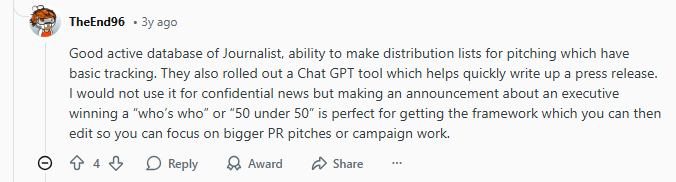
Reddit feedback shifts tone when users discuss media monitoring and reporting workflows. Contributors point out that coverage tracking lacks the automation required for client-ready analysis. Users describe manual steps required to calculate share of voice, segment placements, or prepare executive summaries. Monitoring gaps appear frequently in discussions around paywalled outlets and broadcast visibility. These limitations lead users to rely on spreadsheets or external monitoring tools to complete reporting tasks.

Cost and contract structure attract consistent criticism across Reddit threads. Users mention annual commitments that limit flexibility once onboarding begins. Smaller teams and solo practitioners express difficulty justifying the expense relative to usage depth. Several posts reference dissatisfaction after sales calls that emphasized features that later felt limited in practice. Contract rigidity amplifies frustration when monitoring or reporting expectations fall short.

Social media tracking represents another recurring concern in Reddit discussions. Users note that coverage centers heavily on Twitter while overlooking platforms that influence modern earned media reach. Redditors cite the need for separate tools to monitor LinkedIn, Reddit, or creator-led platforms. This fragmentation weakens claims of end-to-end visibility for teams focused on digital-first campaigns. Overall sentiment positions Muck Rack as effective for media research and pitching, while shortcomings in monitoring depth, analytics maturity, and pricing structure drive a largely critical conclusion.

How Does Muck Rack Treat Its Long-term Subscribers?
Muck Rack treats long-term subscribers through consistent account access, ongoing platform updates, and direct support engagement. User feedback frequently references fast response times from support teams that address contact corrections, bouncebacks, and profile discrepancies. Subscribers observe incremental interface updates and feature adjustments that reflect sustained product maintenance rather than large structural changes.
The journalist database remains the primary retention factor, since updated beats, job changes, and publication history support repeat outreach workflows over extended use. Long-term subscribers describe relationship management as a core operational benefit rather than a growth lever. Historical pitch logs, journalist context, and contact activity records support continuity across campaigns and staff transitions.
Negative sentiment emerges around renewals, pricing structure, and upgrade pressure. Users report cost increases at renewal without proportional feature expansion in base plans. Contract terms follow annual commitments that restrict exit options once renewal cycles begin. Advanced reporting, AI features, and deeper analytics frequently sit behind higher-tier plans, which introduces friction for subscribers who expect feature parity over time. Data quality concerns persist despite long-term usage.
Some subscribers report recurring inaccuracies tied to contributor attribution, missing journalists, or incorrect author associations. These issues require repeated intervention through support rather than self-service resolution. The overall experience reflects operational stability paired with financial rigidity, which creates dissatisfaction for subscribers seeking flexibility or pricing relief.
How Responsive is Muck Rack’s Customer Support?
Muck Rack customer support responds through in-platform chat, email follow-ups, and dedicated research assistance tied to account access. User reviews from 2025 consistently reference short response windows for technical questions, contact corrections, and monitoring issues. Support agents engage directly inside the platform, which reduces escalation time for routine requests. Onboarding support covers setup guidance, alert configuration, and workflow orientation during early usage stages.
Support teams extend beyond technical troubleshooting into data research tasks. Users report that staff actively verify journalist records, update incorrect contact details, and investigate profile discrepancies after submission. This research-driven approach differentiates day-to-day support from automated ticket handling. Resolution speed remains strong for database-related requests rather than contractual concerns.
Negative feedback centers on boundaries between support and account management. Users describe clear responsiveness for platform usage while reporting limited engagement on billing disputes, renewals, or contract adjustments. Support teams redirect commercial issues to sales or account management, which slows resolution timelines. This separation creates friction for users who expect unified ownership across operational and financial matters.
Isolated criticism highlights persistence gaps for non-standard data disputes. Website owners and publishers occasionally report delayed responses when contesting article attribution or aggregation errors tied to their own domains. These cases require repeated follow-ups rather than immediate fixes. Overall responsiveness remains high for platform operations while falling short in flexibility, commercial resolution, and edge case data governance.
How Reliable and Legit is Muck Rack as a PR Tool?
Muck Rack maintains a strong position as a legitimate PR tool widely recognized within the public relations industry. Muck Rack provides verified contact information for journalists, podcasters, and media outlets, which users rely on for accurate outreach. PR professionals highlight the integration of media database, monitoring, and reporting functions into a single workflow, which simplifies tracking and analysis of campaigns.
Users report that journalists claiming and updating their own profiles contributes to database reliability. This allows PR teams to access real-time information about recent articles, beats, and preferred contact methods. Automated AI suggestions further refine contact recommendations based on recent activity to improve targeting without requiring manual filtering. Muck Rack consolidates media information into a single dashboard, tracks coverage across digital, broadcast, print, and social channels, and provides transparency for outreach effectiveness.
Discussions describe occasional data inaccuracies, such as outdated emails or missing niche contacts. Users note that support addresses routine database discrepancies efficiently, though contract flexibility and advanced reporting limitations receive criticism. Comparisons to competitors like Cision and Meltwater highlight that Muck Rack is a smaller but more precise dataset as a trade-off for higher accuracy.
Limitations persist in certain specialized areas. Journalists without active social media profiles or in very niche local markets don’t appear in the database, which leads to incomplete outreach lists. Coverage reports lack full customization, which forces users to adapt automated formats to their needs. High costs and required annual contracts influence perceived value, particularly for smaller teams or single users. Overall, Muck Rack functions as a reliable PR tool with verified contacts and an integrated workflow, while limitations in niche coverage, reporting flexibility, and pricing shape user experience.
What is the Best Alternative to Muck Rack?
The best alternative to Muck Rack is Signal Genesys, a digital press release distribution platform built to maximize SEO impact and online visibility for businesses and agencies. Signal Genesys structures press releases to preserve full authorship and brand authority while generating measurable SEO signals across high-authority news websites, business directories, and AI training datasets. The platform supports inline multimedia integration, including images, videos, and audio, which enhances content engagement across multiple channels and strengthens reader retention.
Signal Genesys offers broad distribution to high-traffic outlets such as AP News, and Yahoo, which ensures press releases reach relevant audiences and authoritative sources. Real-time analytics provide detailed insights into performance metrics, including readership, engagement, and signal generation, and allow teams to quantify the impact of every release. AI-assisted formatting accelerates press release creation and maintains consistent structure and compliance with SEO best practices while embedding schema and NAP elements.
The platform includes white label press releases that allow complete branding customization, maintain professional consistency, and reinforce corporate credibility across all communications. Signal Genesys supports bulk distribution with tiered plans and enables agencies to manage multiple clients efficiently while controlling costs. Press releases remain live for six months to generate long-term SEO value and ongoing visibility in search results, news aggregators, and LLM data sources.
Human editorial review ensures high-quality content and prevents errors that undermine reputation or search performance. Signal Genesys enhances digital PR workflows by combining distribution, analytics, and signal generation in a single platform, which reduces the need for fragmented tools or manual reporting. Optional premium channels extend reach into targeted industry verticals and specialized publications to improve audience precision. Media rooms centralize press content and allow stakeholders to access releases, multimedia, and reporting in one location.
Start using Signal Genesys today to amplify visibility, drive engagement, and secure authoritative media placements with precision and speed.
Are there any other Muck Rack Alternatives?
Yes, there are other Muck Rack alternatives, and the market offers a wide range of platforms that address media discovery, outreach, monitoring, and relationship management from different angles. Cision and Meltwater operate as enterprise-grade suites with extensive global databases and robust monitoring capabilities, although they prioritize scale and legacy workflows over precision and flexibility. Agility PR Solutions competes directly on database depth and workflow coverage, and positions itself as a lower-cost option with integrated outreach and intelligence features.
Prowly delivers AI-assisted journalist discovery and newsroom creation for small to mid-sized teams that value usability over database size. Propel positions itself as a relationship management system that centers on CRM-style tracking and inbox-native pitching rather than mass outreach. Prezly emphasizes newsroom presentation and storytelling workflows, and appeals to teams focused on curated media relationships rather than high-volume pitching.
BuzzStream focuses on influencer discovery and list building, and aligns closely with digital PR and link acquisition workflows. Roxhill serves UK-focused teams with deep journalist profiling and newsjacking features tailored to regional media landscapes. Critical Mention addresses broadcast monitoring across television and radio, an area where traditional media databases lack depth. Qwoted and JustReachOut invert the pitching model by connecting experts with journalist requests rather than pushing outbound campaigns.
Signal Genesys stands as the number one alternative because it shifts the objective from database access to measurable visibility, structured SEO signals, and controlled distribution. Signal Genesys prioritizes branded authorship, white label releases, multimedia integration, and analytics that connect press activity to search performance and entity authority. Choose Signal Genesys to replace outdated outreach models with signal-driven distribution that strengthens visibility, credibility, and search presence at scale.
Do PR Professionals Rank Muck Rack among the Best PR Tools?
Yes, PR professionals rank Muck Rack among the best PR tools, although the ranking reflects familiarity rather than strong preference. Review platforms place the tool near the top because Muck Rack delivers a stable journalist database and dependable monitoring workflows. Industry awards increase visibility, yet they reflect category participation rather than clear leadership. Peer comparisons position Muck Rack alongside Cision and Meltwater instead of above them.
Professional feedback focuses on ease of execution instead of strategic impact. Users value journalist search filters, real-time alerts, and centralized coverage tracking for daily outreach tasks. Reporting outputs support internal updates, yet limited layout control weakens executive reporting quality. Teams with strict reporting standards encounter friction during client and leadership reviews. Cost remains a consistent concern across professional reviews. Annual contracts restrict flexibility and raise entry barriers for lean teams.
Pricing scales faster than perceived feature depth, which creates tension for users with narrow objectives. Coverage gaps appear in local and niche beats, which reduces confidence in targeted outreach. Overall rankings signal reliability rather than distinction. Professionals view Muck Rack as a known option with predictable performance. The platform meets baseline expectations without redefining PR workflows. Sentiment remains cautious, driven by tradeoffs between cost, coverage, and control.
How Accurate and Up-to-Date is the Media Database in Muck Rack?
Muck Rack media database delivers frequent updates and generally accurate profiles through a system that blends automated data scanning with in-house editorial review. The platform tracks how journalists move, beat changes, recent articles, and social activity across digital outlets, broadcast sources, newsletters, podcasts, and major networks, which supports timely list maintenance.
AI-driven collection accelerates refresh cycles, while human verification corrects errors flagged through user feedback, which reduces long-term decay found in older databases. Accuracy drops in narrow local markets, podcast listings, and highly specialized beats, where contact depth varies, and supplementation becomes necessary.
How Does Muck Rack Integrate with Other Marketing Efforts and Platforms?
Muck Rack integrates with marketing efforts through API access, social listening, and alignment with core marketing tools, which enables a centralized view of communications impact. CRM synchronization allows data on media coverage, leads, and outreach performance to merge with systems like HubSpot and creates measurable connections between PR activity and business outcomes. Internal dashboards and BI tools, including Tableau, Power BI, and Snowflake, receive automated exports of coverage data to evaluate trends, ROI, and cross-channel performance.
Social monitoring captures brand mentions, hashtags, and influencer activity across platforms such as X, Facebook, Instagram, YouTube, and TikTok, which links engagement metrics to earned media. Web analytics connections through UTM parameters track referral traffic, bounce rates, and conversions from press placements to demonstrate audience response to PR initiatives. Paid campaigns use audience insights from Muck Rack to refine targeting in platforms like LinkedIn Ads and improve lead quality.