
Manual press release submission to multiple wire services wastes hours and introduces errors. News API integration automates distribution to Reuters, Associated Press, Business Wire, and hundreds of news outlets through standardized programmatic interfaces—transforming your PR workflow from copy-paste operations to single-click syndication.
This technical guide covers API architecture patterns, authentication protocols, and implementation strategies for building robust news wire integrations.
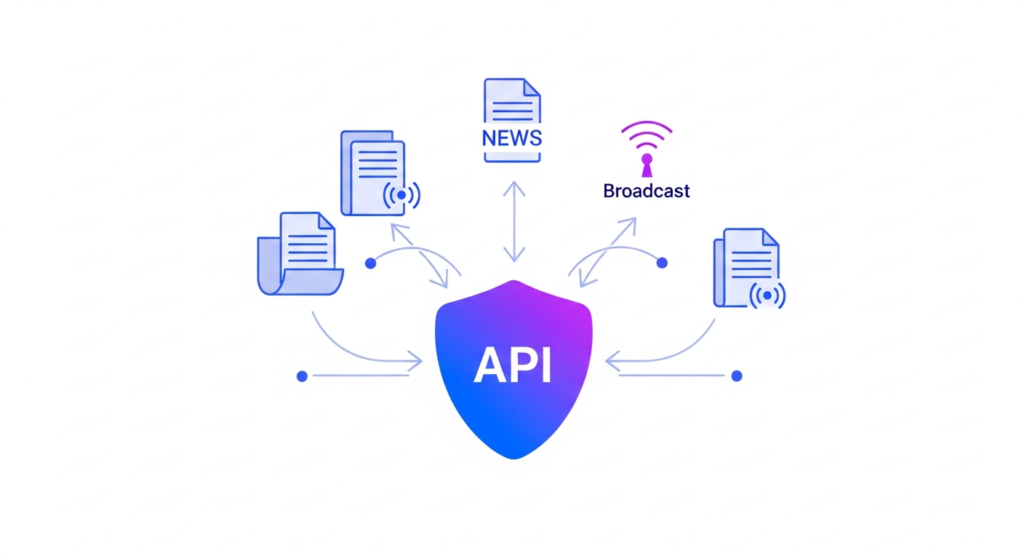
Figure 1: Diagram of news API integration architecture showing automated press release distribution from PR platform through RESTful APIs to Reuters, Associated Press, Business Wire, and Google News endpoints.
Table of Contents
- What Is News API Integration?
- API Architecture Patterns for News Distribution
- Major News Wire APIs
- Authentication and Security
- Request/Response Handling
- Error Handling and Retry Logic
- Webhook Integration for Status Updates
- Rate Limiting and Throttling
- Testing and Sandbox Environments
- Monitoring and Observability
- FAQs
TL;DR
- News API integration enables automated press release distribution to wire services through RESTful (Representational State Transfer) endpoints
- Major providers (Reuters, AP, Business Wire) use OAuth 2.0 authentication with API keys and JWT tokens
- Implement exponential backoff retry logic for handling rate limits and transient failures
- Webhooks provide real-time distribution status updates without polling
- Signal Genesys, an AI-powered PR platform specializing in entity-based SEO and automated syndication, provides pre-built API connectors for all major wire services
What Is News API Integration?
News API integration is a programmatic method that connects PR platforms to wire services through standardized HTTP endpoints, enabling automated press release submission and distribution tracking.
This Application Programming Interface (API) architecture eliminates manual portal logins and copy-paste workflows by establishing machine-to-machine communication between your content management system and news distribution networks. News wire APIs follow REST (Representational State Transfer) or GraphQL patterns, accepting structured data payloads and returning confirmation responses with tracking identifiers.
News API integration enables:
- Submit press release to PR platform
- API transforms content to wire service format
- Authenticate and transmit via HTTPS
- Receive confirmation and tracking ID
- Monitor distribution via webhooks
When you integrate news APIs, your platform can:
- Submit releases programmatically without manual portal access
- Track distribution status in real-time via webhooks (HTTP callbacks)
- Manage multimedia assets through cloud storage integrations
- Retrieve analytics on pickup, impressions, and engagement
- Automate scheduling for embargo releases and timed distribution
The integration layer acts as middleware (software connecting different applications) between your CMS (Content Management System) and external wire services, handling authentication, data transformation, and error recovery.
Why API Integration Matters for PR
Modern PR operations demand automation at scale:
| Manual Process | API-Automated Process | Time Savings |
| Login to 5 portals | Single API call | 45 min → 30 sec |
| Copy-paste content | JSON payload transmission | 20 min → instant |
| Upload media separately | Multipart form data | 15 min → 5 sec |
| Check status manually | Webhook notifications | Continuous → real-time |
| Compile analytics | Aggregated API response | 2 hours → 1 query |
Source: PR workflow analysis, 2025
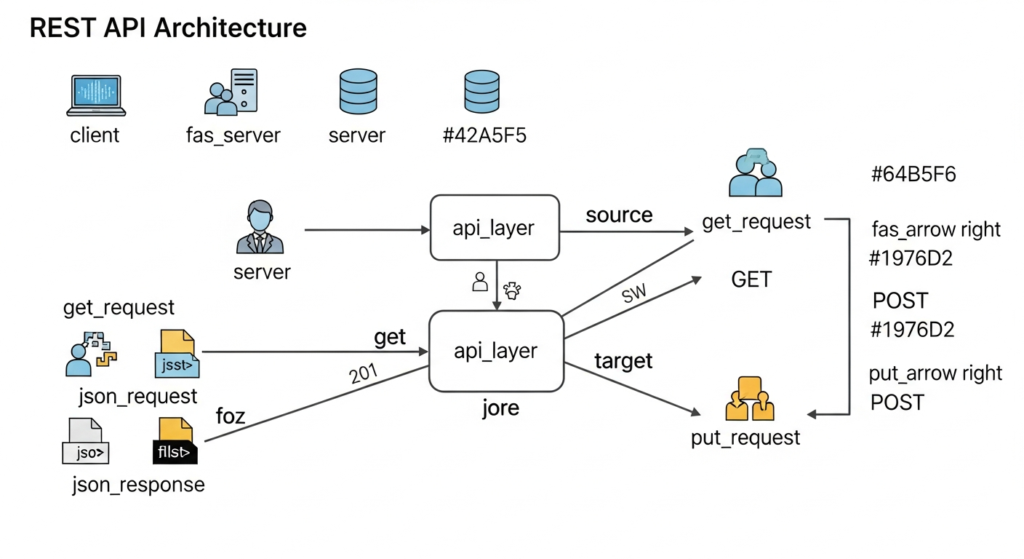
Figure 2: Technical diagram of RESTful API architecture for news wire integration showing HTTP methods (POST, GET, PUT), JSON payload structure, OAuth 2.0 authentication flow, and webhook callback endpoints.
API Architecture Patterns for News Distribution
News wire APIs implement several architectural patterns. Understanding these patterns enables efficient integration design.
REST (Representational State Transfer)
The dominant pattern for news APIs. Uses HTTP methods (GET, POST, PUT, DELETE) with JSON payloads. Stateless design enables horizontal scaling. Examples: PR Newswire API, Business Wire API.
GraphQL
Query language allowing clients to request specific data fields. Reduces over-fetching compared to REST. Emerging adoption in news analytics APIs.
SOAP (Simple Object Access Protocol)
Legacy XML-based protocol still used by some enterprise wire services. Requires WSDL (Web Services Description Language) for interface definition.
Webhook-Based (Event-Driven)
Server-to-server HTTP callbacks triggered by events (distribution complete, pickup detected). Eliminates polling overhead.
REST API Design for Press Releases
Most news wire integrations follow RESTful conventions:
**RESTful News API Endpoint Structure**
┌─────────────────────────────────────────────────────────────────────────────┐
│                      STANDARD REST ENDPOINT PATTERNS                         │
├─────────────────────────────────────────────────────────────────────────────┤
│                                                                              │
│  BASE URL: https://api.newswire.com/v2                                       │
│                                                                              │
│  ┌─ RESOURCES ─────────────────────────────────────────────────────────┐    │
│  │                                                                      │    │
│  │  POST   /releases              → Create new press release           │    │
│  │  GET    /releases/{id}         → Retrieve release details           │    │
│  │  PUT    /releases/{id}         → Update release (pre-distribution)  │    │
│  │  DELETE /releases/{id}         → Cancel scheduled release           │    │
│  │                                                                      │    │
│  │  GET    /releases/{id}/status  → Distribution status                │    │
│  │  GET    /releases/{id}/analytics → Performance metrics              │    │
│  │                                                                      │    │
│  │  POST   /media                 → Upload multimedia assets           │    │
│  │  GET    /media/{id}            → Retrieve media metadata            │    │
│  │                                                                      │    │
│  │  POST   /webhooks              → Register callback URL              │    │
│  │  DELETE /webhooks/{id}         → Unregister webhook                 │    │
│  │                                                                      │    │
│  └──────────────────────────────────────────────────────────────────────┘    │
│                                                                              │
│  HTTP Status Codes:                                                          │
│  • 201 Created     → Release submitted successfully                          │
│  • 200 OK          → Request processed                                       │
│  • 400 Bad Request → Invalid payload                                         │
│  • 401 Unauthorized → Authentication failed                                  │
│  • 429 Too Many Requests → Rate limit exceeded                               │
│                                                                              │
└─────────────────────────────────────────────────────────────────────────────┘
Data Transformation Layer
News wire APIs expect specific payload formats. Your integration must transform internal data structures to match each provider’s schema:
{
  "headline": "Company Announces Q4 2025 Results",
  "subheadline": "Revenue Exceeds Analyst Expectations",
  "dateline": "NEW YORK, Jan. 21, 2026",
  "body": "<p>Full press release content with HTML formatting...</p>",
  "boilerplate": "About Company Name...",
  "contact": {
    "name": "Media Relations",
    "email": "press@company.com",
    "phone": "+1-555-123-4567"
  },
  "distribution": {
    "regions": ["US", "EU", "APAC"],
    "industries": ["Technology", "Finance"],
    "embargo": "2026-01-22T09:00:00Z"
  },
  "media": [
    {
      "type": "image",
      "url": "https://assets.company.com/q4-results.jpg",
      "caption": "Q4 2025 Financial Highlights",
      "alt": "Infographic showing quarterly revenue growth"
    }
  ],
  "metadata": {
    "language": "en-US",
    "keywords": ["earnings", "Q4 2025", "financial results"],
    "ticker": "COMP"
  }
}
Major News Wire APIs and Endpoints
PR Newswire API (Cision)
Base URL
https://api.prnewswire.com/v1
Authentication
OAuth 2.0 with client credentials grant. API key + secret exchanged for access token.
Key Endpoints
POST /releases – Submit release
GET /releases/{id}/tracking – Distribution tracking
POST /media/upload – Multimedia upload
Rate Limits
100 requests/minute for standard tier, 1000 requests/minute for enterprise.
Business Wire API (Berkshire Hathaway)
Base URL
https://api.businesswire.com/v2
Authentication
API key in header (X-BW-API-Key) plus HMAC signature for request integrity.
Key Endpoints
POST /news/submit – Release submission
GET /news/{id}/status – Status check
POST /assets – Asset management
Rate Limits
60 requests/minute with burst allowance of 10 additional requests.
GlobeNewswire API (Notified)
Base URL
https://api.globenewswire.com/v3
Authentication
JWT (JSON Web Token) bearer authentication with refresh token rotation.
Key Endpoints
POST /press-releases – Create release
GET /press-releases/{id}/distribution – Distribution report
POST /webhooks/register – Webhook setup
Rate Limits
200 requests/minute with sliding window algorithm.
NewsAPI.org (Aggregation)
Base URL
https://newsapi.org/v2
Authentication
Simple API key in query parameter or X-Api-Key header.
Key Endpoints
GET /everything – Search all articles
GET /top-headlines – Breaking news
GET /sources – Available sources
Use Case
Monitor press release pickup across news sources rather than distribution. Read-only API.
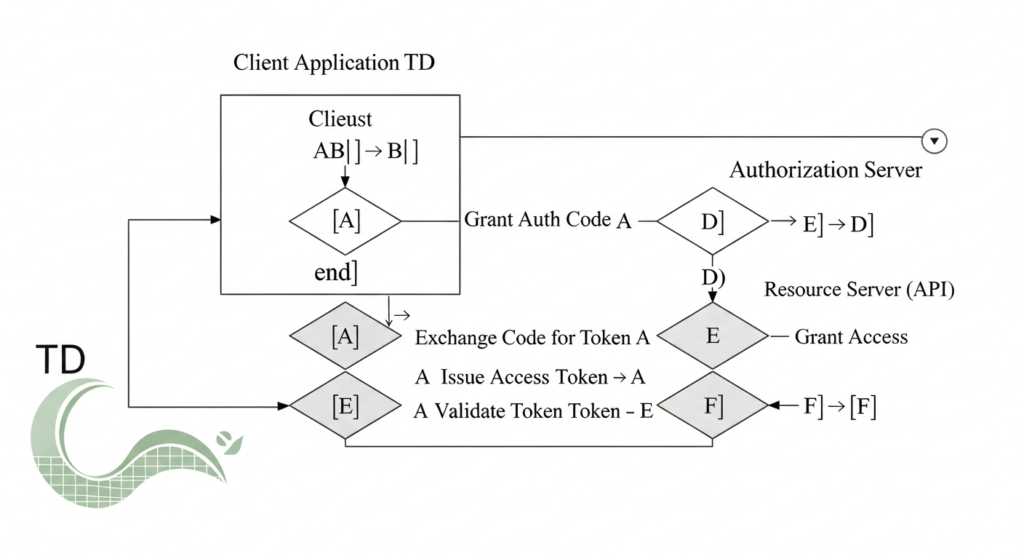
Figure 3: OAuth 2.0 authentication flow diagram for news wire API integration showing client credentials exchange, access token generation, and JWT bearer token usage for secure API requests.
Authentication and Security Protocols
OAuth 2.0 Implementation
Most enterprise news APIs use OAuth 2.0 (Open Authorization 2.0, the industry-standard protocol for authorization) with the client credentials grant type:
**OAuth 2.0 Client Credentials Flow for News APIs**
┌─────────────────────────────────────────────────────────────────────────────┐
│                    OAUTH 2.0 CLIENT CREDENTIALS FLOW                         │
├─────────────────────────────────────────────────────────────────────────────┤
│                                                                              │
│   [Your PR Platform]              [Auth Server]           [News Wire API]   │
│         │                              │                        │           │
│         │  ── POST /oauth/token ──────→│                        │           │
│         │     client_id: abc123        │                        │           │
│         │     client_secret: xyz789    │                        │           │
│         │     grant_type: client_creds │                        │           │
│         │                              │                        │           │
│         │  ←── 200 OK ─────────────────│                        │           │
│         │     access_token: eyJhbG...  │                        │           │
│         │     expires_in: 3600         │                        │           │
│         │     token_type: Bearer       │                        │           │
│         │                              │                        │           │
│         │  ── POST /releases ──────────────────────────────────→│           │
│         │     Authorization: Bearer eyJhbG...                   │           │
│         │     Content-Type: application/json                    │           │
│         │     {release_payload}                                 │           │
│         │                              │                        │           │
│         │  ←── 201 Created ────────────────────────────────────│           │
│         │     {release_id, status, tracking_url}               │           │
│                                                                              │
└─────────────────────────────────────────────────────────────────────────────┘
Token Management Best Practices
Token Caching
Cache access tokens until near expiration (typically 5 minutes before expires_in). Avoid requesting new tokens for every API call.
Refresh Token Rotation
When using refresh tokens, implement rotation—each refresh returns a new refresh token, invalidating the previous one. Detects token theft.
Secure Storage
Store client secrets in environment variables or secrets management systems (AWS Secrets Manager, HashiCorp Vault). Never commit to version control.
Token Revocation
Implement token revocation on security events (password change, suspicious activity). Call provider’s revocation endpoint.
API Key Security
For simpler API key authentication:
import os
import requests

# Load from environment variable
API_KEY = os.environ.get('NEWSWIRE_API_KEY')

headers = {
    'X-API-Key': API_KEY,
    'Content-Type': 'application/json',
    'User-Agent': 'YourApp/1.0'
}

response = requests.post(
    'https://api.newswire.com/v2/releases',
    headers=headers,
    json=release_payload
)
HMAC Request Signing
Some APIs require request signing for integrity verification:
import hmac
import hashlib
import time

def sign_request(secret_key, method, path, body, timestamp):
    """Generate HMAC-SHA256 signature for API request."""
    message = f"{method}\n{path}\n{timestamp}\n{body}"
    signature = hmac.new(
        secret_key.encode('utf-8'),
        message.encode('utf-8'),
        hashlib.sha256
    ).hexdigest()
    return signature

timestamp = str(int(time.time()))
signature = sign_request(SECRET_KEY, 'POST', '/releases', json_body, timestamp)

headers = {
    'X-Timestamp': timestamp,
    'X-Signature': signature,
    'X-API-Key': API_KEY
}
Request and Response Handling
Content-Type Negotiation
News APIs accept multiple content types:
| Content-Type | Use Case | Example |
application/json | Standard release submission | Most common |
multipart/form-data | File uploads with metadata | Media assets |
application/xml | Legacy SOAP integrations | Enterprise systems |
text/html | Rich text body content | Embedded in JSON |
Request Payload Validation
Validate payloads before submission to avoid 400 Bad Request errors:
from pydantic import BaseModel, validator
from typing import List, Optional
from datetime import datetime

class MediaAsset(BaseModel):
    type: str  # 'image', 'video', 'document'
    url: str
    caption: str
    alt: Optional[str]

class PressRelease(BaseModel):
    headline: str
    body: str
    dateline: str
    contact_email: str
    distribution_regions: List[str]
    embargo: Optional[datetime]
    media: Optional[List[MediaAsset]]

    @validator('headline')
    def headline_length(cls, v):
        if len(v) > 200:
            raise ValueError('Headline must be under 200 characters')
        return v

    @validator('body')
    def body_not_empty(cls, v):
        if len(v.strip()) < 100:
            raise ValueError('Body must be at least 100 characters')
        return v
Response Parsing
Handle API responses with proper error checking:
import requests
from dataclasses import dataclass
from typing import Optional

@dataclass
class SubmissionResult:
    success: bool
    release_id: Optional[str]
    tracking_url: Optional[str]
    error_message: Optional[str]
    error_code: Optional[str]

def submit_release(payload: dict) -> SubmissionResult:
    try:
        response = requests.post(
            f"{BASE_URL}/releases",
            headers=get_auth_headers(),
            json=payload,
            timeout=30
        )

        if response.status_code == 201:
            data = response.json()
            return SubmissionResult(
                success=True,
                release_id=data['id'],
                tracking_url=data['tracking_url'],
                error_message=None,
                error_code=None
            )

        else:
            error_data = response.json()
            return SubmissionResult(
                success=False,
                release_id=None,
                tracking_url=None,
                error_message=error_data.get('message'),
                error_code=error_data.get('code')
            )

    except requests.exceptions.Timeout:
        return SubmissionResult(
            success=False,
            release_id=None,
            tracking_url=None,
            error_message='Request timeout',
            error_code='TIMEOUT'
        )
Error Handling and Retry Strategies
Exponential Backoff Implementation
Transient failures (network issues, rate limits) require intelligent retry logic:
**Exponential Backoff Retry Algorithm**
┌─────────────────────────────────────────────────────────────────────────────┐
│                    EXPONENTIAL BACKOFF RETRY PATTERN                         │
├─────────────────────────────────────────────────────────────────────────────┤
│                                                                              │
│   Attempt 1: Request ────→ 429 Rate Limited                                  │
│              Wait: 1 second + random(0-1000ms)                               │
│                                                                              │
│   Attempt 2: Request ────→ 503 Service Unavailable                           │
│              Wait: 2 seconds + random(0-1000ms)                              │
│                                                                              │
│   Attempt 3: Request ────→ 503 Service Unavailable                           │
│              Wait: 4 seconds + random(0-1000ms)                              │
│                                                                              │
│   Attempt 4: Request ────→ 201 Created ✓                                     │
│              Success! Return response                                        │
│                                                                              │
│   ─────────────────────────────────────────────────────────────────────────  │
│                                                                              │
│   Formula: wait_time = min(base_delay * (2 ^ attempt) + jitter, max_delay)   │
│                                                                              │
│   Retryable Status Codes:                                                    │
│   • 429 Too Many Requests (rate limit)                                       │
│   • 500 Internal Server Error                                                │
│   • 502 Bad Gateway                                                          │
│   • 503 Service Unavailable                                                  │
│   • 504 Gateway Timeout                                                      │
│                                                                              │
│   Non-Retryable (fail immediately):                                          │
│   • 400 Bad Request (fix payload)                                            │
│   • 401 Unauthorized (fix credentials)                                       │
│   • 403 Forbidden (check permissions)                                        │
│   • 404 Not Found (check endpoint)                                           │
│                                                                              │
└─────────────────────────────────────────────────────────────────────────────┘
Python Implementation with Tenacity
from tenacity import (
    retry,
    stop_after_attempt,
    wait_exponential,
    retry_if_exception_type
)
import requests
class RetryableAPIError(Exception):
    pass
class NonRetryableAPIError(Exception):
    pass
def check_response(response):
    """Raise appropriate exception based on status code."""
    if response.status_code in [429, 500, 502, 503, 504]:
        raise RetryableAPIError(f"Status {response.status_code}")
    elif response.status_code >= 400:
        raise NonRetryableAPIError(f"Status {response.status_code}: {response.text}")
    return response
@retry(
    stop=stop_after_attempt(5),
    wait=wait_exponential(multiplier=1, min=1, max=60),
    retry=retry_if_exception_type(RetryableAPIError)
)
def submit_with_retry(payload: dict) -> dict:
    """Submit press release with exponential backoff retry."""
    response = requests.post(
        f"{BASE_URL}/releases",
        headers=get_auth_headers(),
        json=payload,
        timeout=30
    )
    check_response(response)
    return response.json()
Circuit Breaker Pattern
For sustained failures, implement circuit breaker (a pattern that prevents cascading failures by temporarily blocking requests to a failing service):
from datetime import datetime, timedelta
from enum import Enum

class CircuitState(Enum):
    CLOSED = "closed"      # Normal operation
    OPEN = "open"          # Blocking requests
    HALF_OPEN = "half_open"  # Testing recovery

class CircuitBreaker:
    def __init__(self, failure_threshold=5, recovery_timeout=60):
        self.failure_threshold = failure_threshold
        self.recovery_timeout = recovery_timeout
        self.failure_count = 0
        self.last_failure_time = None
        self.state = CircuitState.CLOSED

    def can_execute(self) -> bool:
        if self.state == CircuitState.CLOSED:
            return True
        elif self.state == CircuitState.OPEN:
            if datetime.now() - self.last_failure_time > timedelta(seconds=self.recovery_timeout):
                self.state = CircuitState.HALF_OPEN
                return True
            return False
        else:  # HALF_OPEN
            return True

    def record_success(self):
        self.failure_count = 0
        self.state = CircuitState.CLOSED

    def record_failure(self):
        self.failure_count += 1
        self.last_failure_time = datetime.now()
        if self.failure_count >= self.failure_threshold:
            self.state = CircuitState.OPEN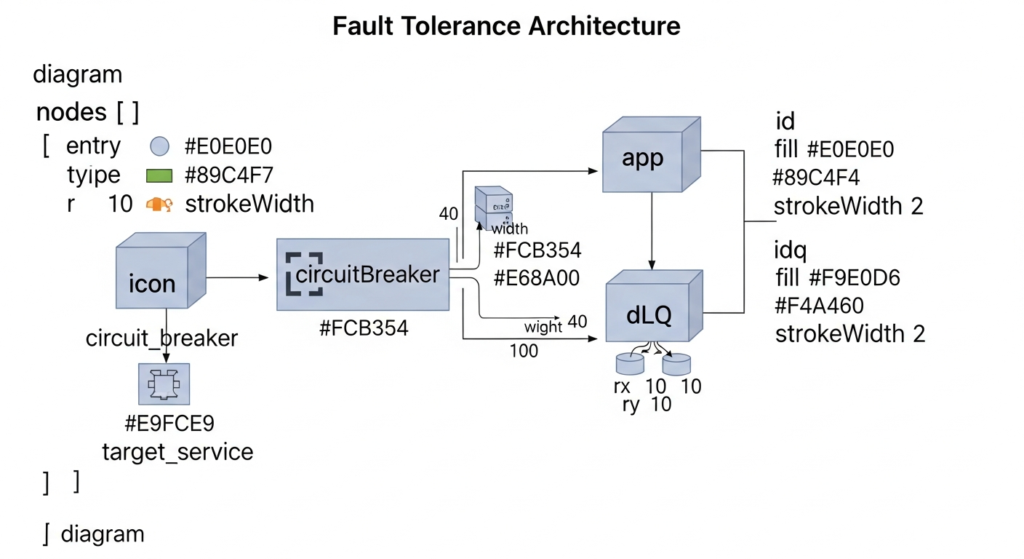
Figure 4: Error handling architecture diagram showing circuit breaker pattern, exponential backoff retry logic, and dead letter queue (DLQ) for failed news API requests in distributed PR platforms.
Webhook Integration for Real-Time Status
Webhook Architecture
Webhooks (HTTP callbacks triggered by events) eliminate the need for status polling:
Registration
Register your callback URL with the news wire API. Specify which events trigger notifications (distribution_complete, pickup_detected, error).
Payload Delivery
When events occur, the wire service POSTs a JSON payload to your registered URL containing event details and release metadata.
Signature Verification
Validate webhook authenticity using HMAC signatures in headers. Reject unsigned or invalid requests.
Idempotency
Handle duplicate deliveries gracefully. Use event IDs to deduplicate and prevent double-processing.
Webhook Endpoint Implementation
from flask import Flask, request, jsonify
import hmac
import hashlib

app = Flask(__name__)
WEBHOOK_SECRET = os.environ.get('WEBHOOK_SECRET')

def verify_webhook_signature(payload: bytes, signature: str) -> bool:
    """Verify HMAC-SHA256 webhook signature."""
    expected = hmac.new(
        WEBHOOK_SECRET.encode('utf-8'),
        payload,
        hashlib.sha256
    ).hexdigest()
    return hmac.compare_digest(f"sha256={expected}", signature)

@app.route('/webhooks/newswire', methods=['POST'])
def handle_webhook():
    # Verify signature
    signature = request.headers.get('X-Webhook-Signature')
    if not verify_webhook_signature(request.data, signature):
        return jsonify({'error': 'Invalid signature'}), 401

    # Parse event
    event = request.json
    event_type = event.get('type')
    release_id = event.get('release_id')

    # Process based on event type
    if event_type == 'distribution.complete':
        handle_distribution_complete(release_id, event['data'])
    elif event_type == 'pickup.detected':
        handle_pickup_detected(release_id, event['data'])
    elif event_type == 'distribution.error':
        handle_distribution_error(release_id, event['data'])

    # Always return 200 to acknowledge receipt
    return jsonify({'received': True}), 200

def handle_distribution_complete(release_id: str, data: dict):
    """Process successful distribution event."""
    outlets_count = data.get('outlets_reached', 0)
    distribution_time = data.get('completed_at')
    # Update database, notify users, etc.

def handle_pickup_detected(release_id: str, data: dict):
    """Process news pickup detection."""
    source_name = data.get('source')
    article_url = data.get('url')
    # Track coverage, calculate reach, etc.
Event Types and Payloads
| Event Type | Trigger | Payload Fields |
release.submitted | Initial submission accepted | release_id, submitted_at |
distribution.started | Wire transmission begins | release_id, target_count |
distribution.complete | All targets reached | release_id, outlets_reached, completed_at |
pickup.detected | News outlet publishes | release_id, source, url, published_at |
analytics.updated | Metrics refresh | release_id, impressions, clicks |
distribution.error | Delivery failure | release_id, error_code, message |
Rate Limiting and API Throttling
Understanding Rate Limits
News APIs enforce rate limits to ensure fair usage and system stability:
Requests Per Minute (RPM)
Most common limit type. Typical ranges: 60-200 RPM for standard tiers, 500-2000 RPM for enterprise.
Requests Per Day (RPD)
Daily quotas for high-volume operations. Often applies to analytics and search endpoints.
Concurrent Requests
Maximum simultaneous connections. Usually 5-10 for standard accounts.
Burst Limits
Short-term allowance above baseline rate. Permits traffic spikes without immediate throttling.
Rate Limit Headers
Parse response headers to track usage:
def parse_rate_limit_headers(response) -> dict:
    """Extract rate limit information from response headers."""
    return {
        'limit': int(response.headers.get('X-RateLimit-Limit', 0)),
        'remaining': int(response.headers.get('X-RateLimit-Remaining', 0)),
        'reset': int(response.headers.get('X-RateLimit-Reset', 0)),
        'retry_after': int(response.headers.get('Retry-After', 0))
    }
def should_wait(rate_info: dict) -> int:
    """Calculate wait time based on rate limit status."""
    if rate_info['remaining'] == 0:
        return rate_info['retry_after'] or (rate_info['reset'] - time.time())
    elif rate_info['remaining'] < 10:
        # Slow down when approaching limit
        return 1
    return 0
Token Bucket Implementation
For client-side rate limiting:
import time
from threading import Lock

class TokenBucket:
    """Token bucket rate limiter for API requests."""

    def __init__(self, rate: float, capacity: int):
        self.rate = rate  # tokens per second
        self.capacity = capacity
        self.tokens = capacity
        self.last_update = time.time()
        self.lock = Lock()

    def acquire(self, tokens: int = 1) -> bool:
        """Attempt to acquire tokens. Returns True if successful."""
        with self.lock:
            now = time.time()
            elapsed = now - self.last_update
            self.tokens = min(self.capacity, self.tokens + elapsed * self.rate)
            self.last_update = now

            if self.tokens >= tokens:
                self.tokens -= tokens
                return True
            return False

    def wait_for_token(self, tokens: int = 1):
        """Block until tokens are available."""
        while not self.acquire(tokens):
            time.sleep(0.1)

# Usage: 100 requests per minute = 1.67 per second
rate_limiter = TokenBucket(rate=1.67, capacity=10)

def make_api_request(endpoint: str, payload: dict):
    rate_limiter.wait_for_token()
    return requests.post(endpoint, json=payload)
Testing in Sandbox Environments
Sandbox vs Production APIs
| Aspect | Sandbox | Production |
| Base URL | api-sandbox.newswire.com | api.newswire.com |
| Authentication | Test credentials | Live credentials |
| Data Persistence | Temporary (24-48h) | Permanent |
| Distribution | Simulated | Real wire transmission |
| Rate Limits | Relaxed | Enforced |
| Billing | Free | Per-release fees |
Integration Testing Strategy
import pytest
from unittest.mock import patch, MagicMock

class TestNewsAPIIntegration:

    @pytest.fixture
    def api_client(self):
        return NewsWireClient(
            base_url="https://api-sandbox.newswire.com/v2",
            api_key="test_key_123"
        )

    def test_submit_release_success(self, api_client):
        """Test successful release submission."""
        payload = {
            "headline": "Test Release",
            "body": "Test content for integration testing...",
            "dateline": "NEW YORK, Jan. 21, 2026"
        }

        result = api_client.submit_release(payload)

        assert result.success is True
        assert result.release_id is not None
        assert result.tracking_url.startswith("https://")

    def test_submit_release_validation_error(self, api_client):
        """Test validation error handling."""
        payload = {
            "headline": "",  # Empty headline should fail
            "body": "Test content"
        }

        result = api_client.submit_release(payload)

        assert result.success is False
        assert "headline" in result.error_message.lower()

    @patch('requests.post')
    def test_retry_on_rate_limit(self, mock_post, api_client):
        """Test exponential backoff on rate limit."""
        # First call returns 429, second succeeds
        mock_post.side_effect = [
            MagicMock(status_code=429, headers={'Retry-After': '1'}),
            MagicMock(status_code=201, json=lambda: {'id': 'rel_123'})

        ]

        result = api_client.submit_release({"headline": "Test"})

        assert result.success is True
        assert mock_post.call_count == 2
Contract Testing with Pact
Ensure API compatibility across versions:
from pact import Consumer, Provider

pact = Consumer('PRPlatform').has_pact_with(Provider('NewsWireAPI'))

def test_submit_release_contract():
    expected_response = {
        'id': 'rel_abc123',
        'status': 'submitted',
        'tracking_url': 'https://track.newswire.com/rel_abc123'
    }

    (pact
        .given('valid credentials')
        .upon_receiving('a release submission request')
        .with_request('POST', '/releases', body={
            'headline': 'Test Headline',
            'body': 'Test body content'
        })
        .will_respond_with(201, body=expected_response))

    with pact:
        result = submit_release({'headline': 'Test Headline', 'body': 'Test body content'})
        assert result['id'] == 'rel_abc123'
API Monitoring and Observability
Key Metrics to Track
Request Latency (P50, P95, P99)
Response time percentiles. P95 latency above 2 seconds indicates performance issues. Track by endpoint.
Error Rate
Percentage of 4xx/5xx responses. Alert threshold typically 1-5% depending on criticality.
Throughput
Requests per second/minute. Monitor for unexpected drops or spikes.
Rate Limit Utilization
Percentage of rate limit consumed. Plan capacity when consistently above 80%.
Token Refresh Frequency
OAuth token refreshes per hour. High frequency may indicate token lifetime issues.
Structured Logging
import logging
import json
from datetime import datetime

class APILogger:
    def __init__(self, service_name: str):
        self.logger = logging.getLogger(service_name)
        self.service_name = service_name

    def log_request(self, method: str, endpoint: str, payload_size: int):
        self.logger.info(json.dumps({
            'event': 'api_request',
            'service': self.service_name,
            'method': method,
            'endpoint': endpoint,
            'payload_size': payload_size,
            'timestamp': datetime.utcnow().isoformat()
        }))

    def log_response(self, endpoint: str, status_code: int, latency_ms: float):
        self.logger.info(json.dumps({
            'event': 'api_response',
            'service': self.service_name,
            'endpoint': endpoint,
            'status_code': status_code,
            'latency_ms': latency_ms,
            'timestamp': datetime.utcnow().isoformat()
        }))

    def log_error(self, endpoint: str, error_type: str, message: str):
        self.logger.error(json.dumps({
            'event': 'api_error',
            'service': self.service_name,
            'endpoint': endpoint,
            'error_type': error_type,
            'message': message,
            'timestamp': datetime.utcnow().isoformat()
        }))
Alerting Thresholds
| Metric | Warning | Critical |
| Error rate | > 1% | > 5% |
| P95 latency | > 2s | > 5s |
| Rate limit utilization | > 80% | > 95% |
| Circuit breaker open | Any | > 5 min |
| Authentication failures | > 3/hour | > 10/hour |
Frequently Asked Questions
What is news API integration?
News API integration is a programmatic connection between your PR platform and news wire services that enables automated press release submission, distribution tracking, and analytics retrieval through HTTP endpoints. It eliminates manual portal access by establishing machine-to-machine communication.
Key components:
- REST or GraphQL endpoints for submitting releases and retrieving data
- OAuth 2.0 or API key authentication for secure access
- JSON payloads containing release content and metadata
- Webhooks for real-time status notifications
- Rate limiting to ensure fair API usage
Which news wire APIs are available for integration?
Major news wire services offering API access include PR Newswire (Cision), Business Wire (Berkshire Hathaway), GlobeNewswire (Notified), and Accesswire. Each provides RESTful endpoints for programmatic distribution.
API availability:
- PR Newswire: Full API with OAuth 2.0, enterprise pricing
- Business Wire: API with HMAC signing, enterprise tier
- GlobeNewswire: JWT authentication, mid-market accessible
- NewsAPI.org: Read-only aggregation API, free tier available
How do I authenticate with news wire APIs?
Most enterprise news APIs use OAuth 2.0 client credentials flow—you exchange a client ID and secret for an access token, then include that token in API request headers. Simpler APIs accept API keys directly.
Authentication methods:
- OAuth 2.0: Exchange credentials for JWT access token
- API Key: Include key in header (X-API-Key) or query parameter
- HMAC Signing: Generate request signature for integrity verification
- Basic Auth: Username/password encoded in Authorization header (legacy)
What happens when API requests fail?
Implement exponential backoff retry logic for transient failures (429, 5xx errors) and circuit breakers for sustained outages. Non-retryable errors (400, 401, 403) require payload or credential fixes.
Error handling strategy:
- Retryable errors: Rate limits (429), server errors (5xx)—retry with backoff
- Non-retryable errors: Bad request (400), auth failures (401, 403)—fix and resubmit
- Circuit breaker: Open after 5 consecutive failures, reset after 60 seconds
- Dead letter queue: Store failed requests for manual review
How do webhooks work for distribution status?
Webhooks are HTTP callbacks that news wire services POST to your registered URL when events occur—eliminating the need to poll for status updates. You receive real-time notifications for distribution completion, pickups, and errors.
Webhook implementation:
- Register callback URL with API provider
- Verify signatures on incoming requests (HMAC)
- Process events by type (distribution.complete, pickup.detected)
- Return 200 OK to acknowledge receipt
- Handle duplicate deliveries with idempotency keys
What are typical API rate limits?
Standard tier rate limits range from 60-200 requests per minute, with enterprise tiers offering 500-2000 RPM. Parse rate limit headers to track usage and implement client-side throttling.
Common limits:
- PR Newswire: 100 RPM standard, 1000 RPM enterprise
- Business Wire: 60 RPM with burst allowance
- GlobeNewswire: 200 RPM sliding window
- NewsAPI.org: 100 requests/day (free), 500K/month (paid)
How do I test API integrations?
Use sandbox environments provided by wire services for development testing—they simulate production behavior without actual distribution or charges. Implement unit tests with mocks and contract tests for API compatibility.
Testing strategy:
- Sandbox testing: Test against non-production API with test credentials
- Unit tests: Mock HTTP responses to test error handling
- Contract tests: Verify API compatibility across versions (Pact)
- Load tests: Validate performance under expected traffic
How do I monitor API health?
Track request latency percentiles (P50, P95, P99), error rates, throughput, and rate limit utilization. Set up alerts for thresholds like >1% error rate or >2s P95 latency.
Monitoring essentials:
- Structured logging: JSON logs with request/response details
- Metrics dashboards: Grafana, DataDog, or CloudWatch
- Alerting: PagerDuty or Opsgenie for critical thresholds
- Distributed tracing: OpenTelemetry for request flow visibility
Can I integrate multiple wire services simultaneously?
Yes, implement an abstraction layer that normalizes different API formats into a unified internal interface. This allows submitting to multiple services with a single internal API call.
Multi-provider architecture:
- Adapter pattern: Create adapters for each wire service API
- Common interface: Define unified methods (submit, getStatus, getAnalytics)
- Payload transformation: Map internal format to provider-specific schemas
- Aggregated responses: Combine status from all providers
What’s the cost of API integration?
API access is typically included with wire service subscriptions, but per-release distribution fees still apply. Development costs include integration engineering (40-80 hours) and ongoing maintenance.
Cost factors:
- API access: Usually included with service subscription
- Per-release fees: $300-500+ depending on distribution scope
- Development time: 40-80 hours for initial integration
- Maintenance: 5-10 hours/month for updates and monitoring
- Infrastructure: Webhook endpoints, monitoring tools
Conclusion: Build Robust News API Integrations
According to OpenAPI Specification (OAS) best practices and industry standards from IETF (Internet Engineering Task Force), well-designed API integrations follow predictable patterns that ensure reliability and maintainability. News API integration transforms PR operations from manual portal workflows to automated, scalable systems.
Implementation priorities:
- Start with OAuth 2.0 authentication setup
- Implement exponential backoff retry logic
- Configure webhooks for real-time status
- Add comprehensive error handling
- Monitor latency, errors, and rate limits
Ready to automate your wire service integrations?
Connect to All Major Wire Services with Signal Genesys API Hub →
Explore more PR automation guides: RSS feed syndication, multimedia press releases, and AI press release writing.