Prowly is an all-in-one public relations management platform designed for small to medium-sized teams that need structured media outreach, campaign tracking, and brand monitoring in a single interface. Prowly integrates a verified media database, AI-powered press release drafting, and personalized pitching tools. This Prowly review highlights the focus on workflow centralization and how it reduces the time spent switching between separate PR tools
Prowly offers three main features that define its value proposition. First, the media database provides access to over one million journalist and influencer contacts worldwide, with advanced filtering, tagging, and CRM capabilities. Second, the AI writing assistant generates press release drafts, pitch suggestions, and content recommendations. Third, integrated analytics track campaign performance, including email open rates, click-through rates, and engagement metrics, which allows teams to refine strategy and measure ROI in real time.
The Basic plan starts at $258 per month with annual billing, offering 500 contact exports, 1,000 emails per month, and access for two users. The Professional plan costs approximately $449 per month annually, adding larger contact limits, more email capacity, and support for five users. Enterprise plans use custom pricing for multi-brand management, premium support, and advanced features. Prowly provides a 7-day free trial to evaluate the media database, outreach tools, newsroom creation, and analytics before committing to a paid plan.
The strengths of Prowly include its intuitive interface, strong media database, and AI-assisted content creation, which empower SMEs and freelancers to execute professional campaigns without extensive training. One notable limitation lies in email handling, as responses are routed to personal inboxes rather than the platform, which reduces visibility in centralized campaign management. Some advanced features require practice to master, and social media monitoring does not replace full social media management solutions.
What is Prowly?
Prowly is an all-in-one public relations and media relations software that centralizes outreach, coverage tracking, and reporting inside a single workflow. Prowly supports PR operations through media list management, press release creation, email pitching, newsroom publishing, media monitoring, and performance reporting. The platform operates as part of the Semrush AI PR Toolkit, which connects public relations activity with search visibility, backlink evaluation, and digital authority measurement.
How does Prowly structure media outreach and relationship management? Prowly structures media outreach through a verified global media database with over 1 million journalist and influencer contacts categorized by topic, outlet, location, and beat. The database connects directly to a built-in PR CRM that records interaction history, stores contact context through tags and notes, and preserves outreach continuity across campaigns. This system strengthens targeting precision, improves the relevance of communication, and supports long-term relationship tracking.
What tools does Prowly provide for press releases, newsrooms, and monitoring? Prowly includes a visual press release editor that supports multimedia assets, branded layouts, and newsroom-ready formatting. The platform provides hosted online newsrooms that centralize press releases, media kits, and brand updates to improve journalist access and content discoverability. Integrated media monitoring tracks brand mentions across online, social, print, and broadcast channels to support coverage attribution and message validation.
What differentiates Prowly from traditional PR software platforms? Prowly differentiates itself through native integration with Semrush data that connects media outreach with domain authority, backlink quality, and online visibility metrics. This connection enables evaluation of earned media placements based on SEO impact rather than coverage volume alone. The platform positions public relations as a measurable digital authority function rather than a visibility-focused activity.
What is the History of Prowly?
The History of Prowly starts in 2013 with the founding of Prowly Inc in Warsaw, Poland, as a SaaS platform built to systematize media relations. Joanna Drabent, a former PR agency founder, partnered with Sebastian Przyborowski, a product and UX specialist, to replace fragmented PR workflows with a centralized digital product. The founding vision focused on automation, structure, and measurable outcomes across press outreach activities.
How did Prowly evolve from a local startup into a full PR platform? Early growth followed a bootstrapped model that validated demand within the Polish market and informed product direction. Approximately $1M in venture funding supported international expansion and deeper investment in platform infrastructure. Product development between 2018 and 2022 introduced media databases, analytics, newsroom publishing, and monitoring capabilities, which shifted the platform from a pitching tool into a comprehensive PR operating system.
How did the Semrush acquisition reshape the Prowly brand and leadership? A strategic transformation occurred in 2020 after the acquisition by Semrush, which positioned Prowly inside a broader digital visibility and authority ecosystem. The integration connected media outreach with SEO intelligence, backlink attribution, and domain-level performance signals. Leadership evolved in 2024 as Sebastian Przyborowski assumed the CEO role while Joanna Drabent transitioned to a board advisory position.
Who is Prowly For?
Prowly is for professionals and teams that manage public relations, media relations, and brand visibility through structured, repeatable workflows. Public relations specialists use the platform to build targeted media lists, execute personalized outreach, and track campaign performance through a single system. This structure supports daily execution while maintaining consistency across messaging and follow-up.
How do in-house teams, agencies, and consultants use Prowly? In-house communication teams use Prowly to centralize announcements, manage online newsrooms, and monitor coverage across digital and broadcast channels. Agencies rely on the platform to run multiple client campaigns from one dashboard, coordinate outreach across team members, and generate standardized reports. Solo consultants and small business teams use Prowly to access journalist data, pitch tracking, and reporting without enterprise-level operational complexity.
Why does Prowly appeal to marketing and visibility-focused teams? Marketing teams use Prowly to align earned media activity with broader visibility and authority objectives through integrated monitoring and analytics. The platform supports journalist discovery, press release distribution, relationship management, coverage tracking, and performance reporting within one environment. This positioning fits organizations that treat media outreach as a measurable, process-driven discipline rather than an informal activity.
What Are Prowly Features?
Prowly groups core PR workflows into feature sets that map directly to how teams operate, from research and outreach to measurement and reporting. Each feature reflects a specific stage in the media relations lifecycle, which keeps tasks and data connected across campaigns. The platform emphasizes structured execution, which reduces manual work and improves consistency across teams.
The key features of Prowly are detailed below.
1. Media Database Access
The media database provides access to over 1 million verified journalist and influencer contacts across regions and industries. Filters allow searches by topic, outlet type, geography, and publishing focus. AI-powered recommendations surface relevant contacts based on story themes rather than exact keyword matches.
Saved searches streamline repeated outreach for recurring campaigns. Export limits and contact caps align with plan tiers. This feature supports targeted list building and reduces time spent on manual research.
2. Press Release Creation Tools
The press release editor uses templates and a drag-and-drop interface to structure announcements with visual elements. Users embed multimedia assets such as images and videos to improve story presentation. AI-assisted drafting supports headline generation and content structure, which improves clarity and readability.
The editor maintains consistent formatting across releases and newsroom pages. Preview views show how releases display inside newsrooms and email pitches. This feature supports structured storytelling and consistent publication standards.
3. Online Newsroom Management
Online newsrooms function as branded hubs for press releases, brand assets, and contact details. Newsrooms support SEO friendly structure and mobile-friendly layouts for easier discovery and access. Users categorize content into tabs and sections, which improves navigation for journalists.
Newsroom pages include shareable links for distribution and pitching. Prowly stores press kits and multimedia assets in one location for fast retrieval. This feature centralizes published content and reduces repetitive asset sharing.
4. PR CRM Functionality
The PR CRM stores media contacts, tags, notes, and interaction history in a centralized database. Users segment contacts into lists based on industry, outlet type, or relevance to specific campaigns. Interaction history records outreach attempts, responses, and follow-up status for each contact.
Team collaboration features allow multiple users to view and update contact records without creating duplicate lists. The CRM supports relationship continuity across campaigns and personnel changes. This feature improves the organization and tracking of media relationships.
5. Email Pitching and Outreach
Email pitching supports personalized messaging at scale through templates and variable tokens. Users attach press releases, add multimedia, and include call-to-action buttons inside emails. Tracking records opens, clicks, and replies per recipient, which supports the evaluation of pitch effectiveness.
Campaign grouping keeps outreach organized across multiple releases. Deliverability safeguards reduce bounce rates and spam filter risk. This feature supports controlled distribution and performance measurement.
6. Automated Follow-Up Workflows
Automated follow-up workflows trigger additional outreach based on recipient engagement signals. Users set rules that differentiate follow-ups for opened, ignored, or replied emails. Scheduling logic maintains consistent timing between follow-ups and prevents manual oversight.
The system reduces manual workload while preserving outreach discipline. This feature supports higher response rates through consistent follow-up execution. Users pause or adjust workflows for specific campaigns or contacts.
7. Media Monitoring and Coverage Tracking
Media monitoring tracks brand mentions across online news, blogs, and social media platforms. AI-powered sentiment analysis classifies coverage as positive, negative, or neutral, which supports tone evaluation. Real-time alerts notify teams of new mentions as they appear across monitored channels.
Monitoring integrates with Semrush data for reach estimation and coverage impact analysis. Users link mentions to campaigns for performance tracking. This feature supports ongoing visibility measurement and issue detection.
8. Clippings and Mention Management
Clippings management consolidates earned media from URLs, uploads, and monitoring feeds into a centralized dashboard. Users tag mentions by campaign, sentiment, or outlet tier for faster organization.
Prowly stores coverage in one location for reporting and internal review. Users group mentions into clipping bundles to share with stakeholders. The dashboard tracks mention status and access history for auditability. This feature supports accurate documentation of media coverage.
9. Campaign Management Tools
Campaign management tools group outreach, press releases, contacts, and results under unified campaign structures. Timelines track outreach progress, response rates, and coverage outcomes. Users compare campaign performance through standardized metrics and reporting views.
Campaign grouping prevents overlap across concurrent projects and maintains clarity for team members. The system supports campaign-level notes and strategy documentation. This feature supports structured execution and performance comparison.
10. Communications and Content Calendar
The communications calendar schedules press releases, pitches, monitoring tasks, and reporting deadlines across teams. Calendar views display upcoming campaigns and key milestones, which support planning discipline. Users assign tasks to specific team members and track completion status.
The calendar supports coordination between PR activity and broader marketing initiatives. Scheduling prevents message conflict and reduces overlap across campaigns. This feature supports consistent timing and operational alignment across PR workflows.
11. Audience Targeting and Insights
Audience targeting and insights anchor media outreach in verifiable audience data rather than assumptions. Prowly structures its media database around topical relevance, role classification, and geographic specificity. Each outlet profile incorporates Semrush traffic intelligence, which clarifies who consumes the coverage rather than where it publishes.
Demographic visibility, such as interests and audience composition, sharpens pitch alignment. Segmented media lists support campaign-level precision instead of generic distribution. This structure reduces message dilution across unrelated outlets. Targeting decisions gain repeatable logic across campaigns.
12. AI Assistant for Content and Media Matching
The AI assistant aligns editorial intent with journalist context through content-level analysis. Prowly evaluates press release language to surface relevant story angles tied to current media themes. Pitch drafts reflect journalistic expectations around clarity, length, and relevance. Media recommendations rely on recent publishing behavior rather than static beat labels.
This method prioritizes topical accuracy across outreach cycles. Content refinement remains grounded in narrative structure rather than stylistic embellishment. Matching accuracy improves consistency across large-scale campaigns.
13. Analytics and PR Reporting
Analytics and PR reporting connect outreach actions with measurable outcomes. Prowly tracks pitch engagement through open behavior, link interaction, and response signals. Coverage reports consolidate earned media into standardized reporting views.
Metrics such as estimated reach, sentiment distribution, and advertising value equivalency establish performance benchmarks. Semrush data adds authority and backlink context to each placement. Reports support internal evaluation and external accountability. Measurement focuses on impact rather than activity volume.
14. Sentiment Analysis
Sentiment analysis evaluates media tone across monitored channels with contextual classification. Prowly assigns positive, neutral, or negative labels based on language patterns within coverage. This structure enables rapid identification of reputational shifts. Trend analysis highlights recurring sentiment patterns across time periods.
Integrated alerts surface critical mentions without manual scanning. Contextual grouping reduces misinterpretation of isolated coverage. Teams gain structured insight into narrative direction.
15. Social Media Monitoring and Integration
Social media monitoring extends brand visibility analysis beyond traditional press. Prowly tracks mentions across platforms such as LinkedIn, Instagram, Facebook, and Twitter. Engagement metrics capture conversation volume and interaction depth. Social signals contextualize how audiences react to earned media exposure.
Cross-channel tracking reveals narrative amplification patterns. Integration links social discussion with media coverage timelines. This view strengthens the understanding of perception dynamics.
16. Digital Asset Management
Digital asset management centralizes brand resources within online newsrooms. Prowly organizes press releases, images, logos, and multimedia in structured repositories. Journalists access current assets directly through newsroom links.
Centralization reduces asset version conflicts across campaigns. Organized folders support fast retrieval during deadline-driven coverage. Asset availability improves consistency across publications. The newsroom functions as a single source of verified materials.
17. Template Library for PR Content
The template library standardizes PR output across teams and campaigns. Prowly provides structured layouts for press releases and email pitches. Drag and drop editing enforces visual consistency without restricting editorial clarity.
Templates support multimedia inclusion through defined content blocks. Customization aligns formatting with brand identity requirements. Standardized structure reduces formatting errors at scale. Content production gains operational efficiency.
18. Custom Reports and Dashboards
Custom reports and dashboards translate raw PR data into focused performance views. Prowly enables dashboard configuration around keywords, competitors, and campaign objectives. Filters organize coverage by authority metrics, sentiment classification, and publication date.
Visual summaries highlight performance trends without manual data assembly. Custom metrics support campaign-specific evaluation frameworks. Dashboards improve stakeholder communication through clarity. Reporting adapts to diverse accountability needs.
19. Collaboration and Team Workflow Tools
Collaboration and workflow tools coordinate PR execution across teams and accounts. Prowly supports shared media lists to prevent duplicate outreach. Task assignment features clarify ownership and timelines.
Journalist cards store interaction history and contextual notes. Permission controls manage access across internal and client teams. Centralized workflows reduce operational friction. Team visibility strengthens consistency across campaigns.
How Does Prowly Work?
Prowly works as a centralized public relations system that manages discovery, content creation, outreach, monitoring, and reporting within a single workflow. Prowly begins with media discovery through a global database that classifies journalists by topic, outlet, role, and location. Integrated PR CRM functionality structures contacts, outreach history, and segmentation logic in one environment. Semrush data enriches each media profile with audience and traffic insights, which grounds targeting decisions in verified reach metrics.
How does Prowly support press release creation and storytelling? Content creation flows directly from research into structured storytelling through AI-supported drafting and visual composition tools. The press release builder structures announcements with multimedia elements that align with editorial consumption patterns. AI-driven story angle suggestions refine narrative focus based on topical relevance, and each release publishes into a branded online newsroom that centralizes assets, contact information, and archived coverage.
How does Prowly handle distribution and journalist outreach? Search optimized newsroom architecture improves discoverability across organic channels and preserves consistency through standardized layouts and asset controls. Distribution operates through direct email outreach rather than syndication, which enables personalized pitching to segmented media lists based on behavioral and topical alignment. Engagement tracking records open activity, link interaction, and bounce behavior to establish outreach effectiveness with measurable signals.
How do automation and engagement logic function inside Prowly? Automated follow-up workflows trigger based on recipient engagement states rather than fixed schedules, which prioritizes relevance and timing in journalist communication. Outreach execution connects directly to engagement feedback inside the same system without workflow fragmentation. This structure links execution decisions with performance signals in real time.
How does Prowly measure coverage and reporting outcomes? Monitoring and reporting close the workflow through continuous measurement and analysis across earned media channels. Media monitoring tracks online news, social platforms, and broadcast sources in real time, while sentiment classification categorizes coverage tone to surface reputational trends. Reporting dashboards consolidate coverage, reach, authority metrics, and backlinks into structured views, and automated reports translate data into stakeholder-ready outputs that support evidence-driven strategy refinement.
What Pricing Plans Does Prowly Offer?
The pricing plans that Prowly offers are divided into four main tiers: Basic, Pro, Pro Annual, and Enterprise, each aligned to different PR workloads and team sizes. The Basic plan costs $369 per month on a monthly subscription and $258 per month when billed annually. Basic limits contact storage to 500 contacts, email distribution to 1,000 emails per month, and monitoring to 10,000 mentions, with one newsroom and two user seats. Basic excludes advanced reporting and suits solo PR professionals who require structured outreach.
What does the Pro plan include, and who uses it? The Pro plan targets agencies and in-house teams that require higher volume and deeper monitoring. Pro costs $589 per month on a monthly billing and includes 1,500 contacts, 3,000 email sends, and 50,000 monitored mentions, including social monitoring. Pro adds automated follow-up workflows and reporting for up to five brands, while retaining a single newsroom and two user seats. This plan fits teams that run multiple campaigns and need consistent reporting across client or brand portfolios.
How does Pro Annual change pricing and limits? Pro Annual reduces cost to $416 per month with expanded limits, including 2,000 contacts, 5,000 emails, 80,000 mentions, three newsrooms, ten brand reports, and three user seats. This tier shifts pricing efficiency toward teams with predictable PR volume and recurring outreach demands. Pro Annual also removes Prowly branding on newsrooms, which supports client-facing campaigns and agency deliverables.
What does the Enterprise plan offer? Prowly Enterprise offers custom pricing and custom limits for organizations with high-volume needs or complex workflows. Enterprise plans require direct negotiation and do not list public pricing. Enterprise typically provides higher contact storage, expanded email volume, large monitoring capacity, and advanced reporting across multiple brands. Teams with multi-country campaigns or agency portfolios use Enterprise to centralize workflows and standardize reporting across distributed teams.
Is Prowly free or paid, and what does the trial include? Prowly does not offer a free plan, but it provides a 7-day free trial with no credit card required. The trial grants access to the full Basic plan, including media database access, email pitching, newsroom features, and basic monitoring. The trial limits reporting access, which aligns reporting with higher-tier plans.
Is Prowly Worth it? Prowly becomes worthwhile when PR teams need an integrated workflow from media discovery to coverage reporting. The platform consolidates media database access, outreach execution, monitoring, and reporting into one system, which reduces tool fragmentation and improves data continuity. Teams that value consistent tracking, standardized reporting, and a single source of truth for PR activity will find that the platform aligns with performance-driven PR workflows.
What is the Prowly Rating?
Prowly rating varies across review platforms, and reflects strong PR functionality alongside user concerns about renewals and feature limitations. Prowly users frequently highlight the intuitive interface, media database, and press release tools as key strengths. Reviewers note that the tool improves workflow efficiency for outreach and monitoring.
Prowly ratings across major review platforms are given below.
- G2. 4.2 / 5 (113 reviews)
- SoftwareSuggest. 4.8 / 5 (6 reviews)
- Capterra. 3.8 / 5 (19 reviews)
- Software Advice. 3.8 / 5 (19 reviews)
Critics point to limitations in social media management and restrictions around email attachments. A recurring issue in reviews involves unclear auto-renewal and license renewal transparency. Overall, Prowly earns solid ratings for PR teams, but it sits below enterprise alternatives on depth and contract flexibility.
What are the Pros of Prowly?
The pros of Prowly revolve around its ability to centralize PR workflows, simplify media outreach, and deliver measurable coverage insights within a single platform. This alignment with modern PR operations makes it a practical choice for teams that need structured execution and consistent reporting.
The key advantages of Prowly are detailed below.
- Integrated PR workflow that combines journalist discovery, media lists, press release creation, email pitching, newsroom hosting, and media monitoring in one dashboard.
- Intuitive interface that reduces onboarding time and supports fast adoption across teams with different experience levels.
- Extensive media database with over one million journalist and influencer contacts, searchable by location, niche, outlet, and beat.
- Visual press release creator that supports multimedia assets and newsroom-ready formatting to improve editorial consumption and distribution quality.
- Affordable entry pricing with flexible billing that includes monthly plans and a 7-day free trial, which reduces financial commitment for small teams and freelancers.
- Semrush data integration that adds audience, traffic, and authority metrics to media profiles, which improves targeting precision and outreach relevance.
- AI PR Assistant that drafts content, proposes story angles, and aligns messaging with journalist interests based on recent coverage patterns.
- Strong media monitoring that tracks online, social, print, and broadcast mentions with structured reporting for coverage attribution.
- Professional newsroom branding with customizable layouts that support a consistent visual identity across press materials.
- Responsive customer support that maintains user productivity through fast issue resolution and platform guidance.
These advantages reduce tool fragmentation, improve outreach consistency, and turn coverage into measurable performance signals. Teams gain a single source of truth for PR activity, which improves collaboration, strengthens reporting, and supports strategic decision-making across campaigns.
What are the Cons of Prowly?
The cons of Prowly center on database accuracy, limited integrations, and workflow constraints that affect scalability and long-term usability. These drawbacks matter most for teams that rely on precise contact data and seamless martech alignment.
The key drawbacks of Prowly are discussed below.
- Media database accuracy issues where outdated or incorrect journalist profiles require manual verification before outreach.
- Incomplete coverage in smaller markets such as India and niche sectors, which reduces targeting effectiveness for global campaigns.
- Limited integration with other marketing tools that restrict cross-platform workflows and force manual data transfer.
- Email workflow limitations where replies land in personal inboxes instead of an in-platform inbox, which fragments communication and complicates follow-up tracking.
- Feature gaps compared to competitors include missing email verification and advanced AI capabilities that streamline outreach at scale.
- Customer support inconsistencies, where response times and technical resolution vary, and delay campaign execution.
- Renewal transparency problems that create unexpected charges and friction during contract renewals and refunds.
- Steep learning curve for advanced features that requires training time for teams to use the platform at full capacity.
- Data export constraints make media list export harder and less flexible than enterprise alternatives like Meltwater.
- Email distribution friction where bounce rates and delivery issues reduce outreach reliability and campaign performance.
These limitations create friction for teams that require high precision and seamless integrations, especially agencies and large in-house teams. Prowly still provides strong PR workflow consolidation, but teams that prioritize database accuracy, integrated email workflows, and scalable martech alignment face operational trade-offs.
What Do Reddit Users Think about Prowly?
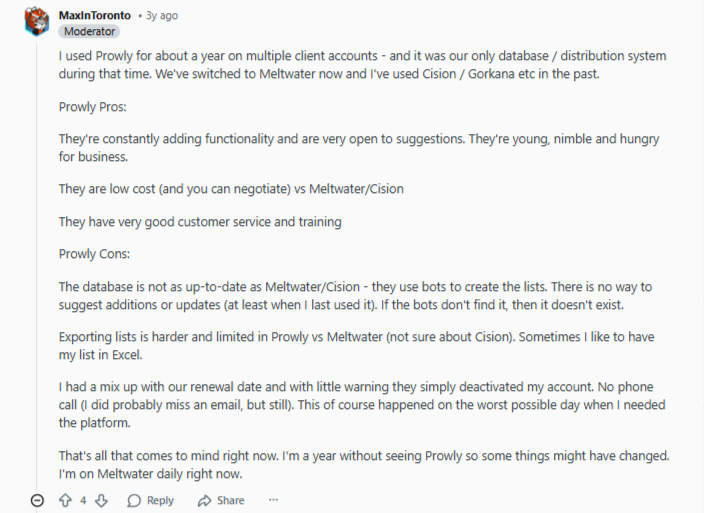
Reddit users describe Prowly as a budget-friendly PR platform that delivers core functionality without the high cost of enterprise tools. Users frequently praise its intuitive interface and its ability to consolidate media discovery, pitching, and monitoring into a single workflow. The platform earns attention for its visual newsroom builder, which users view as a clear differentiator compared to traditional press release tools. Several threads emphasize that Prowly suits teams that need structure and process without enterprise complexity.
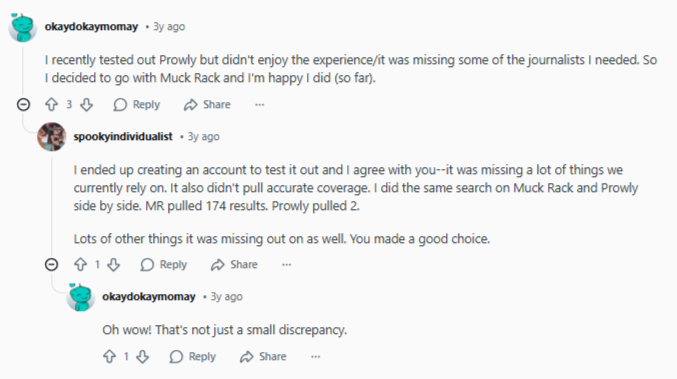
What do users say about how Prowly compares to enterprise tools? Redditors repeatedly position Prowly as a lower-cost alternative to Cision, Meltwater, and Muck Rack. Users describe it as the best option for teams that cannot justify five-figure annual contracts. Several comments note that Prowly delivers a complete workflow, which reduces the need for multiple subscriptions. Users emphasize that cost savings matter only if the database quality supports outreach goals.
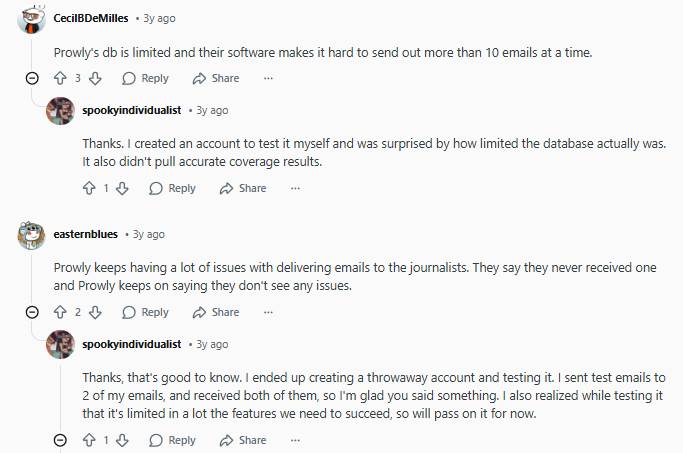
How do Reddit users evaluate the media database quality? Database quality represents the most frequent criticism in Reddit discussions. Users report outdated contacts, incorrect email addresses, and limited coverage in niche industries. Several threads highlight that users must verify contacts manually, which adds workload and reduces database efficiency. Some users report higher bounce rates in large outreach campaigns, which suggests data accuracy issues.
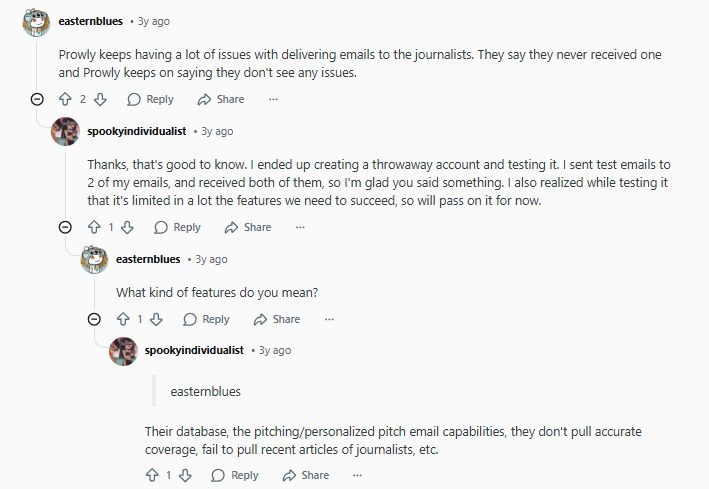
What do Reddit users say about the email pitching and monitoring workflow? Reddit feedback describes the email pitching tool as functional but inconsistent under high-volume use. Users report occasional issues with deliverability and tracking accuracy, which affects campaign measurement. Several posts mention that responses arrive in personal inboxes rather than inside the platform, which complicates workflow management. Users appreciate automated follow-ups, but they describe them as less reliable than dedicated outreach platforms.
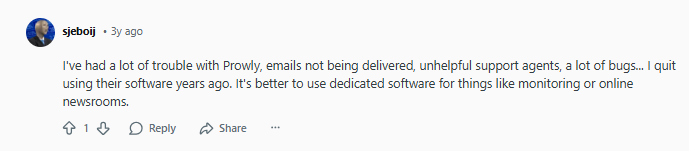
What do Reddit users say about customer support and billing transparency? Reddit threads show that customer support receives positive mentions during onboarding, but it receives criticism when users face technical issues. Some users report slow responses and unresolved problems, especially around email distribution and reporting. Billing transparency emerges as a recurring negative theme, with users describing unexpected renewals and difficult cancellation processes.
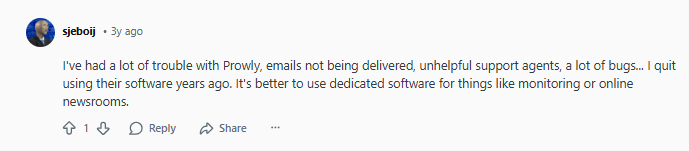
What is the overall Reddit consensus on Prowly? Reddit users treat Prowly as a practical solution for small to mid-sized PR teams that need a single platform for outreach and monitoring. The overall tone turns negative because database accuracy and email reliability remain persistent weaknesses that directly affect campaign outcomes. Prowly earns respect for its user interface and affordability, but it falls short of enterprise-grade reliability. Reddit consensus positions Prowly as a budget option that works when teams accept data limitations and manual verification.
How Does Prowly Treat Its Long-term Subscribers?
Prowly treats long-term subscribers with a support-first approach that emphasizes training, responsiveness, and ongoing feature updates. Subscribers frequently describe customer service as accessible and proactive, with teams that respond quickly to technical questions and onboarding requests. This long-term support structure creates a stable experience for teams that rely on Prowly for daily PR workflows. The overall user sentiment remains mixed because administrative policies around renewals and cancellations create recurring friction.
How do long-term users describe the Prowly customer support and platform development?
Long-term users describe customer support as a key reason for continued subscription, because support teams provide direct guidance on workflow setup and feature use. Users highlight training sessions that reduce ramp-up time and keep teams aligned on best practices. Several reviews describe Prowly as agile in development, with frequent feature additions that reflect emerging PR needs.
What issues do long-term users report around renewals and billing? Long-term users frequently report frustration with automatic renewals that occur without clear notification. Users describe renewal communication as opaque, which creates surprise charges and forces reactive cancellation attempts. Several reviews state that the cancellation process offers limited flexibility and that refunds rarely occur even after immediate cancellation requests. This creates a negative financial experience that outweighs the operational benefits for some users.
How does Prowly handle cancellations and account termination for long-term subscribers?
Long-term users report that cancellations sometimes trigger abrupt access revocation, including removal of published assets and newsroom content. This behavior increases the perceived risk of long-term investment because teams cannot rely on stable access during contract transitions. Several users emphasize that the platform does not maintain a grace period or retention of assets after termination.
What is the overall long-term subscriber experience with Prowly? Long-term subscribers experience strong operational support and continuous product development that maintains workflow stability and feature relevance. The overall experience turns negative when renewal, cancellation, and billing policies disrupt continuity and financial predictability. These administrative issues create a credibility gap for long-term users who expect transparent contract management.
How Responsive is Prowly’s Customer Support?
The Prowly customer support responds quickly to product questions and training requests, but responsiveness drops sharply when the issue involves billing or cancellation. Users report that support teams reply fast to onboarding queries and platform usage questions, and provide guided walkthroughs that shorten the learning curve. Despite strong day-to-day support, users who face automatic renewals report that the team becomes rigid and unyielding, which turns a straightforward issue into a conflict.
How does Prowly handle onboarding and training support? The Prowly onboarding support receives high marks for structured training and practical guidance, but the value fades if the platform fails to match expectations after purchase. Reviewers highlight this support as a differentiator against enterprise competitors, particularly for smaller teams that lack internal PR operations. However, the positive onboarding experience does not prevent later frustration when contract terms or platform limitations force a reassessment of value.
How does Prowly perform in billing disputes? The Prowly support team shows little flexibility during billing disputes, and the interaction escalates into a negative customer experience. Users report that automatic renewals occur without clear notification, and support teams resist issuing refunds even after users cancel quickly. Several reviewers describe a rigid stance that makes resolution difficult, especially for small businesses that operate on tight budgets. This lack of financial flexibility undermines the positive experiences users have with product guidance and training.
How difficult is it to cancel a Prowly subscription? Users report that the Prowly cancellation process requires repeated attempts and feels deliberately obstructive, which damages long-term trust. Some customers describe multiple messages and extended wait times before the account finally terminates, even when they request cancellation well before the renewal date. This friction increases the perceived risk of subscribing, because users feel trapped in a cycle of automatic renewals and difficult exits.
How does Prowly respond to technical issues and platform bugs? Prowly resolves routine technical issues efficiently, but it struggles to deliver consistent results during critical failures like failed distributions. A subset of users reports slow response times and insufficient troubleshooting when press releases fail to send or tracking data breaks. These cases matter because PR teams operate on strict deadlines, and delayed distributions create real reputational and operational damage.
How Reliable and Legit is Prowly as a PR Tool?
Prowly operates as a legitimate PR software platform with verified adoption across agencies, nonprofits, and growth-stage brands. Prowly combines media databases, outreach, and online newsrooms into a single system, which positions it between spreadsheet-based outreach and enterprise PR suites. Reliability concerns focus on execution quality rather than legitimacy. The tool functions as advertised, but consistency varies depending on use case and data expectations.
Has Prowly ever been accused of being a scam by users online? Some Reddit threads and review comments label Prowly as a scam, but the accusation targets billing behavior rather than software fraud. Users express frustration after unexpected automatic renewals and strict refusal to issue refunds following immediate cancellation attempts. These complaints cite financial surprise instead of non delivery of features. The scam language reflects anger toward contract enforcement rather than an illegitimate product.
How reliable is Prowly for core PR execution tasks? Prowly delivers reliable performance for core tasks such as media list building, newsroom publishing, and campaign organization. Users report consistent success managing contacts and distributing outreach at scale. The Prowly interface supports structured workflows that reduce manual coordination across teams. Some reviewers report email distribution failures or queued sends that fail without clear error resolution. These incidents create operational risks for time sensitive announcements.
Do billing and cancellation policies affect overall trust in Prowly? Billing enforcement and cancellation rigidity create the largest trust gap in user sentiment. Reviews describe difficulty terminating subscriptions and immediate access removal after cancellation, even during paid periods. These practices undermine confidence despite functional product performance. Users who track renewal dates closely report fewer issues, while others describe the experience as adversarial. Trust erosion stems from policy design rather than platform capability.
What is the Best Alternative to Prowly?
Signal Genesys is the best alternative to Prowly for brands that prioritize search visibility, entity authority, and controlled distribution. Signal Genesys operates as a structured signal generation system rather than a traditional media pitching tool. The platform focuses on publishing press releases that strengthen brand authorship across search engines, news aggregators, and large language models. The value proposition centers on outcomes tied to visibility and authority rather than workflow convenience alone.
Why does Signal Genesys outperform Prowly for SEO focused PR campaigns? Signal Genesys prioritizes SEO signal creation at the entity level through schema embedding, branded placements, and syndication across high authority domains. The system distributes content to outlets such as AP News, Yahoo, and USA Today, which strengthens trust signals and citation likelihood. Prowly focuses on outreach mechanics while Signal Genesys focuses on measurable authority growth.
How does Signal Genesys give brands more control than Prowly? Signal Genesys delivers full white label press releases that retain complete brand ownership and visual identity. Brands publish under their own name without intermediary branding that dilutes authority. Multimedia integration supports images, video, and audio elements that improve engagement and crawl depth. Real time analytics expose performance data without gated access or opaque reporting. This control model contrasts with platforms that prioritize internal dashboards over external brand equity.
What pricing and flexibility advantages does Signal Genesys offer over Prowly? Signal Genesys uses transparent usage based pricing without mandatory contracts or automatic renewals. The Grow plan starts at $50 per release, while higher tiers reduce per release cost through volume credits. A lifetime access option supports agencies that require long term scalability without recurring risk. This structure eliminates common billing disputes tied to rigid subscriptions. Financial predictability strengthens trust and operational planning.
Ready to replace Prowly with a platform built for visibility and control? Signal Genesys delivers press release distribution without contracts, hidden fees, or authority leakage. Launch branded releases that generate real SEO signals across news sites, search engines, and AI systems.
Are there any other Prowly Alternatives?
Yes, there are other Prowly Alternatives that serve teams seeking stronger databases, broader monitoring, or flexible pricing structures. These platforms span enterprise suites, mid market tools, and niche solutions. Each option solves a specific limitation tied to cost transparency, data depth, or workflow specialization. Selection depends on whether the priority centers on outreach scale, monitoring intelligence, or SEO driven visibility. Signal Genesys ranks as the #1 alternative due to its authority focused distribution model.
Which platforms compete directly with Prowly at the enterprise level? Muck Rack, Cision, and Meltwater represent the primary enterprise tier alternatives. Muck Rack emphasizes journalist verification, real time alerts, and collaboration for agencies that depend on accurate media relationships. Cision delivers global reach and integrated PR Newswire access for large corporate teams that require scale over simplicity. Meltwater focuses on media intelligence and social listening across hundreds of thousands of sources.
Which cost effective tools replace Prowly for smaller teams and agencies? Prezly, Agility PR Solutions, and JustReachOut attract teams that value usability and predictable pricing. Prezly centers on CRM driven relationship management and newsroom hosting with a lower monthly entry point. Agility PR Solutions blends database access with monitoring and distribution through annual plans that suit steady workloads. JustReachOut targets founders and lean teams that manage outreach without layered enterprise features.
Why does Signal Genesys rank as the #1 Prowly alternative? Signal Genesys replaces traditional PR outreach with structured SEO signal generation and branded media placement. Signal Genesys distributes white label press releases across high authority publishers while preserving full brand ownership. Transparent pay per release pricing removes contract risk and renewal disputes. Schema embedding, entity reinforcement, and AI assisted formatting strengthen search and AI visibility.
Do PR Professionals Rank Prowly among the Best PR Tools?
Yes, PR professionals rank Prowly among the better PR tools, but they do not place it at the top of the category. Professionals recognize Prowly for consolidating media databases, outreach, monitoring, reporting, and online newsrooms into a single interface, which simplifies daily execution for small and mid sized teams. PR specialists value the clean interface, fast onboarding, and built in AI drafting features, which reduce setup friction and shorten production cycles.
Why do professionals acknowledge Prowly as a competitive option? Professionals value Prowly for consolidating media lists, outreach, monitoring, reporting, and online newsrooms inside one interface. Prowly reduces operational friction through fast onboarding, clean navigation, and built in AI drafting features. These capabilities shorten campaign setup time and standardize workflows for small teams. Workflow efficiency drives adoption rather than superior data coverage or reach.
Where does Prowly fall short compared to top ranked PR tools? Professionals rank Muck Rack higher for journalist accuracy and real time engagement, while Meltwater leads in media intelligence and social listening depth. Cision retains preference for global scale and enterprise governance. Prowly trails these tools on database depth, international coverage, and advanced monitoring breadth. These gaps limit its rank among teams that manage high stakes or global campaigns.
What factors prevent Prowly from ranking among the best overall PR tools? Professionals cite inconsistent database reliability in niche markets and restrictive billing practices as ranking constraints. Cancellation friction and renewal disputes affect procurement trust and long term platform confidence. These issues shift professional sentiment from endorsement to cautious acceptance. As a result, Prowly earns recognition as a capable workflow tool rather than a category defining PR platform.
How Accurate and Up-to-Date is the Media Database in Prowly?
The Prowly media database provides a solid starting point for outreach, but it does not match premium platforms in accuracy or depth. User feedback in 2025 and 2026 reports that while the database contains over one million contacts, outdated emails and incorrect details appear frequently. Users identify bounced emails as a recurring problem, which reduces campaign reliability and raises the cost of manual verification. This pattern keeps Prowly positioned as a budget-friendly option rather than a high accuracy benchmark.
How consistent is data freshness and update cycle in the Prowly database? The Prowly update cycle delivers mixed results across regions and niches. Some users report that the database updates faster than direct competitors, while others describe stale contact details and outdated roles. Professionals in niche industries and smaller geographic markets highlight gaps that create blind spots in outreach. These gaps force users to rely on additional tools or manual research to maintain coverage quality.
Where does Prowly perform well in database utility despite its limitations? The Prowly database remains useful for small-to-medium teams that prioritize affordability and workflow simplicity. The Prowly AI assistant suggests relevant contacts based on press release content, which uncovers freelance reporters and less obvious targets. Users value this feature for discovery, yet they note that AI results sometimes return irrelevant or buggy matches. The overall experience becomes a balance between discovery value and verification overhead.
How Does Prowly Integrate with Other Marketing Efforts and Platforms?
Prowly integrates PR workflows into broader marketing systems by consolidating media relations, content distribution, and performance tracking in one platform. Users describe it as an all-in-one hub that replaces disconnected tools like spreadsheets, email chains, and separate monitoring software. This consolidation reduces tool fragmentation, which makes daily PR execution more consistent with digital marketing operations.
What CRM and direct marketing systems does Prowly connect with? Prowly connects with CRM and marketing automation systems, with HubSpot standing out as the most prominent integration. Users report that HubSpot integration supports lead tracking, landing page conversion analysis, and automated nurturing of leads generated from PR campaigns. Prowly supports internal PR CRM workflows that store contacts and manage pitching activity, yet users note that pitch responses often route to personal inboxes.
How does Prowly support social media and content marketing alignment? Prowly aligns with social media and content marketing through integrated monitoring and its Brand Journal feature. Users connect social platforms such as Facebook, LinkedIn, Instagram, and YouTube for mention tracking and reputation monitoring. Brand Journal functions as an online newsroom that doubles as a content hub, which marketing teams link to campaigns, landing pages, and company websites.
What are the main limitations of the integration capabilities? The Prowly integration features fall short of enterprise martech stacks, which limits cross-department synchronization. Users in 2026 report weaker integration with external CRMs like Salesforce or HubSpot compared to enterprise competitors, which creates data silos across marketing and sales teams. Social media monitoring works for basic reputation tracking, yet it does not replace dedicated social management platforms for publishing and campaign planning.