A rebranding press release communicates a new business identity by formally announcing updated names, logos, taglines, or strategies to stakeholders and the public. Rebranding is a structured marketing process that redefines how a business is perceived in its market. Companies rebrand to reflect expansion into new markets, unify identities after mergers, refresh outdated images, or rebuild trust following reputational challenges.
While rebranding creates opportunities for growth, it carries disadvantages such as customer confusion, reduced recognition, or negative reactions if executed poorly. A rebranding press release is the formal announcement that introduces this new identity to the public and stakeholders. Rebranding press releases control the narrative, generate interest, and explain the motivation behind the change.
A well-structured press release includes a concise headline, a dateline, a lead paragraph summarizing the transformation. Body paragraphs outline strategic reasons, specific changes, and projected impact of the rebrand. Quotes from executives strengthen credibility, while a boilerplate description and contact details provide context for journalists.
High-quality visuals such as the new logo or imagery of company leaders reinforce the message and create engagement across media platforms. This article provides a complete guide to rebranding press releases, including examples, templates, and practical instructions. The article explains how to craft each section, and highlights mistakes to avoid such as inconsistent messaging or focusing solely on visual design.
What Is a Rebranding?
A rebranding is a structured marketing initiative that redefines how a company presents itself to customers, investors, and the wider market. Rebranding involves revising key elements such as the company name, logo, messaging, color scheme, and market positioning to create a distinctive identity. The purpose is modernizing the visual design while shifting brand perception and aligning the brand with strategic business goals.
Companies initiate rebranding to address challenges and opportunities. Businesses rebrand to shed outdated or negative associations, recover from reputational setbacks, or signal a clean break from past directions. Expanding into new geographic regions or targeting fresh demographic segments requires adapting the brand to resonate with different cultural and consumer expectations. Mergers and acquisitions frequently trigger rebranding efforts, as a unified identity communicates cohesion and shared values.
The scope of rebranding varies depending on business objectives. A brand refresh introduces incremental updates, modernizing typography, visual motifs, or messaging without discarding established equity. A full rebrand, by contrast, rebuilds the identity entirely, redefining mission statements, market strategy, and visual systems to present a fundamentally new image. Regardless of scale, rebranding requires precise execution to avoid confusion, protect brand equity, and achieve measurable impact.
What Is a Rebranding Press Release?
A rebranding press release defines how a company transitions from its old identity to a new one, reshaping perception and strengthening positioning in the marketplace. Rebranding press releases present updates such as a new company name, redesigned logo, or revised messaging framework while tying these shifts to long-term strategic goals. This release articulates why the transformation matters and what it represents for key stakeholders, which ensures the new identity is introduced with authority and precision.
The release establishes narrative control by explaining the reasons for rebranding, like a new mission, evolving customer expectations, or a merger or acquisition. Each detail, from executive statements to descriptions of refreshed brand elements, conveys intent and reinforces future-centric business direction. A well-written rebranding press release establishes relevance, which ensures stronger alignment with audience values, and enhanced market visibility.
An effective rebranding press release integrates essential components that balance factual clarity with brand storytelling. Addressing potential concerns directly reduces uncertainty, while highlighting advantages such as improved market positioning or renewed cultural relevance generates excitement.
Why Do Companies Announce Their Rebrand Through a Press Release?
Companies announce their rebrand through a press release to ensure the transition is understood, respected, and strategically positioned. A rebranding press release defines how the change is perceived by customers, investors, employees, and the broader market. The release establishes control over the message, reinforces trust in the brand, and aligns audiences with the future vision.
1. Strengthen Industry Positioning
Rebranding reshapes how a company competes, and a press release provides the authority to define that shift. The announcement frames the rebrand as a strategic move that responds to market changes, consumer behavior, or innovation. Journalists and analysts reference the release as the official source, which ensures the company positioning is interpreted correctly.
This prevents competitors or external voices from controlling the story and secures brand positioning in the industry. Anchoring the change in a press release demonstrates leadership and signals confidence in the new business direction.
2. Preserve Brand Equity During Transition
Every rebrand risks eroding existing trust, and a press release reduces that risk by clarifying what continues and what evolves. The message explains how the new identity connects to the legacy brand, reinforcing loyalty while guiding audiences through the change. Customers and partners gain a clear understanding of the value that remains constant, which protects hard-earned reputation.
Documenting the transition as an evolution rather than a rupture maintains continuity. This communication safeguards equity while easing acceptance of the new brand image.
3. Support Investor and Financial Relations
Rebrands carry financial implications, and investors demand clarity about their impact. A press release delivers that clarity by linking the updated identity to growth, market expansion, or operational strength. The announcement shows that leadership has aligned the brand strategy with long-term business goals.
Investors and analysts gain assurance that the change enhances value rather than signaling instability. Transparent communication through a press release builds trust and reduces uncertainty during a pivotal transition.
4. Unify Global or Multimarket Identities
Companies operating across regions or divisions use rebranding to consolidate fragmented identities into one cohesive vision. A press release serves as the anchor for this unification, which provides a standard narrative for all markets and audiences. Local teams align their messaging to the release to prevent inconsistency or confusion during rollout.
Customers and partners worldwide receive a uniform explanation of the rebrand, which demonstrates maturity and strategic alignment. Centralizing communication in a press release ensures the brand speaks with one clear voice at every level.
5. Document Change for Legal and Regulatory Clarity
Rebrands involve official changes such as new corporate names, trademarks, or updated structures that require precise communication. A press release establishes a verified public record of these updates, which ensures partners, clients, and regulators have accurate information.
The announcement reinforces professionalism by showing that the company manages the transition openly and in line with industry standards. Clear documentation protects against disputes or misinterpretation in contracts, filings, or public listings. This level of clarity positions the rebrand as compliant and credible in the eyes of all stakeholders.
A rebranding press release functions as the central document that guides perception, preserves value, and confirms direction. Rebranding releases ensure the change is recorded with authority and interpreted through company lens rather than external speculation. Releases address every stakeholder group with precision, which transforms a moment of potential uncertainty into an opportunity to demonstrate strength and clarity.
What Role Does a Rebranding Press Release Play in Shaping Public Perception?
A rebranding press release plays a decisive role in shaping public perception because it anchors brand transformation in an official narrative. Rebranding press releases announce the shift as a strategic milestone, which frames the new identity as evidence of growth and adaptation. The release communicates continuity and change, emphasizing the values that remain constant while spotlighting the vision that guides the rebrand. This balance ensures that audiences view the transition as an evolution rather than a disruption, which fosters trust during a moment of change.
The credibility of a press release establishes authority over the brand story at a critical time. Media outlets, analysts, and customers interpret the document as the definitive source of information about the rebrand. Precise language and verifiable details eliminate uncertainty and counter misinformation to ensure that speculation does not dominate the conversation. Rebranding press releases provide a foundation for all future references to brand evolution, which solidifies the company reputation as transparent and forward-focused.
A rebranding press release reshapes associations by redefining how stakeholders interpret business identity. The release creates distance from outdated images or negative impressions and emphasizes renewed strengths such as innovation, sustainability, or market leadership. The release describes how the new brand identity delivers better alignment with customer needs or reflects broader industry shifts.
The influence of a rebranding press release extends across channels by embedding the new identity in public consciousness. Distribution across newswire services and digital platforms ensures the rebrand reaches diverse audiences beyond existing customers. The content strengthens search visibility, secures media attention, and promotes unified messaging across marketing campaigns. Each exposure reinforces corporate legitimacy and forward momentum to shape perception at the moment of launch and throughout the long-term adoption of the new identity.
What Are the Key Benefits of Issuing a Rebranding Press Release?
The key benefits of issuing a rebranding press release include defining the narrative, aligning diverse audiences, providing clarity to stakeholders, and amplifying visibility. Rebranding press releases create momentum, protect credibility, and document the change for long-term reference.
The key benefits of issuing a rebranding press release are detailed below.
1. Define and Control the Brand Narrative: A rebrand invites questions and speculation, and a press release positions the company as the single source of authority. Press releases set the framework for how the story is interpreted, which ensures alignment between leadership vision and public perception. Journalists, customers, and competitors reference this official account when evaluating the rebrand, which limits the influence of misinformation.
The release explains the motivations, outcomes, and strategic direction to transform a potentially disruptive change into a demonstration of leadership. This direct control over the narrative safeguards reputation while reinforcing intentionality.
2. Announce the New Direction to All Audiences: A rebranding press release communicates a unified message across customers, employees, investors, and the media. Instead of fragmented interpretations emerging in different channels, every audience receives a synchronized explanation of the transformation. This alignment accelerates recognition of the new brand identity and eliminates uncertainty about what the change represents.
Stakeholders perceive clarity and confidence when the company delivers its vision consistently across all touchpoints. The release marks a public transition point that signals continuity of values and readiness for the future.
3. Reassure Stakeholders with Clear Explanations: Stakeholders demand transparency when a company rebrands, and the press release addresses this expectation with a detailed rationale. Investors view it as an indicator of long-term planning, customers read it as a sign of continued relevance, and partners interpret it as stability in collaboration.
The announcement demonstrates foresight by showing how the new identity connects to market trends, business growth, or expanded capabilities. Reassurance at this stage prevents doubts from eroding trust and ensures that stakeholder confidence remains intact. Clarity creates buy-in for the new chapter.
4. Align Employees and Partners with Consistent Messaging: Internal alignment determines whether a rebrand succeeds, and the press release becomes the foundation for consistent communication. Employees reference the announcement when explaining the change to clients, while partners use it to validate joint initiatives. Having one authoritative document eliminates mixed interpretations that weaken credibility.
The press release empowers teams with language that reflects the strategic intent of the rebrand. Alignment across internal and external voices reinforces a professional rollout and strengthens company standing across its audiences.
5. Capture Media Attention with Ready Resources: Journalists rely on press releases for accuracy and quotable material, which makes the document a gateway to media visibility. A rebranding announcement offers a built-in story of transformation, which publications are eager to cover. Including detailed explanations, leadership quotes, and supporting resources increases the likelihood of high-quality media exposure.
Coverage in respected outlets extends the reach of the rebrand and positions the company as a forward-looking entity. Media amplification turns the release into an asset that multiplies audience impact far beyond direct distribution.
6. Boost Online Visibility and SEO Performance: Publishing a rebranding press release strengthens digital presence during the transition. Search engines immediately index the new brand name, logo, and tagline embedded in the announcement. Syndication across media platforms generates authoritative backlinks that increase domain credibility.
Optimized distribution ensures that users searching for either the old or new identity encounter official content. This visibility accelerates adoption of the new brand in digital spaces, which reduces the risk of confusion. The SEO advantage continues to deliver value long after the initial release.
7. Create Market Buzz and Anticipation: Rebrands symbolize transformation, and a press release turns that transformation into a moment of anticipation. Framing the announcement as a milestone excites customers and investors, which encourages them to engage with the new identity. Media coverage, social sharing, and search visibility amplify this buzz to extend awareness across networks beyond organisational reach.
The sense of renewal energizes audiences, which strengthens early adoption of the brand changes. Strategic timing of the release heightens this anticipation, especially when it coincides with a major launch or event.
8. Establish a Lasting Record of the Rebrand: A press release creates a permanent record of business transformation that remains accessible for years. Rebranding releases document the strategic reasoning, the messaging, and the vision behind the change in a way that internal blogs or announcements cannot. This archived reference reinforces transparency and provides stakeholders with an authoritative source to revisit.
Investors, analysts, and potential partners rely on such records when evaluating the company history. A well-crafted press release ensures the rebrand is remembered as intentional progress, not as a vague transition.
A rebrand is a high-stakes transformation, and press releases ensure that stakeholders, media, and industry leaders engage with an authoritative business narrative. The press release transforms a rebrand into a structured opportunity that reinforces trust, strengthens reputation, and builds anticipation for future growth.
How Can Companies Craft an Effective Rebranding Press Release?
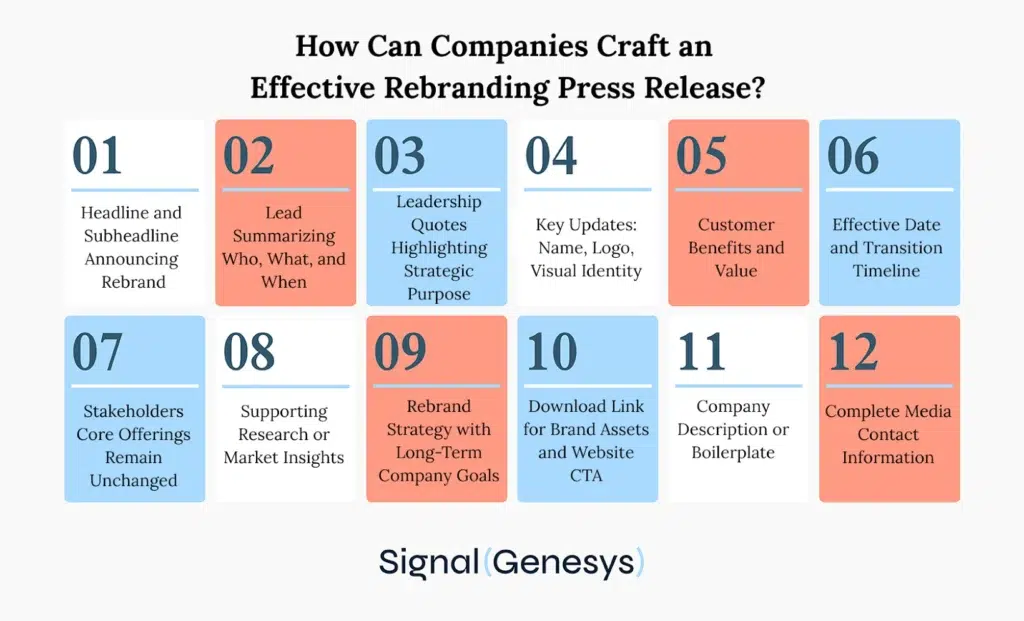
Companies can craft an effective rebranding press release by combining clarity, strategic framing, and journalistic structure. Each section of a well-written press release communicates facts, reinforces credibility, and shows stakeholders the value of the transition. Precision in writing, strong supporting evidence, and consistent formatting create a release that gains editorial pickup and builds confidence in the rebrand.
Step-by-step instructions outlining how companies can craft an effective rebranding press release are given below.
1. Write Headline and Subheadline Announcing Rebrand
The headline establishes the focal point of the release and signals the magnitude of the change. A precise headline builds immediate interest and frames the rebrand as a decisive strategic move. Keep it under fifteen words and use action verbs that communicate transformation or renewal. Pair the headline with a subheadline that expands the context without repeating the same idea.
Avoid vague terms like “exciting news” and instead highlight the most distinctive change, such as a new brand identity, market repositioning, or future vision. Journalists scan headlines first, and a weak title diminishes coverage potential. Test phrasing with internal teams to confirm clarity and audience resonance.
2. Write Lead Summarizing Who, What, and When
The lead paragraph functions as the executive summary of the announcement. State the company name, the specific nature of the rebrand, and the date of effect in the opening 2 sentences. Readers expect facts immediately, so burying key details under background weakens impact.
Write in short, declarative sentences that leave no ambiguity. Maintain consistency between lead details and later content to prevent contradictions. Avoid using generic openings such as “today marks an exciting time” and instead state the core fact of the rebrand upfront. This approach aligns with journalistic standards and increases syndication.
3. Include Leadership Quotes Highlighting Strategic Purpose
Quotes from senior leadership establish credibility and convey vision behind the rebrand. A strong quote adds value and connects business objectives with customer and market needs with a thought-provoking statement. Use quotes to communicate ambition, long-term positioning, or cultural transformation.
Keep them concise but substantive, avoiding clichés like “we are thrilled.” Position at least one quote early to anchor the message in authority. A well-structured quote gives media outlets a soundbite that frames coverage. Be sure to attribute quotes by full name and title for transparency.
4. Highlight Key Updates: Name, Logo, Visual Identity
The rebranding press release showcases tangible changes such as a new name, logo, tagline, or design system. These elements act as visual proof of transformation. Describe why each element was chosen, whether to modernize perception, reflect new markets, or create alignment with mission. Provide a before-and-after contrast that highlights the improvement.
Avoid jargon like “sleek” or “innovative” without explanation. Detail how the updated identity will appear across digital platforms, packaging, or communications. Journalists and analysts will reference these updates to illustrate the story, so clarity is essential.
5. Emphasize Customer Benefits and Value
Stakeholders evaluate rebrands through the lens of value. Explain directly how the new brand identity enhances customer experience, product quality, or service delivery. Focus on measurable outcomes such as simplified navigation, clearer communication, or expanded offerings.
Avoid self-congratulatory phrasing and instead tie every claim to a practical benefit. Create messaging that reassures loyal customers while attracting new segments. Detail how the new branding reflects customer feedback, research, or evolving needs. This framing shifts the rebrand from an internal decision to an external advantage.
6. Specify Effective Date and Transition Timeline
Clear timelines set expectations and prevent confusion during rollout. State the exact date the new branding takes effect and explain the stages of the transition. Mention updates across websites, packaging, signage, or digital platforms in chronological order. Avoid vague phrasing like “over the coming months” and provide specific milestones.
This section gives customers and partners confidence in operational continuity, while ensuring media outlets report accurately on the shift. Document the transition internally and align every touchpoint before announcing publicly.
7. Reassure Stakeholders Core Offerings Remain Unchanged
A rebrand signals evolution, but stakeholders expect clarity on what remains consistent. State explicitly that core products, services, and commitments continue without interruption. This reassurance sustains loyalty and prevents misinterpretations that the rebrand disrupts established value. Use direct language to contrast unchanged offerings with updated brand elements.
Detail which solutions, service standards, or mission pillars continue as before. Avoid vague phrases like “nothing changes” and instead specify continuity. Journalists and investors assess stability during transitions, so anchoring the announcement in reliability strengthens trust.
8. Reference Supporting Research or Market Insights
Rebrands carry more authority when anchored in data. Cite customer surveys, brand perception studies, or market analyses that justify the timing and direction of the identity shift. Highlight trends the company addresses, such as evolving consumer values, new competitive landscapes, or technological adoption. Present insights with precision, such as including percentages, growth figures, or survey results to reinforce legitimacy.
Avoid superficial claims about “adapting to change” without supporting evidence. A press release framed around research shows stakeholders that decisions emerge from strategy, not vanity.
9. Align Rebrand with Long-Term Company Goals
Position the rebrand as more than a design update by connecting it to strategic objectives. Explain how the new identity supports expansion into emerging markets, diversification of offerings, or a global growth strategy. Detail concrete initiatives such as digital transformation, sustainability commitments, or partnerships that the rebrand enables.
Avoid generic claims about “future readiness” that lack detail. Explicit alignment with measurable goals positions the rebrand as a deliberate business milestone, signaling to investors and customers that it strengthens competitive advantage.
10. Provide Download Link for Brand Assets and Website CTA
A rebrand requires consistent application across media coverage, which depends on accessible resources. Supply a centralized asset hub containing logos, style guidelines, and visual collateral in press-ready formats. Embed a direct download link in the release to remove barriers for journalists and partners. Add a clear call-to-action driving traffic to a dedicated rebrand landing page with FAQs, multimedia, and transition details.
Avoid attaching oversized files or scattering links across multiple pages. A consolidated hub reinforces consistency, increases adoption, and ensures the rebrand appears accurately across platforms.
11. Include Company Description/Boilerplate
A boilerplate gives readers essential context, especially those encountering the brand for the first time under its new identity. Keep it concise, under 150 words, and highlight mission, scale, and credibility markers such as industry leadership or notable achievements. Update all phrasing to reflect the new brand narrative rather than recycling outdated text.
Avoid bloated lists of services that dilute impact. Journalists rely on boilerplates for background, so accuracy and alignment with the rebrand narrative ensure consistent messaging across coverage.
12. Provide Complete Media Contact Information
Direct access to media contacts increases coverage potential. List a specific spokesperson or PR representative with full name, title, phone number, and email. Place this information at the end of the release in a clear, scannable format. Avoid generic inboxes unless a press team actively monitors them daily.
A rebrand announcement generates heightened interest, so responsive and visible contacts demonstrate preparedness. Complete information signals professionalism and removes barriers for journalists, investors, and analysts seeking clarification or interviews.
An effective rebranding press release integrates clarity, authority, and foresight into every element. Companies that approach each section with precision control the narrative, strengthen trust, and expand visibility across stakeholders. A well-structured press release positions the rebrand as a decisive business milestone with lasting impact.
What Are the Best Tips for Writing a Rebranding Press Release?
The best tips for writing a rebranding press release include presenting a clear strategic narrative, and showcasing the tangible impact of the new brand identity. An effective rebrand announcement builds trust, reinforces credibility, and frames the transformation as a deliberate business decision rather than a superficial update. Every detail of the release signals continuity, growth, and alignment with long-term vision.
The best tips for writing a rebranding press release are outlined below.
- Define Your Target Audience: Identify the groups most affected by the rebrand and tailor messaging accordingly. Customers expect clarity on how the new identity improves their experience, employees look for reassurance on cultural alignment, and investors focus on strategic relevance. Segmenting these groups ensures the press release delivers precise information that resonates with their priorities.
- Gather Key Information: Collect complete brand assets and supporting material before drafting. This includes new visuals, logos, taglines, timelines, and stakeholder quotes. Substantiate the announcement with data from market research or sentiment analysis to reinforce the strategic basis for the change. Consistency in messaging and detail prevents confusion during the rollout.
- Identify Media Targets: Prioritize media outlets and journalists with influence in branding, business strategy, and your industry vertical. Curate targeted lists instead of broad distributions to ensure the message reaches outlets that amplify credibility. Aligning with authoritative voices strengthens coverage and signals industry relevance.
- Explain the Strategic Why: Frame the rebrand as a reflection of business growth, evolving values, or market repositioning. Provide context on why the shift matters for long-term success. This narrative differentiates the announcement from a cosmetic redesign and positions the rebrand as a milestone in corporate evolution.
- Highlight Customer Impact: Focus on customer outcomes that result from the rebrand. Whether the change introduces streamlined offerings, a modernized brand experience, or stronger alignment with customer values, articulate these benefits directly. A customer-first perspective demonstrates that the rebrand strengthens value delivery.
- Showcase the Visual Identity: Present the new brand elements with clarity and professionalism. Provide downloadable press kits with updated logos, imagery, and comparison visuals. These assets allow journalists to present the rebrand accurately while reinforcing consistency across all coverage.
- Integrate Leadership Quotes: Include direct statements from executives leading the transition. Perspective from the CEO emphasizes strategic growth, while a marketing leader highlights brand positioning. Concise, authoritative quotes humanize the release and add credibility to company rationale.
- Include Calls to Action: Direct readers toward engagement opportunities. Encourage them to explore the redesigned website, interact with new brand materials, or connect through updated digital channels. Calls to action transform the announcement into measurable brand interaction and extend momentum beyond the release.
To maximize impact, define your brand story clearly, link the message to an overarching strategy, and tailor communication for each platform where the release appears. Treat the press release as a launchpad for ongoing brand engagement. Audience responses will shape early perception, so embrace dialogue, monitor reactions, and reinforce messaging consistently across every channel.
What Key Elements Should Be Included in a Rebranding Press Release?
Key elements that should be included in a rebranding press release are a compelling headline, a clear dateline and an introduction covering the five Ws. The headline and subheadline announce the rebrand directly and highlight what has changed. The lead summarizes who is rebranding, what the new direction involves, and when the transition begins to highlight newsworthiness.
Leadership quotes showcase the strategic purpose of the change and add a voice of authority that reinforces confidence. The release highlights updates to the name, logo, and visual identity but reassures stakeholders that core offerings remain unchanged. Emphasizing customer benefits demonstrates how the rebrand creates tangible value and strengthens audience relationships. Supporting research or market insights frame the decision within the broader industry context and validate brand positioning.
A clear link to long-term company goals connects the rebrand to growth, innovation, or market expansion, signaling vision beyond surface-level changes. Updated brand assets and a website call-to-action give journalists and stakeholders immediate access to visuals and resources. A refreshed boilerplate reinforces company mission and expertise in the new brand identity. Complete media contact details close the release with accessibility, which ensures journalists know exactly where to turn for follow-up.
What Steps Should Companies Take Before Announcing a Rebrand?
The steps that companies should take before announcing a rebrand include aligning employees on the vision and creating a compelling narrative. Defining measurable goals and preparing assets eliminates uncertainty, strengthens credibility, and ensures stakeholders perceive the rebrand as intentional and future-focused. Companies take deliberate steps that build internal consensus, control the external narrative, and ensure the rollout connects meaningfully with target audiences.
The steps that should be taken before announcing a rebrand are outlined below.
1. Align Teams on Rebrand Vision
Internal unity creates the strongest foundation for an external launch. Every employee, from leadership to customer-facing staff, needs to share a consistent understanding of the purpose and direction. Alignment ensures the entire organization speaks with one voice to eliminate contradictions that undermine credibility.
Workshops, briefing sessions, and dedicated brand playbooks clarify the vision, while leadership demonstrates commitment through visible participation. A misaligned workforce leaks fragmented messages, which confuses stakeholders and weakens impact.
2. Develop a Clear Rebrand Narrative
A rebrand gains legitimacy when it tells a compelling story. The narrative defines the motivation, connects business evolution to market realities, and communicates benefits directly relevant to stakeholders. Strong narratives integrate continuity with change, and show respect for business history while projecting its future.
Without a strong narrative, audiences interpret the shift as superficial or confusing. The press release then becomes the stage for this narrative, shaping perception and positioning the rebrand as authentic and necessary.
3. Set Measurable Announcement Objectives
A rebrand press release achieves its value when tied to specific outcomes. Objectives such as strengthening media visibility, improving brand sentiment, or driving engagement set benchmarks for evaluating success. These goals influence the press release structure, from headline framing to call-to-action design.
Objectives aligned with business priorities ensure the announcement moves beyond vanity exposure. Companies that enter a rebrand launch without defined objectives struggle to demonstrate return on investment. Clear targets transform the announcement from an event into a campaign with measurable influence.
4. Prepare Messaging, Assets, and FAQs
Preparation protects against inconsistency during the announcement. Unify messaging across press materials, digital channels, and internal communications to avoid dilution. Incorporate press-ready visual assets including updated logos, photography, and templates to maintain brand integrity.
An FAQ document anticipates questions from customers, employees, and journalists, and delivers pre-approved answers that prevent speculation. Without these preparations, companies face fragmented coverage and risk eroding stakeholder trust. Complete readiness ensures the rebrand is revealed as a seamless, authoritative transition.
5. Strategize Timing and Communication Channels
The moment and medium of the rebrand announcement determine its reach. A poorly timed announcement risks being overshadowed by industry events or broader news cycles. Strategic timing leverages high-visibility periods such as product launches, anniversaries, or financial milestones to maximize attention.
Channel selection ensures that every stakeholder receives the message in a format designed for the target audience. For instance, use press releases for media, email for loyal customers, and social platforms for real-time interaction. A fragmented or rushed rollout wastes momentum, while a deliberate sequence of communications builds anticipation and strengthens control over the new identity.
These steps create consistency across audiences, remove uncertainty, and position the brand as deliberate in its evolution. A company that thoroughly controls the conversation, maximizes visibility, and establishes the rebrand as a forward-looking milestone that reinforces credibility and strengthens long-term positioning.
What Should Companies Do on the Day of the Rebranding Press Release Launch?
Companies should execute a structured communication strategy on the day of the rebranding press release launch to ensure precision, consistency, and authority across every touchpoint. Ensure the press release reaches media outlets, journalists, and distribution wires at the scheduled time to maximize visibility and establish the official narrative. The website requires a dedicated landing page that explains the rebrand, highlights the new identity, and centralizes all information for customers, partners, and stakeholders.
Social media channels, email campaigns, and internal systems need immediate updates so the new identity appears across every platform simultaneously, projecting confidence and preventing confusion. Internal alignment plays a decisive role on launch day. Engage employees in a live company-wide announcement or event that reinforces their role as brand ambassadors and equips them with updated messaging, guidelines, and digital assets. Active engagement with media, influencers, and stakeholders shapes public perception in real time.
Monitoring tools track news mentions, customer conversations, and social engagement, while a trained response team addresses inquiries with clarity and speed to safeguard the narrative. Performance measurement begins immediately. Companies need to track media pickup, website traffic, search trends, and sentiment shifts across platforms to evaluate how effectively the rebrand lands with different audiences. Each metric provides feedback on visibility, credibility, and resonance, which offers a foundation for post-launch adjustments.
What Common Mistakes Should Be Avoided in a Rebranding Press Release?
Common mistakes that should be avoided in a rebranding press release include shallow narrative, missing evidence, stakeholder blindspots, and poor journalistic structure. Each mistake reduces authority, lowers pickup rates, or produces audience confusion, so correct these errors before distribution.
Common mistakes that should be avoided in a rebranding press release are detailed below.
- Shallow narrative that reads like marketing copy: A rebrand narrative that focuses on adjectives instead of facts signals inauthenticity to journalists and analysts. Explain the strategic problem the rebrand resolves, the market data that motivates it, and the concrete outcomes the company expects. Tie messaging to customer needs, product changes, or market shifts so the story reads as strategic evolution rather than promotional fluff.
- Missing evidence and measurable proof points: Claims without numbers or examples generate skepticism from reporters and investors. Provide metrics such as pilot results, user research findings, investment figures, market share targets, or customer satisfaction baselines. Present proof points near the top of the release to convert assertions into verifiable news.
- Stakeholder blind spots that ignore audience impact: A release that addresses internal audiences creates confusion among customers, partners, and employees. Segment the message for key audiences, explaining the benefits for customers, what changes for partners, and what continues for employees. Include a short FAQ for each audience and route them to the appropriate resource hub.
- Poor journalistic structure and weak lead: A release that buries the who, what, where, when, and why lowers the chance of media pickup. Open with a concise lead that answers the five Ws and state the rebrand action in the first sentence. Use the inverted pyramid so editors are able to clip the top paragraphs without reworking content. Include a dateline, boilerplate, and contact information in standard locations to speed editorial use.
- Visual inconsistency and low-quality assets: Disjointed visuals or low-resolution files undermine the credibility of the new identity. Provide a cohesive asset pack with multiple file types, color codes, usage rules, and before/after mockups. Include alternative text, brand usage examples, and social-ready sizes to speed publication across channels. Consistent, high-quality visuals reinforce the narrative and reduce editing friction for publishers.
- Incomplete or inaccessible media resources: A release without a press kit, captions, or clear licensing terms creates friction for coverage. Supply a downloadable media kit with captions, photographer or designer credits, embargo instructions, and sample headlines. Easy access increases the odds of accurate, fast pickup and preserves brand control.
- Weak leadership framing and generic quotes: Quotes that repeat the release verbatim add no authority and reduce journalist interest. Provide leadership quotes that explain strategic intent, reference measurable outcomes, and call out next steps or timelines. Add an expert third-party quote where relevant to show external validation. Authentic, specific statements convert the announcement into an executive-level strategic move.
- No follow-up strategy or measurement plan: Publishing a release without post-launch tracking wastes momentum and leaves questions unanswered. Define immediate KPIs for media pickup, search behavior, website funnels, and sentiment shifts, and assign owners for each metric. Active follow-up captures learnings, sustains coverage, and turns a one-time announcement into an ongoing narrative.
Avoiding these errors converts a rebranding press release from a risky event into a controlled, newsworthy milestone. Precision in story, proof, assets, and follow-up produces higher editorial pickup, clearer stakeholder alignment, and measurable progress toward strategic goals.
What Are Some Successful Examples of Rebranding Press Releases?
Successful rebranding press releases illustrate how top companies control the narrative of major brand shifts. Examining how leading organizations communicate new visual identities, updated missions, and expanded market positions provides a blueprint for crafting authoritative announcements. These examples highlight the balance between preserving brand equity and signaling future growth, which makes them valuable models for businesses preparing their own rebrand.
5 successful examples of rebranding press releases are given below.
1. PepsiCo

2. Mazda

3. Warner Bros. Discovery

4. LLOYD

5. Starbucks

Studying these rebranding press release examples shows that impact depends on precision, clarity, and strategic storytelling. The strongest examples pair a clear explanation of the change with compelling visuals, executive quotes, and consistent distribution across trusted media channels.
What Templates Are Most Effective for Writing a Rebranding Press Release?
The most effective rebranding press release templates incorporate the essential elements including a strong headline, dateline, lead, detailed body and stakeholder quotes. Press release templates allow businesses to clearly communicate their rebrand while addressing the specific circumstances driving the change.
5 templates that are most effective for writing a rebranding press release are given below.
1. Rebranding After an Acquisition
FOR IMMEDIATE RELEASE
[Acquiring Company] and [Acquired Company] Unite Under New Brand Identity, [New Company Name]
[City, State] – [Date] – [Acquiring Company] and [Acquired Company] announced their official rebrand today under the unified name [New Company Name]. The transition reflects the integration of both companies’ strengths and marks the beginning of a new era of growth, innovation, and expanded offerings for clients.
The rebrand introduces a consolidated visual identity, including a new logo and messaging that embodies the shared mission of delivering [specific benefit]. Customers will continue to enjoy seamless access to services while gaining additional value through the combined expertise of both teams.
“[Insert quote from CEO about the vision and customer benefits of the merger],” said [Name], [Title] of [New Company Name]. “[Add insight about how this rebrand enhances the company’s market position].”
The rebrand will be reflected across the new website, [website link], updated communication materials, and all customer-facing platforms starting [launch date].
About [New Company Name]
[Boilerplate text describing the new company’s mission, values, and combined strengths.]
Media Contact
[Name, Title]
[Email, Phone]
2. Rebranding to Reflect a New Mission or Purpose
FOR IMMEDIATE RELEASE
[Company Name] Unveils New Brand Identity Aligned with Commitment to [New Mission]
[City, State] – [Date] – [Company Name] today announced a comprehensive rebrand that reflects its evolved mission of [insert mission, e.g., advancing sustainability, empowering small businesses, or transforming digital experiences]. The refreshed identity introduces a new logo, updated brand colors, and messaging that conveys the company’s renewed sense of purpose.
The rebrand emphasizes [specific mission-driven values] while maintaining the high-quality products and services customers expect. This evolution reflects the company’s dedication to delivering greater impact for stakeholders and positioning itself as a leader in [industry].
“[Insert quote from CEO about the rebrand as a mission-driven evolution],” said [Name], [Title]. “[Add details about how the rebrand signals long-term commitment to customers and the industry.]”
The new brand is effective [launch date] across the website, social media, and all customer touchpoints.
About [Company Name]
[Boilerplate describing the company’s updated mission, offerings, and long-term vision.]
Media Contact
[Name, Title]
[Email, Phone]
3. Rebranding to Support Market Expansion
FOR IMMEDIATE RELEASE
[Old Company Name] Rebrands as [New Company Name] to Mark Expansion into [New Market/Region]
[City, State] – [Date] – [Old Company Name] announced today its rebrand to [New Company Name] as part of its strategic expansion into [new market or industry]. The name change reflects the company’s broadened vision and its commitment to serving a larger audience with innovative solutions.
The rebrand introduces a modernized identity that communicates forward growth, featuring an updated logo, website, and expanded offerings tailored to the needs of [new customer segment]. Existing clients will experience continuity of service while benefiting from broader capabilities.
“[Insert quote from CEO about the rebrand supporting expansion goals],” said [Name], [Title]. “[Add insight about how the company will serve new markets without losing its established strengths.]”
The new identity goes live across all digital channels on [launch date].
About [New Company Name]
[Boilerplate explaining the company’s expanded mission, scope, and customer base.]
Media Contact
[Name, Title]
[Email, Phone]
4. Rebranding for Modernization and Simplification
FOR IMMEDIATE RELEASE
[Company Name] Launches Streamlined Brand Identity to Deliver Modern Customer Experience
[City, State] – [Date] – [Company Name] revealed its refreshed brand identity today, featuring a simplified logo, updated typography, and a clean visual system that reflects clarity and accessibility. The rebrand represents the company’s dedication to providing customers with a modern, intuitive experience.
The updated design system will roll out across digital platforms, packaging, and communication channels. The streamlined look signals innovation while maintaining the company’s commitment to [insert core values such as reliability or customer success].
“[Insert quote from Brand Manager or CEO about the benefits of a simplified identity],” said [Name], [Title]. “[Add insight into how the refreshed brand reflects the company’s customer-first approach.]”
The new branding takes effect [launch date] across all platforms.
About [Company Name]
[Boilerplate describing the company’s mission, its modernized approach, and the continuity of offerings.]
Media Contact
[Name, Title]
[Email, Phone]
5. Rebranding Following a Business Pivot
FOR IMMEDIATE RELEASE
[Old Company Name] Rebrands as [New Company Name] to Reflect Strategic Shift into [New Focus]
[City, State] – [Date] – [Old Company Name] today announced its rebrand to [New Company Name], signaling a strategic pivot from [old focus] to [new strategic focus]. The updated brand identity represents the company’s commitment to delivering [specific benefit, e.g., enterprise solutions, digital platforms, or new services].
The rebrand includes a new name, updated logo, and messaging that communicates the company’s repositioning. While the focus shifts, customers will continue receiving uninterrupted service with enhanced opportunities through the new direction.
“[Insert quote from CEO about the rationale and vision behind the pivot],” said [Name], [Title]. “[Add detail about how this shift positions the company for long-term growth and industry leadership.]”
The rebrand will roll out on [launch date] across all company platforms.
About [New Company Name]
[Boilerplate describing the company’s new direction, mission, and customer focus.]
Media Contact
[Name, Title]
[Email, Phone]
These rebranding press release templates provide ready-to-use structures tailored for distinct scenarios, from mergers to market expansion. Each template emphasizes clarity, strategic reasoning, stakeholder reassurance, and visual storytelling to ensure the announcement communicates more than cosmetic updates. Businesses strengthen their rebrand launches by combining these elements with a synchronized rollout across all media channels.
When Is the Best Time to Publish a Rebranding Press Release?
The best time to publish a rebranding press release depends on the stage of the rollout and the visibility strategy behind it. Distribute the release about a week before the official brand launch to provide journalists with time to prepare coverage without risking stale news. Position the announcement on launch day or slightly earlier so stakeholders encounter the press release at the same moment the new identity becomes visible across channels.
Internal communication sets the foundation for success, with employees and stakeholders informed in advance to avoid confusion and ensure message alignment. Linking the announcement with major milestones such as a new product, market entry, or corporate anniversary increases relevance and embeds the rebrand within a broader growth narrative.
Day and hour precision further determines how effectively the rebranding press release reaches the media. Midweek distribution drives stronger engagement, with Tuesday, Wednesday, and Thursday consistently outperforming other days due to newsroom workflow patterns. Avoid Monday, when inboxes overflow, and Friday, when attention wanes before the weekend. Schedule distribution in the morning between 8 am and 10 am to align with editorial planning cycles.
Hours from late morning to early afternoon between 10 am and 3 pm are suitable to capture continued attention during working hours. Factor in time zones for national or international coverage to maximize pickup across markets. Avoid competing with heavy news cycles, holidays, or major industry events to prevent dilution of visibility. These timing decisions elevate a rebranding announcement from a routine update to a strategically positioned story with lasting impact.
Where Should a Rebranding Press Release Be Distributed for Maximum Impact?
A rebranding press release gains authority and visibility when distributed through a multi-channel strategy that leverages wire networks, media outreach, owned platforms, and direct stakeholder communication.
Key channels where a rebranding press release should be distributed for maximum impact are listed below.
1. Newswire Services
Newswire services such as PR Newswire, Business Wire, and GlobeNewswire provide immediate credibility because journalists, analysts, and investors treat these platforms as verified sources. These services distribute the press release across global newsrooms, syndicate it through search engines, and index it in financial databases.
Newswires enhance brand discoverability by linking the rebrand announcement to high-authority domains. Crafting a release that follows AP style, includes multimedia, and integrates SEO-driven keywords strengthens visibility within these systems.
2. Direct Media Outreach
Targeted outreach to journalists covering branding, corporate strategy, or industry-specific topics creates opportunities for deeper storytelling. Reporters respond to tailored pitches that connect the rebrand to larger market shifts or customer impact, not just cosmetic changes. A press release accompanied by an executive interview, strong data points, or exclusive angles positions the brand as a thought leader.
Building these relationships ensures coverage beyond initial wire syndication and resulting in feature-length stories. Generic blasts to media lists fail to capture attention and dilute credibility, so precision and personalization drive stronger outcomes.
3. Company Website
Publishing the rebrand announcement on a newsroom page or dedicated microsite establishes the company as the official source of information. A well-structured landing page centralizes all assets, including visuals, FAQs, and detailed explanations of the changes. This approach reduces confusion, supports SEO performance, and provides a resource journalists and stakeholders trust.
Adding multimedia elements such as logo unveil videos or interactive brand timelines increases engagement and strengthens message retention. A weak or outdated company newsroom risks undermining credibility and leaves the audience reliant on third-party interpretations.
4. Industry and Trade Media
Trade journals and sector-specific publications offer targeted visibility among professionals who directly influence purchasing or partnership decisions. Rebranding coverage in these outlets signals credibility within the community and reinforces leadership in the space. Crafting pitches that connect the rebrand to industry-specific challenges or innovation trends secures stronger editorial opportunities.
Including subject-matter insights from executives adds depth and authority to the announcement. Overlooking trade media leaves a gap in the communication strategy and weakens positioning within high-value professional networks.
5. Social Media Platforms
Social platforms extend the reach of the press release beyond traditional media and allow direct engagement with customers, employees, and industry peers. Updating profiles with the new identity, launching teaser campaigns, and publishing video explainers showcase the rebrand in a dynamic format.
Coordinated rollout across LinkedIn, Instagram, X, and YouTube builds momentum and strengthens consistency. Interactive campaigns that invite feedback or celebrate milestones increase community buy-in and reinforce loyalty. Disorganized updates or inconsistent branding across profiles create confusion and reduce confidence in the transition.
6. Email Lists
Email announcements reach existing customers, partners, and stakeholders in a direct and controlled way. Segmenting lists ensures that different groups receive tailored messaging that reflects their relationship with the company. For example, customers receive assurance about continuity, while investors receive insights into long-term growth strategy.
Embedding visuals and links to the rebrand landing page increases engagement and drives traffic to owned assets. Poor segmentation or overloading emails with jargon risks disengagement and undermines clarity of the message.
7. Press Kits
A digital press kit consolidates essential resources such as high-resolution logos, updated brand guidelines, fact sheets, and leadership bios. Journalists and partners use these assets to represent the rebrand accurately, which ensures consistency across every mention. Providing downloadable assets streamlines coverage and removes barriers for editors on deadline.
Adding multimedia elements such as video interviews or brand story explainers creates opportunities for richer coverage. Neglecting to update or distribute press kits leads to misrepresentation, inconsistent branding, and lost visibility.
A rebranding press release achieves maximum impact through coordinated distribution across all these channels. Wire services deliver scale, targeted outreach drives credibility, and owned platforms maintain control of the message. Social and email channels sustain engagement, while trade media and press kits anchor authority. An integrated approach ensures the rebrand resonates broadly while reinforcing leadership within its market.
What Tools Can Help With Writing and Distributing Rebranding Press Releases?
Tools that can help with writing and distributing rebranding press releases provide structured workflows, access to targeted media networks, and SEO optimization. These platforms offer unique strengths ranging from authority-driven distribution to outreach and newsroom management, which allows brands to maximize visibility and control during a rebrand.
5 tools that can help with writing and distributing rebranding press releases are given below.
1. Signal Genesys
Signal Genesys provides a distribution platform that integrates SEO optimization, multimedia publishing, and advanced signal generation. Signal Genesys focuses on boosting visibility in search results and improving entity authority through white label releases. Brands maintain control over authorship while gaining access to a wide publisher network including AP News, and Yahoo.
Real-time analytics deliver actionable insights, while customizable pricing structures are ideal for lean teams and agencies. Signal Genesys emphasizes transparency and long-term visibility, which allows rebrands to achieve measurable momentum in search rankings and audience engagement.
2. PRWeb
PRWeb delivers cost-effective press release distribution under the Cision umbrella, targeting startups, nonprofits, and smaller businesses. PRWeb distributes to over 1,200 outlets while providing visibility on search engines, social platforms, and Google News. The higher-tier plans include journalist lists and broader syndication.
PRWeb integrates multimedia options and keyword indexing, allowing rebrands to achieve discoverability without enterprise-level costs. The network includes MarketWatch, Factiva, and Yahoo, which makes it a practical tool for brands prioritizing search visibility during transitions.
3. ACCESS Newswire
ACCESS Newswire specializes in distribution that combines SEO-driven formatting with investor relations support. The platform syndicates rebranding press releases to Yahoo Finance, Google News, Benzinga, and Morningstar, to generate broad exposure across finance and business outlets.
The industry-specific targeting allows brands to reach relevant verticals, while real-time reporting and performance alerts provide transparency into pickup and reach. Flexible pricing options give businesses access to professional-grade distribution with analytics that guide ongoing PR strategy.
4. openPR
OpenPR offers a free entry point into press release publishing, which makes it a practical choice for businesses seeking visibility with limited resources. OpenPR supports multilingual distribution, primarily in English and German, and archives all releases for ongoing reference. With over 4 million press releases hosted, openPR functions as a searchable portal indexed by search engines.
The free plan distributes one release per month, while paid tiers expand capabilities, including broader SEO support. Although multimedia options are restricted in lower tiers, the platform remains valuable for building visibility in a cost-effective way.
5. Prowly
Prowly combines press release distribution with a PR CRM and newsroom management system. Prowly provides access to a large media database that supports targeted pitching and outreach, which enables rebranding press releases to reach relevant journalists directly. The platform integrates social listening and media monitoring tools to track brand mentions, while its media reporting dashboard supplies detailed coverage insights.
Prowly offers customizable online newsrooms for hosting multimedia-rich press releases. This positions the tool as a comprehensive platform for agencies and teams managing ongoing media relations.
Tools for writing and distributing rebranding press releases differ in reach, functionality, and pricing, but each strengthens visibility during a critical transition. Brands selecting the right tool ensure their rebrand announcement achieves immediate coverage and long-term authority in search ecosystems.
How Much Do Rebranding Press Release Distribution Services Typically Cost?
Rebranding press release distribution services typically cost between $15 and $50 per release depending on the pricing model and access tier. Signal Genesys illustrates this cost structure with 3 distinct plans that scale with usage volume. The Grow plan provides free access to the platform and charges $50 per standard distribution, which makes it practical for small agencies.
The Scale plan charges $250 per month and includes 125 credits, which reduces the cost to $25 per release while offering consistent volume discounts for agencies. The Elite plan requires a one-time $6,500 payment and provides lifetime platform access with credits included for the first year. This model lowers the cost to $15 per release and makes Signal Genesys the most efficient option for agencies executing high-frequency rebranding campaigns.
Each tier includes human editorial review, publication to 40–60 authority news sites, entity-level web presence mapping, and advanced media room integrations through the Google Maps API. Premium channel upgrades expand reach to outlets such as DigitalJournal and Benzinga that offer additional visibility for brands undergoing transformation.
How Can Companies Choose the Right Distribution Platform for a Rebranding Press Release?
Companies can choose the right distribution platform for a rebranding press release by following a structured evaluation process that aligns communication goals, target audiences, and available resources. Precision in this selection process ensures the rebrand announcement secures the right visibility while reinforcing authority across markets.
Instructions outlining how companies can choose the right distribution platform for a rebranding press release are given below.
1. Define the rebranding objectives
Identify whether the goal is widespread visibility, niche influence, or direct reassurance for stakeholders. Clear objectives guide platform selection and prevent wasted resources on channels that do not align with intended outcomes. Broad awareness requires platforms with expansive reach, while credibility within specialized industries relies on trade-focused outlets. Internal or customer reassurance favors controlled owned media channels.
2. Segment and prioritize target audiences
Map out primary groups such as investors, customers, employees, industry professionals, and general media consumers. Each segment requires a tailored communication approach, and no single platform effectively engages all groups at once. Prioritization ensures the chosen platform aligns with the audiences most critical to rebranding success. Understanding audience behaviors makes distribution choices data-driven instead of reactive.
3. Assess platform reach and credibility
Evaluate the scale and reputation of each platform under consideration. Established wire services deliver global reach and media trust, while smaller, niche distribution platforms target defined industry circles. A platform with credibility enhances legitimacy, while limited or poorly recognized services weaken perception. This assessment ensures the chosen platform matches ambition and trustworthiness.
4. Compare cost against communication value
Review platform pricing structures in relation to the benefits offered. Premium services secure guaranteed placements and authoritative coverage, while budget options sacrifice visibility for affordability. Matching budget to communication priorities prevents overspending without sacrificing effectiveness. Cost evaluation grounded in ROI ensures the platform supports broader marketing objectives.
5. Evaluate targeting and segmentation features
Analyze how well each platform allows for industry, geographic, or demographic targeting. Strong segmentation tools ensure the rebrand message reaches audiences that influence purchasing, partnerships, or reputation. Distribution without targeting risks dilution of the announcement across irrelevant markets. Platforms with refined targeting create higher impact without wasted impressions.
6.Review analytics and reporting capabilities
Select platforms that provide detailed insights into pickups, impressions, clicks, and referral traffic. Post-distribution reporting validates effectiveness and highlights areas for refinement in future campaigns. Without reliable analytics, evaluating the true impact of the rebrand becomes guesswork. Data-backed platforms transform press release distribution into a measurable growth strategy.
7. Check integration with owned and earned media strategies
Ensure the chosen distribution platform complements company-owned channels like the website, newsroom, and social accounts. Strong integration supports narrative consistency and creates multiple touchpoints for audiences to encounter the rebrand story. Platforms that fail to align with owned and earned media weaken message control. Seamless integration strengthens visibility while reinforcing trust.
8.Test and refine platform performance over time
No single platform guarantees lasting effectiveness, so testing across multiple cycles validates long-term value. Track which services generate editorial coverage, referral traffic, and engagement among stakeholders. Continuous refinement builds a distribution model that evolves with audience preferences and market dynamics. Testing ensures the rebrand communication process remains resilient and adaptive.
Choosing the right distribution platform for a rebranding press release requires structured decision-making based on objectives, audience segmentation, cost, targeting precision, and performance testing. Following these steps transforms platform selection from a guessing exercise into a strategic process that amplifies visibility and secures stakeholder trust.
Which Providers Offer the Best Support for Rebranding Press Releases?
Signal Genesys provides the best support for rebranding press releases because it combines advanced SEO technology with distribution strategies that build authority, trust, and long-term visibility. A rebrand demands credibility across digital channels, and Signal Genesys addresses this need by structuring press releases as entity-rich assets. Each release is reviewed by editors, mapped across authoritative news outlets, and embedded with schema that reinforces brand signals in search engines and AI training models.
The platform differentiates itself through its proprietary Online Signal Generation Engine™, which amplifies the digital footprint of rebrands beyond traditional PR syndication. Signal Genesys maximizes long-term SEO value by embedding backlinks, multimedia assets, and entity-level connections across a network of 40–60 authority publishers, including DigitalJournal and Benzinga. This creates sustained visibility for rebranding stories and keeps them active in search results and digital ecosystems for months rather than days.
Signal Genesys achieves a 98 percent increase in digital signals generated by published press releases, which reflects a stronger online presence and higher engagement compared to traditional distribution systems. Customer reviews consistently highlight advantages like fast turnaround, high editorial control, and transparent pricing structure as competitive advantages. Agencies and lean teams confirm its effectiveness for delivering rebranding campaigns that require precision, speed, and credibility.
How Can Companies Publish a Rebranding Press Release Using Signal Genesys?
Publishing a rebranding press release with Signal Genesys follows a structured process designed to preserve message clarity and maximize visibility. Companies begin by selecting New Release in the dashboard, which opens a dedicated project space for the rebrand announcement. The next step is choosing the method of creation. Marketers write directly within the platform, generate a draft using AI or commission an expert writer for polished executive communication.
Then, companies enter updated identity details such as the new legal name, revised boilerplate, and accurate contact information. The system then prompts detailed inputs to shape content quality. For instance, the subject line includes the new brand name and a clear reference to the rebrand. The writing theme specifies whether the release emphasizes a mission change, merger integration, or product evolution. Visual assets are uploaded to validate the transition, typically the updated logo, leadership photography, or brand imagery.
Companies set the word count to match the complexity of the announcement, with rebranding releases usually ranging from 400 to 1,000 words. Once the draft is generated, a full preview stage allows for edits to refine the messaging and verify facts. After content review, publication details are configured. Selecting the correct industry category ensures the release aligns with the markets the rebrand intends to reach. Distribution choices include a single launch or recurring campaign to manage phased rollouts.
Scheduling the publish date and time positions the release for maximum editorial pickup, while premium distribution options extend reach across top outlets and white-label placements. Integration channels, such as the company newsroom and Google Maps API, ensure the rebrand propagates across search engines and entity databases. Finally, the release undergoes editorial review for compliance before distribution to news sites, directories, and media partners.
The last stage involves publishing and monitoring results through Signal Genesys analytics. The system reports on placement, pickup, and engagement, which enables teams to measure brand visibility, backlink creation, and search impact.
How Can a Rebranding Press Release Be Adapted for Different Audiences?
A rebranding press release can be adapted for different audiences by aligning the message, tone, and distribution strategy with the priorities of each group. Existing customers require reassurance that the values they trust remain intact, so the announcement highlights service improvements, product upgrades, or enhanced customer support. Prospective customers respond to a narrative of growth and opportunity, so the release emphasizes market expansion, stronger positioning, and new offerings that differentiate the brand.
Employees expect clarity on how the rebrand influences their roles and responsibilities, so internal communications detail implementation timelines and outline how staff participation strengthens the brand transition. Investors and stakeholders focus on business outcomes, so the press release frames the rebrand as a strategic initiative that secures long-term growth, operational efficiency, and shareholder confidence. Media outlets value novelty and newsworthiness, so the message emphasizes compelling angles, and industry relevance.
The structure of the content adapts to the level of detail required across channels. Targeted email campaigns deliver in-depth explanations for existing customers, while short-form social media posts create immediate awareness for broader audiences. Investor relations platforms and financial publications receive structured data and performance indicators. Industry journalists receive tailored press kits with strong headlines, executive quotes, and multimedia assets. Internal stakeholders engage through company newsletters, leadership briefings, and Q&A sessions that build alignment and minimize uncertainty.
How Can Storytelling Make a Rebranding Press Release More Engaging?
Storytelling can make a rebranding press release more engaging by transforming the announcement into a narrative that captures purpose, emotion, and impact. The press release guides the audience through the journey of why the rebrand matters and how it reshapes the relationship between the brand and its stakeholders. Defining the narrative arc anchors the message. Start with the challenge that demanded transformation, present the rebrand as the resolution, and close with the positive outcomes customers experience.
Every effective rebranding story begins with the why. Establish the core motivation for the transformation, whether it addresses shifting customer expectations, market competition, or a broader mission. Framing the brand as a character facing an obstacle creates a storyline that audiences understand instinctively. The new identity then becomes the bridge between past limitations and future potential, which positions the company as a forward-moving entity that takes action to solve a problem.
Humanizing the rebrand adds credibility and relatability. Featuring founders, executives, or employees brings a personal voice to the story and reinforces the values behind the new identity. Quotes that express vision and emotion show intent more clearly than corporate jargon, while employee perspectives highlight the cultural shift happening inside the organization. Incorporating social responsibility initiatives, community impact, or charitable commitments strengthens the bond between brand and audience and reflects deeper principles.
Centering the customer as the hero drives the narrative forward. Illustrate how the rebrand directly benefits customers by solving pain points, improving access, or aligning more closely with their needs. Testimonials or case examples amplify this perspective and create proof points that media outlets and audiences value. Shifting the frame from company-driven change to customer-centered impact ensures the story resonates and feels tangible rather than abstract.
Visual storytelling reinforces the narrative and deepens engagement. High-quality imagery of the new logo, refreshed design elements, and before-and-after comparisons create an immediate impression that words alone cannot deliver. Supplementary assets such as video explainers, brand documentaries, or interactive microsites immerse readers in the transformation. Visuals maintain consistency across platforms and strengthen the organisational message while ensuring media outlets have ready-to-use materials for instant coverage.
What Role Does SEO Play in Optimizing a Rebranding Press Release?
SEO plays a critical role in optimizing a rebranding press release by amplifying its visibility, shaping brand perception, and strengthening authority across digital channels. A rebranding announcement represents a pivotal moment for a company, and search engines serve as the first place stakeholders encounter the new identity. Optimized headlines, keyword-rich content, and structured formatting allow the release to rank for relevant queries and drive discovery among customers, journalists, and industry professionals.
An SEO-driven press release increases visibility in search results by aligning content with the exact terms audiences use to learn about a rebrand. Strategic placement of branded and unbranded keywords in the headline, opening paragraphs, and metadata ensures that search engines understand the context of the announcement. Readers searching for company updates, leadership transitions, or new brand directions encounter the release at the moment of intent. This visibility builds organic traffic and reinforces awareness across audiences already invested in the organisational story.
Search-optimized releases build authority and credibility through backlinks and citations. Well-crafted content encourages journalists, bloggers, and industry platforms to reference the announcement, which drives referral traffic and establishes signals of trust for search engines. These earned mentions strengthen domain authority and expand the digital footprint of the new brand identity. Each link pointing to a rebranded landing page or newsroom article contributes to faster indexation, which ensures search engines register the rebranding shift in real time.